

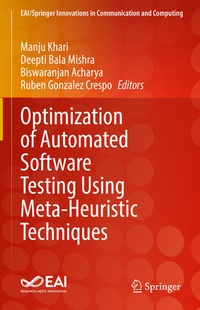
Optimization of Automated Software Testing Using Meta-Heuristic Techniques
Description

More details
Other editions
Additional editions
Persons
Dr. Manju Khari an Assistant Professor in AIACTR, Under Govt. Of NCT Delhi affiliated with GGSIP University, Delhi, India. She is also the Professor- In-charge of the IT Services of the Institute and has experience of more than twelve years in Network Planning & Management. She holds a Ph.D. in Computer Science & Engineering from National Institute of Technology Patna and She received her master's degree in Information Security from AIACTR, formally this institute is known as Ambedkar Institute of Technology affiliated GGSIP University, Delhi, India. Her research interests are software testing, software quality, software metrics, information security and nature-inspired algorithm.
Dr. Deepti Bala Mishra received her Ph.D. from Kalinga Institute of Industrial Technology (KIIT), Deemed to be University, Bhubaneswar. She is now working as an Assistant Professor in the Department of Computer Science and Engineering at C. V. Raman Global University, Bhubaneswar. She has more than 7 years of academic as well as research experiences.Her research interests include Software Engineering, Soft Computing, and Data Analytics.She has published many research papers in these fields and received Best Paper Awards in various Universities.
Biswa Ranjan Acharya is an academic currently associated with Kalinga Institute of Industrial Technology Deemed to be University along with pursuing PhD in computer application at Veer SurendraSai University of Technology (VSSUT), Burla, Odisha, India. He has received MCA in 2009 from IGNOU, New Delhi, India and M.Tech in Computer Science and Engineering in the year of 2012 from BijuPattanaik University of Technology (BPUT), Odisha, India. He is also associated with various educational and research societies like IEEE, IACSIT, CSI, IAENG, and ISC. He has along with 2 years of industry experience as a software engineer, a total of 10 years experience in both academia of some reputed university like Ravenshaw University and software development field. He is currently working on research area multiprocessor scheduling along with different fields like Data Analytics, Computer Vision, Machine Learning and IOT. He published some research article in international repute journal as well as serving as reviewer.
Dr. Ruben Gonzalez Crespo has a PhD in ComputerScience Engineering. Currently he is Vice Chancellorof Academic Affairs and Faculty from UNIR and GlobalDirector of Engineering Schools from PROEDUCAGroup. He is advisory board member for the Ministry ofEducation at Colombia and evaluator from the NationalAgency for Quality Evaluation and Accreditation of Spain(ANECA). He is member from different committees at ISO Organization. Finallyhe has published more than 200 paper in indexed journals and congresses.
Content
Introduction.- Testing Fundamentals.- Strategies and Methods For Test Cases.- Automated Testing Levels.- Polices and Plans for Testing.- Test Organization.- Controlling and Monitoring Testing Process.- Evaluating Automated Software Quality.- Defect Analysis and Prevention.- Optimization.- Security Testing.- Conclusion.
