

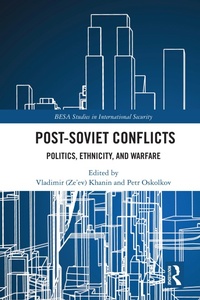
Post-Soviet Conflicts
Politics, Ethnicity, and Warfare
Published on 8. June 2026
232 pages
978-1-040-68231-9 (ISBN)
Description

This edited book offers an overview of how political structures, ethnic tensions, and emerging warfare continue to shape the region within the borders of the former Soviet Union.
Bringing together Israeli, European, and US scholars, the volume traces decades of conflict dynamics across Eastern Europe, South Caucasus, and Central Asia, with particular emphasis on the implications of recent regional and global geopolitical developments, such as the Russian-Ukrainian war. Through detailed case studies and theoretical observations, the chapters illustrate the intersections between nationalism, identity politics, inter-ethnic grievances, state-building, sovereignty-seeking, and battlefield dynamics. Combining both macro- and micro-levels of analysis, the chapters draw attention not only to political interactions between governments and countries but also to a more individual and socio-oriented understanding of conflict effects. Overall, the volume demonstrates how old grievances, new geopolitical developments, and contested national narratives continue to fuel instability across post-Soviet states.
This book will be of much interest to students of Post-Soviet Studies, War and Conflict Studies, Eastern European Studies and International Relations.
Bringing together Israeli, European, and US scholars, the volume traces decades of conflict dynamics across Eastern Europe, South Caucasus, and Central Asia, with particular emphasis on the implications of recent regional and global geopolitical developments, such as the Russian-Ukrainian war. Through detailed case studies and theoretical observations, the chapters illustrate the intersections between nationalism, identity politics, inter-ethnic grievances, state-building, sovereignty-seeking, and battlefield dynamics. Combining both macro- and micro-levels of analysis, the chapters draw attention not only to political interactions between governments and countries but also to a more individual and socio-oriented understanding of conflict effects. Overall, the volume demonstrates how old grievances, new geopolitical developments, and contested national narratives continue to fuel instability across post-Soviet states.
This book will be of much interest to students of Post-Soviet Studies, War and Conflict Studies, Eastern European Studies and International Relations.
More details
Series
Language
English
Place of publication
London
United Kingdom
Publishing group
Taylor & Francis Ltd
Target group
College/higher education
Professional and scholarly
Product notice
Reflowable
Illustrations
11 Tables, black and white; 1 Line drawings, black and white; 1 Illustrations, black and white
File size
0,83 MB
ISBN-13
978-1-040-68231-9 (9781040682319)
Copyright in bibliographic data and cover images is held by Nielsen Book Services Limited or by the publishers or by their respective licensors: all rights reserved.
Schweitzer Classification
Other editions
Additional editions
Book
06/2026
1st Edition
Routledge
€191.50
Shipment within 15-20 days
Persons
Vladimir (Ze'ev) Khanin is a professor of political science and heads the Post- Soviet Conflicts Research Program at the Begin-Sadat Centre for Strategic Studies, Bar-Ilan University, Israel. He is the author/editor of nine academic books, including, most recently, The Jews of Contemporary Post-Soviet States (2023) and Russian Speaking Jews as a Political Body: A Global Perspective (co-edited with Olaf Gloeckner, 2025).
Petr Oskolkov is a postdoctoral researcher at the School of Communication and the Department of Middle Eastern Studies and Political Science, Ariel University, and an affiliated researcher at the Post-Soviet Conflicts Research Program, Begin- Sadat Center for Strategic Studies, Bar-Ilan University, Israel.
Petr Oskolkov is a postdoctoral researcher at the School of Communication and the Department of Middle Eastern Studies and Political Science, Ariel University, and an affiliated researcher at the Post-Soviet Conflicts Research Program, Begin- Sadat Center for Strategic Studies, Bar-Ilan University, Israel.
Content
1: Introduction: Ethnicity, Modern Warfare, and the Post-Soviet Political Practice, Petr Oskolkov and Vladimir (Ze'ev) Khanin 2: Russia's New War Nationalism: Putin's Regime and Z-Nationalists, Jules Sergei Fediunin 3: Development and Transformation of the Ethno-Linguistic Factor in the Context of the Full-Scale Russian-Ukrainian War, Anatoliy Romanyuk and Vitaliy Lytvyn 4: Patronage in Peril: The war in Ukraine as a gamechanger for the Eurasian de facto states, Helge Blakkisrud 5: Transnistrian settlement in the context of the formation of a new European security architecture, Anatolii Dirun 6: Potential for Inter-Ethnic Conflicts in the North Caucasus, Velvl Chernin 7: Peace narratives in the South Caucasus: The case of Armenia and Azerbaijan, Anna Ayvazyan 8: Russia's pressure and evolution of multi-vector foreign policies of Central Asian states in the period of the war in Ukraine, Andrey Kazantsev and Svetlana Medvedeva 9: Ethnically Motivated Electoral Participation in the Baltic States: Preventing or Stimulating Conflicts?, Petr Oskolkov 10: Russia and the Israel-Hamas War: An Assessment of The First Six Months, Robert O. Freedman 11: Jewish Factor in the Age of Military Conflicts in the Post-Soviet Space: Identity, Loyalty and Antisemitic Tropes, Vladimir (Ze'ev) Khanin 12: Conclusion, Petr Oskolkov and Vladimir (Ze'ev) Khanin
