

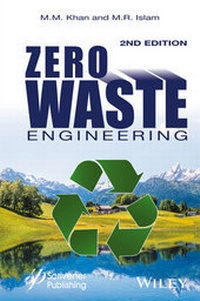
Zero Waste Engineering
Description

More details
Other editions
Additional editions

Previous edition
Persons
M. M. Khan was recently a lecturer in chemical engineering at the Bangladesh University of Engineering and Technology, before moving to Canada. He has written a dozen papers and coauthored a book on zero waste engineering and sustainable technology.
M. R. Islam is Professor of Petroleum Engineering at the Civil and Resource Engineering Department of Dalhousie University, Canada. He has over 700 publications to his credit, including 6 books. He is on the editorial boards of several scholarly journals. In addition to his teaching duties, he is also director of Emertec Research and Development Ltd. and has been on the boards of a number of companies in North America and overseas.
Content
Preface xiii
1 Introduction 1
1.1 Background 1
1.2 The Deficiency of Current Engineering Practices 8
1.3 The Zero-Waste Approach 17
1.4 Scope of the Book 17
1.5 Organization of the Book 19
2 A Delinearized History of Time and Its Impact on Scientific Cognition 23
2.1 Introduction 23
2.2 The Importance of The Continuous Long-Term History 28
2.3 Delinearized History of Time and Knowledge 32
2.4 Role of Water, Air, Clay and Fire in Scientific Characterization 52
2.5 A Reflection on the Purposes of Sciences 70
2.6 Role of Intention in Technology Development 86
2.7 Cyclic Nature of Civilization 90
2.8 About the "New Science" of Time and Motion 98
2.9 What is New Versus what is Permitted: Science and the Establishment? 117
2.10 The Nature-Science Approach 127
2.11 Conclusions 134
3 Towards Modeling of Zero-Waste Engineering Processes with Inherent Sustainability 137
3.1 Introduction 137
3.2 Development of a Sustainable Model 139
3.3 Problem with the Current Model: The Case of Electricity 140
3.4 How Could We Have Averted the Downturn? 161
3.4.1 Violation of Characteristic Time 167
3.5 Observation of Nature: Importance of Intangibles 169
3.6 Analogy of Physical Phenomena 173
3.7 Intangible Cause to Tangible Consequence 174
3.8 Removable Discontinuities: Phases and Renewability of Materials 175
3.9 Rebalancing Mass and Energy 176
3.10 ENERGY - The Existing Model 178
3.11 Conclusions 181
4 The Formulation of a Comprehensive Mass and Energy Balance Equation 183
4.1 Introduction 183
4.2 The Law of Conservation of Mass and Energy 188
4.3 Continuity of Matter and Phase Transition 189
4.4 The Science of Water and Oil 205
4.5 From Natural Energy to Natural Mass 230
4.6 The Avalanche Theory of Mass and Energy 256
4.7 Aims of Modeling Natural Phenomena 262
4.8 Simultaneous Characterization of Matter and Energy 264
4.9 Consequences of Nature-Science for Classical Set Theory and Conventional Notions of Mensuration 269
4.10 Conclusions 271
5 Colony Collapse Disorder (CCD) and Honey Sugar Saccharine Aspartame (HSSA) Degradation in Modern Engineering 273
5.1 Introduction 273
5.2 Background 274
5.3 The Need for the Science of Intangibles 275
5.4 The Need for Multidimensional Study 284
5.5 Assessing the Overall Performance of a Process 290
5.6 Facts about Honey and the Science of Intangibles 295
5.7 CCD In Relation to Science of Tangibles 303
5.8 Possible Causes of CCD 311
5.9 The HSS®A® (Honey ¿ Sugar ¿ Saccharin® ¿ Aspartame®) Pathway 322
5.10 Honey and Cancer 344
5.11 The Sugar Culture and Beyond 362
5.12 The Culture of the Artificial Sweetener 368
5.13 The Honey-Sugar-Saccharin-Aspartame Degradation in Everything 406
5.14 The Nature Science Approach 411
5.15 A New Approach to Product Characterization 413
5.16 A Discussion 416
5.17 Conclusions 419
6 Zero-Waste Lifestyle with Inherently Sustainable Technologies 421
6.1 Introduction 421
6.2 Energy from Kitchen Waste (KW) and Sewage 425
6.3 Utilization of Produced Waste in a Desalination Plant 432
6.4 Solar Aquatic Process to Purify Desalinated/Waste Water 438
6.5 Direct Use of Solar Energy 445
6.6 Sustainability Analysis 451
7 A Novel Sustainable Combined Heating/Cooling/Refrigeration System 455
7.1 Introduction 455
7.2 Einstein Refrigeration Cycle 458
7.3 Thermodynamic Model and its Cycle's Energy Requirement 460
7.4 Solar Cooler and Heat Engine 463
7.5 Actual Coefficient of Performance (COP) Calculation 464
7.6 Absorption Refrigeration System 466
7.7 Calculation of Global Efficiency 468
7.8 Solar Energy Utilization in the Refrigeration Cycle 475
7.9 The New System 476
7.8 Pathway Analysis 478
7.9 Sustainability Analysis 482
7.10 Conclusions 484
8 A Zero-Waste Design for Direct Usage of Solar Energy 487
8.1 Introduction 487
8.2 The prototype 491
8.3 Results and Discussion of Parabolic Solar Technology 495
8.4 Conclusions 502
9 Investigation of Vegetable Oil as The Thermal Fluid in A Parabolic Solar Collector 503
9.1 Introduction 503
9.2 Experimental Setup and Procedures 507
9.3 Experimental Procedure 511
9.4 Results and Discussion 511
9.5 Conclusions 515
10 The Potential of Biogas in Zero-Waste Mode of a Cold-Climate Environment 517
10.1 Introduction 517
10.2 Background 518
10.3 Biogas Fermentation 520
10.4 Factors Involved in Anaerobic Digestion 521
10.5 Heath and Environmental Issue 526
10.6 Digesters in Cold Countries 528
10.7 Experimental Setup and Procedures 529
10.8 Discussion 532
10.9 Conclusions 536
11 The New Synthesis: Application of All Natural Materials for Engineering Applications 537
11.1 Introduction 537
11.2 Metal Waste Removal with Natural Materials 538
11.3 Natural Materials as Bonding Agents 544
12 Economic Assessment of Zero-Waste Engineering 569
12.1 Introduction 569
12.2 Delinearized History of the Modern Era 570
12.3 Insufficiency of Conventional Economic Models 581
12.4 The New Synthesis 584
12.5 The New Investment Model, Conforming to the Information Age 587
12.6 The Most Important Research Questions in the Information Age 590
12.7 Future Engineering Projects 594
12.8 Economics of Zero-Waste Engineering Projects 595
12.9 Quality of Energy 605
12.10 Conclusions 607
13 General Conclusions and Recommendations 609
13.1 Summary 609
13.2 Conclusions 613
13.3 Recommendations 615
13.4 Future Projects 616
References and Bibliography 619
Index 665
Chapter 1
Introduction
1.1 Background
Plato said, "Strange times are these in which we live when old and young are taught falsehoods. And the one man that dares to tell the truth is called at once a lunatic and fool." Few question the notion that the 'strange times' are right now when it come so far as politics goes. However, fewer understand the science behind these 'strange times', even fewer appreciate how these 'strange times' have pervaded all aspects of our civilization. Practically no one sees this as a problem in the science and technology development sector. Many dislike the current system but few see the big picture and the direction that our civilization is moving and none can tell us how to fix the system.
Yet, the solutions to today's problems are simple as long as we can be humble and be down to earth - literally accepting the premise than the mother nature is perfect. This is not a new theme. In fact, this theme as old as human civilization. Ancient Greeks tell us the story of Antaeus, who was rendered powerless only by breaking contact with the earth. In ancient India, it is the concept of representation, or life's purpose, is founded in the notion of 'avatar'. The word derived from the Sanskrit avatara, meaning 'descent,' from ava 'down' + tar- 'to cross.' The word was used to describe believed deities or representative of gods on earth. This is not to be conflated with the notion of the reincarnation of Jesus, for example, as the word Avatar can be used to describe pious and gurus in general-i.e., the expert practitioners of God's attributes. It in fact can signal to the fact that God's presence is in all creatures. This implies that Hinduism itself supported the notion that on an ideal level, the purpose of life is representing and practicing the attributes of God. In Islam, the purpose of life as well as the standard of a lifestyle and knowledge are explicit. The ideals of. Islamic civilization tell us the virtue of pro-nature and conscientious lifestyle that will give us eternal peace. All these boil down to sustainability in the long term, with the logic that if Nature is perfect, and humans are the best creation of nature, doing good for the environment should be innate nature of humans. Pro-nature and pro-environment in its fundamental orientation, this book provides a première-quality space for research and development of sustainable technologies.
Even though claims have been to emulate nature, no modern technology truly emulates the science of nature. It has been quite the opposite: observations of nature have rarely been translated into pro-nature technology development. Today, some of the most important technological breakthroughs have been mere manifestations of the linearization of nature science: nature linearized by focusing only on its external features. Today, computers process information exactly opposite to how the human brain does. Turbines produce electrical energy while polluting the environment beyond repair even as electric eels produce much higher-intensity electricity while cleaning the environment. Batteries store very little electricity while producing very toxic spent materials. Synthetic plastic materials look like natural plastic, yet their syntheses follow an exactly opposite path. Furthermore, synthetic plastics do not have a single positive impact on the environment, whereas natural plastic materials do not have a single negative impact. In medical science, every promise made at the onset of commercialization proven to be opposite what actually happened: witness Prozac, Vioxx, Viagra, etc. Nature, on the other hand, did not allow a single product to impact the long-term negatively. Even the deadliest venom (e.g., cobra, Poisoned arrow tree frog) has numerous beneficial effects in the long-term. This catalogue carries on in all directions: microwave cooking, fluorescent lighting, nuclear energy, cellular phones, refrigeration cycles to combustion cycles. In essence, nature continues to improve matters in its quality, as modern technologies continue to degrade the same into baser qualities.
By contrast, the modern age is synonymous with waste generation. In industrialized countries, there is a direct correlation between the standard of living and generation of waste (McBean et al., 1995). However, it is becoming increasingly clear that such a lifestyle is not sustainable from economic (Zatzman and Islam, 2007), technological (Khan and Islam, 2007; Islam et al., 2010; 2012; 2015), computational (Islam et al., 2016a) or lifestyle and health (Islam et al., 2015; 2016). Issues ranging from global warming to toxic shock continue to confirm that the 3Rs (reduction, reuse, recycling) approach is not sufficient and an alternate approach to technology development must be introduced.
Energy is the driver of this civilization of wasteful lifestyle and the amount of waste has been iconic in the energy sector. As time progressed, energy consumption per capital has sky rocketed. If our claim of progress is true, shouldn't we spend less energy for sustaining life? Figure 1.1. shows how per capita energy consumption has become the icon of civilization. The energy consumption in Qatar, for instance is over 50 times higher than that in India. Yet, India is still much poorer than Qatar. Yet, the same region is blessed with the brightest sun - the source of 'good energy'. However, that blessing has been reduced to nuisance and heat is seen as a distraction (Picture 1.1). The same region that once led the world in science for over 1000 years (7th to 18th century) has somehow become fixated to the notion 'nature is the problem and must be fixed'. In this book, we change that paradigm and introduce the notion, "Nature is perfect and must be emulated, not fought against".
Figure 1.1 Per capita energy consumption in select countries and regions.
Picture 1.1 Kuwait City (60 C, July 3, 2016), the heat melted the rubber shades.
When it comes to insanely obsessed with tangibles and short-term benefits, Europeans and the west in general are the leaders, but the problem of the third world countries (both affluent and poor) is that they are emulating the western wasteful habits. So, it is no surprise, it is once again the west that is calling the shot and asking the third world countries to become energy-wise, the pre-dominant theme being: Energy Efficiency Is The Most Important Fuel We Didn't Know We Had (Climate Progress, 2014). Here is a list of countries, ranked by their energy inefficiency, as shown in their respective per capital energy consumption in oil equivalent.
- Iceland - 18,774 kg. With most of Iceland's energy coming from hydroelectric and geothermal power, Icelanders are planet's least energy-conscious, as if having non-fossil fuel energy is a ticket to becoming energy ignorant.
- Qatar - 17,418 kg. Similar to Icelanders, Qataris are addicted to wasteful energy habits. Electricity in Qatar is called "liquid electricity" because it is often produced through desalination, a very energy-intensive process. Qatar's per capita emissions are the highest in the world, and three times that of the United States. To cap the insanity, 60% of the electricity is consumed domestically.
- Trinidad and Tobago - 15,691 kg. Trinidad and Tobago is one of the richest countries in the Caribbean, and the region's leading producer of oil and gas; it houses one of the largest natural gas processing facilities in the Western Hemisphere. T&T is the largest LNG exporter to the United States. Its electricity sector is entirely fueled by natural gas.
- Kuwait - 10,408 kg. Despite holding the sixth-largest oil reserves in the world, and an estimated 63 trillion cubic feet of natural gas reserves, the demand for electricity in Kuwait often outstrips supply. According to the U.S. Energy Information Administration (EIA), Kuwait is perpetually in electricity supply shortage and experiences frequent blackouts each summer. The country has become a net importer of natural gas to address the imbalance.
- Brunei - 9,427 kg. This nation of roughly half a million has the region's highest number of cars per capita. Brunei also subsidizes both vehicle fuel and electricity, which is sold to the public at below-market prices. That obviously explains the mindset of the consumers.
- Luxembourg - 7,684 kg. Landlocked Luxembourg is almost totally dependent on energy imports, mostly oil and gas. That doesn't prevent them from being energy-ignorant.
- United Arab Emirates - 7,407 kg. Nothing says wasteful energy consumption like Ski Dubai. The indoor resort featuring an 85-meter-high mountain of man-made snow burns the equivalent of 3,500 barrels of oil a day. UAE is also the second (close to USA's 215 m3/year) most wasteful of water resources, consuming over 200 m3/year (550 l/day, Khaleej Times, 2016). This is remarkable considering UAE gets its nearly 99% of water through desalination - an extremely energy-inefficient process. In addition, negligible amount of this water is used for irrigation. Not surprisingly, UAE also leads in pediatric diabetes (Islam et al., 2015). Figure 1.2 shows per capita water consumption of some of the countries.
- Canada - 7,333...
