

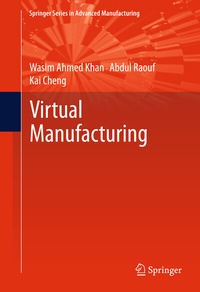
Virtual Manufacturing
Description

Virtual Manufacturing is centered on the description of the development of augmented reality models for a range of processes based on CNC, PLC, SCADA, mechatronics and on embedded systems. Further discussions address the use of augmented reality for developing augmented reality models to control contemporary manufacturing systems and to acquire micro- and macro-level decision parameters for managers to boost profitability of their manufacturing systems.
Guiding readers through the building of their own virtual factory software, Virtual Manufacturing comes with access to online files and software that will enable readers to create a virtual factory, operate it and experiment with it.
This is a valuable source of information with a useful toolkit for anyone interested in virtual manufacturing, including advanced undergraduate students, postgraduate students and researchers.
More details
Other editions
Additional editions
Persons
Professor Wasim Ahmed Khan teaches Engineering and Computer Science undergraduate and postgraduate students in ABET and other environments. His research interests include operations research, virtual reality, virtual manufacturing and education management. He has been involved in the design and development of laboratories for undergraduate and postgraduate studies. Dr Khan also develops software for business, science and engineering domains, organizes seminars and international conferences, and has published books and research papers with international publishers. Dr. Khan is a fellow of Institution of Mechanical Engineers, UK. He is currently acting as HEC Foreign Professor at the Institute of Business Administration, Karachi, Pakistan.
Professor Abdul Raouf is an Institute Professor at the University of Management and Technology, Pakistan, since 2005. He gained his PhD from the University of Windsor. He holds one of the Pakistan's highest civil awards for his worldwide services in the domain of Industrial Engineering. He has published more than 150 Research papers and is author of eight books. He is on the editorial board of several International Journals including Editor-in-Chief of International Journal of Quality in Maintenance Engineering.
Professor Kai Cheng holds the chair professorship in Manufacturing Systems at Brunel University. His current research interests focus on micro manufacturing, design of precision machine tools, and global/sustainable manufacturing and systems. Professor Cheng has published over 160 papers in learned international journals and referred conferences, authored/edited 5 books and contributed 6 book chapters.
Professor Cheng is a fellow of the IET and IMechE. He is the head of the Advanced Manufacturing and Enterprise Engineering (AMEE) Department at Brunel University, which consists of 10 academics and over 40 research assistants/fellows and PhD students. Thedepartment is currently working on a number of research projects funded by the EPSRC, EU 7th Framework Programs, Technology Strategy Board (TSB) high value manufacturing program, KTP Programs and the industry. The department is involved in 2008 RAE (research assessment exercise) Generation Engineering unit submission and ranked the 5th in the country. Professor Cheng is the European editor of the International Journal of Advanced manufacturing Technology and a member of the editorial board of International Journal of Machine Tools and Manufacture.
