

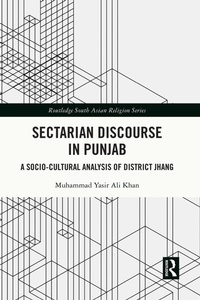
Sectarian Discourse in Punjab
A Socio-Cultural Analysis of District Jhang
1st Edition
Will be published approx. on 15. July 2026
162 pages
978-1-040-91812-8 (ISBN)
Description

Shedding new light on sectarianism outside the confines of Pakistan's sociopolitical context, this novel book recontextualizes religious sectarianism in the country by studying it as a cultural and historical phenomenon.
The book examines religious texts and speeches to understand how different religious groups interact and develop, combining historical, phenomenological and dialectical methods of study. Amongst the literature that focuses on conflict between sects, the book provides a cutting-edge discussion on how sectarian discourse can in fact promote integration, assimilation and peaceful coexistence alongside division. The chapters describe the distinctive influence of sociocultural patterns on sectarian discourse and argue that the major neo-sectarian divisions owe their existence to the socio-cultural process.
Despite the regional focus on Jhang District, the book contributes to the socio-cultural discourse in South Asia and the religio-sectarian discourse in the Muslim world. Ultimately, the book looks to promote a culture of knowledge exchange between traditional and modern streams of knowledge, and will interest scholars and readers interested in South Asian religion, politics, history, culture and society.
The book examines religious texts and speeches to understand how different religious groups interact and develop, combining historical, phenomenological and dialectical methods of study. Amongst the literature that focuses on conflict between sects, the book provides a cutting-edge discussion on how sectarian discourse can in fact promote integration, assimilation and peaceful coexistence alongside division. The chapters describe the distinctive influence of sociocultural patterns on sectarian discourse and argue that the major neo-sectarian divisions owe their existence to the socio-cultural process.
Despite the regional focus on Jhang District, the book contributes to the socio-cultural discourse in South Asia and the religio-sectarian discourse in the Muslim world. Ultimately, the book looks to promote a culture of knowledge exchange between traditional and modern streams of knowledge, and will interest scholars and readers interested in South Asian religion, politics, history, culture and society.
Reviews / Votes
"This is a wonderful theory-cum-participatory analysis of functional discourse of sectarian text/oratory, shedding light on subtle socio-cultural relations in religious perspective. It sets a new methodology to understand socio-religious phenomenon in the Pakistani Punjab."-- Muhammad Shafique, Professor, Department of History and Civilization Studies, Bahauddin Zakariya University, Multan
More details
Series
Edition
1. Auflage
Language
English
Place of publication
London
United Kingdom
Publishing group
Taylor & Francis Ltd
Target group
College/higher education
Professional and scholarly
File size
3,90 MB
ISBN-13
978-1-040-91812-8 (9781040918128)
Copyright in bibliographic data and cover images is held by Nielsen Book Services Limited or by the publishers or by their respective licensors: all rights reserved.
Schweitzer Classification
Other editions
Additional editions
Book
approx. 07/2026
1st Edition
Routledge
€191.50
Not yet published
Person
Muhammad Yasir Ali Khan is Associate Professor in the Department of History and Civilization Studies, Bahauddin Zakariya University, Multan, Pakistan.
Content
Introduction
Chapter 1 Foundations: History, Literature and Theory
Chapter 2 Sectarian Discourse in Sociocultural Contexts
Chapter 3 Oral Performances and Sectarian Reflexivity
Chapter 4 Textual Sectarian Performance and Re-scripting the Sectarian 'Other'
Chapter 5 Conclusion
Chapter 1 Foundations: History, Literature and Theory
Chapter 2 Sectarian Discourse in Sociocultural Contexts
Chapter 3 Oral Performances and Sectarian Reflexivity
Chapter 4 Textual Sectarian Performance and Re-scripting the Sectarian 'Other'
Chapter 5 Conclusion
