

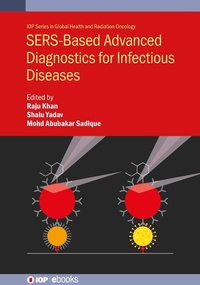
SERS-Based Advanced Diagnostics for Infectious Diseases
Description

Surface Enhanced Raman Spectroscopy (SERS) has emerged as a robust analytical tool for the analysis of single-molecule level sensitivity and its capacity of quantitative detection. Driven by the global demand for healthcare and point-of-care testing applications, next-generation diagnostic tools of diseases require sensing platforms that enable a rapid, quantitative readout of analysis with excellent specificity and sensitivity. SERS-based detection methods have demonstrated actuality in accomplishing these goals, particularly when combined with other biosensors.
This comprehensive book focuses on SERS-based techniques for the detection of infectious diseases. It contains detailed and well-organised information on SERS, its workings, the historical overview of its utility, and recent advancements for diagnostic applications. This book discusses the applications of SERS labels and tags, the importance of nanomaterials for the fabrication of SERS substrates/nanotags in the biomedical domain, and the fabrication of robust portable devices with enhanced features. The advantages of SERS integration are compared with traditional detection methods and point-of-care methods, such as lateral flow assays. The integration of SERS-based techniques with smart digital technologies is discussed.
This book provides a broad perspective for researchers, academics, clinicians, and readers to use nanotechnology, nanomaterials, miniaturisation, IoT, and other methodologies with SERS-based techniques for potential advanced diagnostics of emerging infectious diseases.
More details
Other editions
Additional editions

Persons
Dr Raju Khan, FRSC, is currently working as a Principal Scientist & Associate Professor at CSIR-AMPRI in Bhopal, India. He has more than 15 years of experience in electrochemistry exploring the electrochemical properties of nanostructures to design and develop efficient biosensor devices for health care monitoring. He has published 95 articles with high citation scores in several renowned scientific journals and has two patent files filled. He has shown workmanship by writing 35 book chapters with publishers such as Elsevier, Taylor and Francis, and IOP. He has also shown proficiency by editing 20 books with various reputed publishers.
Shalu Yadav is a research scholar working under the supervision of Dr. Raju Khan at CSIR-AMPRI in Bhopal, India. Her research interests are in electrochemistry, nanotechnology and materials science, and the fabrication of biosensors and applications concerning infectious diseases. She has published several referred journal articles, along with numerous book chapters.
Mohd. Abubakar Sadique is a research scholar at CSIR-AMPRI in Bhopal, India. His research interests are in carbon-based nanostructures and their effectiveness in the purview of bio-sensing, diagnostics, and healthcare applications. He has published several research articles and book chapters.
Content
- Fundamentals of Raman and Surface Enhanced Raman Spectroscopy in Diagnostics
- Overview of Infectious diseases and its diagnostic techniques
- Historical preview of SERS in biomedical applications: Infectious diseases
- Use of nanotechnology in SERS-based diagnostics
- Significance, design and synthesis method of SERS Tags/probes
- SERS-integrated detection techniques for clinical samples; overcoming the challenges
- SERS-based conventional diagnostics for diagnosis of SARS-CoV-2
- SERS-based Point-of-Care Biosensors for rapid detection of viral infections: SARS-CoV-2 study
- SERS-based Lateral Flow immunoassay for Viral infections
- SERS-based microfluidics for real sample detection
- IoMT based SERS detection as advanced diagnostics
- Optimization of SERS setup for high efficiency, rapid detection of infectious diseases
- Futuristic potential of SERS based advanced diagnosis in real life conditions
