

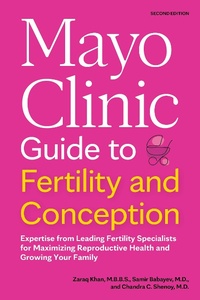
Mayo Clinic Guide to Fertility and Conception, 2nd Edition
Expertise from Leading Fertility Specialists for Maximizing Reproductive Health and Growing Your Family
2nd Edition
Published on 23. January 2024
304 pages
979-8-88770-196-7 (ISBN)
Description

With sensitivity and an inclusive approach, this is the essential guide for anyone who wants to have a baby.
Deciding to add a baby to your family is full of unknowns. How long will it take to get pregnant? How will age and other factors play into your chances of conceiving? If you need some help, what are your options? Many of these questions have different answers for every person and every pregnancy. With Mayo Clinic Guide to Fertility and Conception, you can take on the adventure of trying for a baby with clear, empathetic guidance.
Based on their extensive expertise in helping people build their families, Mayo Clinic physicians break down topics such as:
- Factors that contribute to healthy eggs and sperm
- Steps you can take to get ready for pregnancy
- Tips for ovulation tracking and timing sex
- Improving your chances of conception
- Reproductive assistance
- Third party reproduction
- Fertility preservation
- The many options now available to help all families-including LGBTQ, transgender and single parents-to-be-achieve the dream of having a baby.
More details
Persons
Zaraq Khan, M.B.B.S., is a physician at the forefront of modern reproductive issues. After earning his medical degree in Pakistan, he completed a residency in obstetrics and gynecology, a fellowship in reproductive endocrinology and infertility, and a masters in clinical research at Mayo Clinic College of Medicine and Science. He also received specialized training in minimally invasive gynecologic and reproductive surgery as a Mayo Clinic Travelling Scholar across Western Europe. Dr. Khan's clinical expertise includes diagnosis and management of infertility, uterine fibroids and endometriosis, and minimally invasive surgery for complex conditions. In addition, his research focuses on the impact of endometriosis on fertility and fertility preservation through ovarian tissue cryopreservation and uterine transplants.
Samir Babayev, M.D., born and raised in Azerbaijan, earned his medical degree at Istanbul University in Turkey. He then completed his residency in obstetrics and gynecology at New York Medical College and a fellowship in reproductive endocrinology and infertility at the University of Texas Southwestern Medical Center. Dr. Babayev's broad research interests and clinical expertise span reproductive surgery, reproductive endocrinology and infertility. Through his work with minimal stimulation in vitro fertilization (IVF), he has helped to develop protocols that minimize the use of fertility medications, lowering certain risks without compromising success rates. Dr. Babayev serves as the IVF Clinic director at Mayo Clinic in Rochester, Minnesota, where he strives to offer the most up-to-date and comprehensive fertility treatments available.
Chandra C. Shenoy, M.D., is an assistant professor and physician in obstetrics and gynecology at Mayo Clinic in Rochester, Minnesota. Following medical school at St. Louis University, she completed residency at MetroHealth Medical Center and the Cleveland Clinic. She also completed a fellowship in reproductive endocrinology and infertility at Mayo Clinic, as well as a masters in biomedical sciences. Clinically, Dr. Shenoy specializes in infertility with a focus on complex in vitro fertilization (IVF) and third party reproduction. She is the medical director for the Third Party Reproduction Program at Mayo Clinic, which helps build families through donor sperm, donor eggs, or gestational carriers. She advocates for single parents, the LGBTQ community, and couples experiencing infertility or pregnancy loss and is dedicated to helping build families of all kinds.
Samir Babayev, M.D., born and raised in Azerbaijan, earned his medical degree at Istanbul University in Turkey. He then completed his residency in obstetrics and gynecology at New York Medical College and a fellowship in reproductive endocrinology and infertility at the University of Texas Southwestern Medical Center. Dr. Babayev's broad research interests and clinical expertise span reproductive surgery, reproductive endocrinology and infertility. Through his work with minimal stimulation in vitro fertilization (IVF), he has helped to develop protocols that minimize the use of fertility medications, lowering certain risks without compromising success rates. Dr. Babayev serves as the IVF Clinic director at Mayo Clinic in Rochester, Minnesota, where he strives to offer the most up-to-date and comprehensive fertility treatments available.
Chandra C. Shenoy, M.D., is an assistant professor and physician in obstetrics and gynecology at Mayo Clinic in Rochester, Minnesota. Following medical school at St. Louis University, she completed residency at MetroHealth Medical Center and the Cleveland Clinic. She also completed a fellowship in reproductive endocrinology and infertility at Mayo Clinic, as well as a masters in biomedical sciences. Clinically, Dr. Shenoy specializes in infertility with a focus on complex in vitro fertilization (IVF) and third party reproduction. She is the medical director for the Third Party Reproduction Program at Mayo Clinic, which helps build families through donor sperm, donor eggs, or gestational carriers. She advocates for single parents, the LGBTQ community, and couples experiencing infertility or pregnancy loss and is dedicated to helping build families of all kinds.
Content
- Intro
- Title
- Copyright
- Introduction
- How to use this book
- Contents
- Part 1: Getting Ready for Pregnancy
- Chapter 1 Lifestyle and healthy habits for fertility
- Exercise
- The evidence for exercise
- Exercise and weight
- Athletes and fertility
- Getting started
- Weight
- Why it matters
- Managing weight
- Sleep
- Sleep and your overall health
- Night shifts and fertility
- Stress
- Your body and stress
- Fertility and stress
- Sex and stress
- Alcohol, tobacco and other toxins
- Alcohol
- Tobacco
- Marijuana
- Other recreational drugs
- Environmental exposures
- Diet
- Chapter 2 Healthy eating for conception
- Is there a "fertility diet?"
- Carbohydrates: Natural, not processed
- Simple and complex carbs
- Carbs and blood sugar
- Carbs and fertility
- Dietary fats: Go for good fats
- Avoid trans fats
- Healthier daily habits
- Protein: Eat more beans and nuts
- Make a protein plan
- Dairy: Creamier is better
- Caffeine and conception
- Focus on your health
- Chapter 3 Additional preparations
- Going off birth control
- Medications and supplements
- Prenatal vitamins
- Prescription vs. over-the-counter
- Vaccinations
- Vaccines during pregnancy
- Vaccines and fertility
- Chronic medical conditions
- Genetic tests
- Take heart
- Chapter 4 Producing healthy sperm
- Sperm health and fertility
- Quantity
- Structure
- Movement
- How to improve sperm health
- Maintain a healthy weight
- Eat a healthy diet
- Exercise
- Manage stress
- Prevent and treat infections
- What to avoid
- Chapter 5 Family-building options for single and LGBTQ+ parents
- Single parents
- Women without a male partner
- Men without a female partner
- Same-sex couples
- Female couples
- Male couples
- Transgender and gender-diverse parents
- Transgender men
- Transgender women
- Adoption and third-party reproduction
- Part 2: How to Get Pregnant
- Chapter 6 How babies are made
- Reproductive organs
- The female reproductive system
- The male reproductive system
- Ovulation
- Fertilization
- Implantation
- Pregnancy
- Multiple babies
- Chapter 7 Ovulation and your fertility window
- Your menstrual cycle
- The follicular phase: Prep time
- The ovulatory phase: Go time
- The luteal phase: Resolution time
- Your fertility window
- Use a calendar
- Monitor your temperature
- Watch for cervical changes
- Putting it all together
- Apps, devices and other products that can help
- Ovulation predictor kits
- Fertility monitors
- Apps and wearable tech
- Other devices
- Don't be afraid to seek help
- Chapter 8 Tips for increased odds of success
- Plan ahead
- Know your window
- Finding your window
- What to know about frequency
- Forget about positions and routines
- Avoid most lubricants
- Have fun
- Frequent sex and semen quality
- Don't forget about the rest of your relationship
- Chapter 9 Are you pregnant?
- Early signs and symptoms
- Tender, swollen breasts
- Fatigue
- Slight bleeding or cramping
- Nausea with or without vomiting
- Food aversions or cravings
- Increased urination
- Headaches and dizziness
- Mood swings
- Raised basal body temperature
- Home pregnancy tests
- Reading the results
- Test accuracy
- Follow-up blood test
- When to see a healthcare professional
- Bleeding
- Emergency symptoms
- Miscarriage and ectopic pregnancy
- Chapter 10 Pregnancy loss and ectopic pregnancy
- Miscarriage
- Signs and symptoms
- Causes
- Getting medical attention
- Recovery
- Recurrent pregnancy loss
- Causes
- Evaluation
- Treatment
- Ectopic pregnancy
- Signs and symptoms
- Treatment
- Future pregnancies
- Recovery after pregnancy loss
- Emotional recovery
- Physical recovery
- Part 3: Common Fertility Problems
- Chapter 11 Age, fertility and pregnancy
- Female reproductive life span
- Female fertility and age
- Fertility over the years
- What about today?
- Related risks
- Pregnancy loss
- Chromosomal abnormalities
- Other complications
- Male fertility and age
- Effect on pregnancy rates
- Health of aging sperm
- Related risks
- When to seek help
- Chapter 12 Guide to fertility problems
- Ovulation and female hormone issues
- Thyroid problems
- Elevated prolactin
- Hypothalamic dysfunction
- Polycystic ovary syndrome
- Premature ovarian insufficiency
- Luteal phase deficiency
- Female structural and anatomical issues
- Fallopian tube damage or blockage
- Endometriosis
- Adenomyosis
- Uterine conditions
- Congenital abnormalities
- Cervical narrowing or blockage
- Sperm problems
- What causes a low sperm count?
- When there's no sperm
- Male structural and anatomical issues
- Varicoceles
- Undescended testicles
- Sperm duct abnormalities
- Hypospadias
- Tumors
- Male hormone imbalances
- Primary hypogonadism
- Secondary hypogonadism
- Ejaculation issues
- Retrograde ejaculation and anejaculation
- Erectile dysfunction
- Male chromosome defects
- Evaluating infertility: A summary
- Unexplained infertility
- Part 4: When You Need Some Help
- Chapter 13 Seeing a doctor
- When to see a doctor
- Whom should you see?
- What to expect
- Medical history
- Physical exam
- Fertility tests
- Fertility tests
- Semen analysis
- Scrotal ultrasound
- Ovulation tests
- Ovarian reserve tests
- Uterine and fallopian tube tests
- Hormone tests
- Keeping a positive outlook
- Chapter 14 Medications
- Many options
- Fertility medications
- Clomiphene
- Aromatase inhibitors
- Gonadotropins
- Human chorionic gonadotropin
- Metformin
- Medications for specific conditions
- Chapter 15 Fertility-related surgeries
- Surgery options to treat infertility
- Fibroids
- Uterine polyps
- Endometriosis
- Adenomyosis
- Müllerian anomalies
- Isthmocele
- Asherman's syndrome
- Obstruction of the fallopian tubes
- Hydrosalpinx
- Tubal ligation reversal
- Varicocele
- Obstruction of the epididymis or ejaculatory tract
- Vasectomy reversal
- Looking ahead
- Chapter 16 Reproductive assistance: IUI and IVF
- Intrauterine insemination
- Why do IUI?
- How IUI works
- After the procedure
- Risks
- Assisted reproductive technology
- The first IVF babies
- IVF today
- How IVF works
- Superovulation
- Egg retrieval
- Sperm collection or retrieval
- Fertilization
- Embryo transfer
- Freezing extra embryos
- Risks of IVF
- Alternative ART methods
- Zygote intrafallopian transfer (ZFT)
- Gamete intrafallopian transfer (GIFT)
- Assisted hatching
- Preimplantation genetic testing
- Financial costs of ART
- The success of ART
- Extra embryos
- Understanding IVF failure
- Treating infertility: A summary
- Chapter 17 Third-party reproduction
- Donor eggs
- Do you need donor eggs?
- How egg donation works
- Donor sperm
- Do you need donor sperm?
- How donor sperm works
- Donor embryos
- Gestational carriers and surrogates
- Do you need a gestational carrier?
- How gestational carriers work
- Selecting a donor or carrier
- Egg donor
- Sperm donor
- Gestational carrier
- Directed donor or carrier
- Costs and contracts
- Donor sperm
- Donor eggs
- Donor embryos
- Gestational carriers
- Directed donors
- Take your time
- Part 5: Support and Special Considerations
- Chapter 18 Coping and support for infertility
- Stress and infertility
- Causes of stress
- Sexual dysfunction
- Coping techniques
- Support groups and counseling
- Other coping techniques
- Chapter 19 Fertility preservation
- Reasons for fertility preservation
- Cancer
- Other medical conditions
- Personal reasons
- Seeing a specialist
- Options for people with ovarian tissue
- Embryo cryopreservation
- Egg cryopreservation
- Ovarian tissue freezing
- Radiation shielding
- Ovarian transposition
- Conization and radical trachelectomy
- Options for people with testicular tissue
- Sperm cryopreservation
- Radiation shielding
- Looking forward
- Chapter 20 Other options
- When to consider alternatives
- Deciding with a partner
- Adoption
- Issues to consider
- Selecting an adoption resource
- How to begin the process
- Forums and support groups
- Child-free living
- Facts about child-free living
- The benefits of child-free living
- Other ways to get involved with children
- Finding support
- Additional resources
