

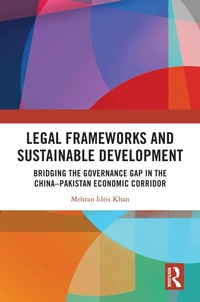
Legal Frameworks and Sustainable Development
Bridging the Governance Gap in the China-Pakistan Economic Corridor
1st Edition
Will be published approx. on 19. June 2026
254 pages
978-1-040-91742-8 (ISBN)
Description

The China-Pakistan Economic Corridor (CPEC) represents the largest infrastructure project of its kind, spanning 3,000 km and linking two nations. This monograph is the first to provide a comprehensive analysis of the environmental governance gaps and reform pathways of the CPEC.
Drawing on primary and secondary sources, project monitoring data and policy analysis, the book examines the reasons for the divergence in environmental standards between China and Pakistan. Pakistan's 27-year-old environmental legislation, fragmented provincial governance and limited regulatory capacity are inadequate for overseeing a USD 62+ billion corridor designed by a nation with advanced environmental institutions and robust enforcement mechanisms. Rather than merely critiquing current trajectories, the book proposes a three-pillar approach and a bilateral institutional framework in the form of a Joint CPEC Environmental Commission. This commission would have authority over Phase II projects (2025-2035) and could align infrastructure development with climate commitments and biodiversity protection.
Through legal analysis and comparative institutional assessment, the book offers policymakers, civil society, and scholars a practical blueprint for sustainable transnational development.
Drawing on primary and secondary sources, project monitoring data and policy analysis, the book examines the reasons for the divergence in environmental standards between China and Pakistan. Pakistan's 27-year-old environmental legislation, fragmented provincial governance and limited regulatory capacity are inadequate for overseeing a USD 62+ billion corridor designed by a nation with advanced environmental institutions and robust enforcement mechanisms. Rather than merely critiquing current trajectories, the book proposes a three-pillar approach and a bilateral institutional framework in the form of a Joint CPEC Environmental Commission. This commission would have authority over Phase II projects (2025-2035) and could align infrastructure development with climate commitments and biodiversity protection.
Through legal analysis and comparative institutional assessment, the book offers policymakers, civil society, and scholars a practical blueprint for sustainable transnational development.
Reviews / Votes
"Legal Frameworks and Sustainable Development: Bridging the Governance Gap in the China-Pakistan Economic Corridor offers a timely and interdisciplinary examination of the environmental challenges surrounding one of the world's most ambitious infrastructure initiatives. Integrating legal analysis with insights from environmental governance, development studies, and policy practice, the book demonstrates how institutional design and regulatory capacity shape sustainability outcomes in CPEC. Its forward-looking focus on CPEC 2.0 and its integrated governance framework make this monograph essential reading for scholars, policymakers, and practitioners concerned with sustainable infrastructure and Belt and Road governance."Sheng Zhang, Professor at Xi'an Jiaotong University School of Law
More details
Edition
1. Auflage
Language
English
Place of publication
London
United Kingdom
Publishing group
Taylor & Francis Ltd
Target group
College/higher education
Professional and scholarly
Illustrations
9 Tables, black and white; 10 Line drawings, black and white; 10 Illustrations, black and white
File size
3,78 MB
ISBN-13
978-1-040-91742-8 (9781040917428)
Copyright in bibliographic data and cover images is held by Nielsen Book Services Limited or by the publishers or by their respective licensors: all rights reserved.
Schweitzer Classification
Other editions
Additional editions
Mehran Idris Khan
Legal Frameworks and Sustainable Development
Bridging the Governance Gap in the China-Pakistan Economic Corridor
Book
approx. 06/2026
1st Edition
Routledge
€191.50
Not yet published
Person
Mehran Idris Khan is Associate Professor of Law at the University of International Business and Economics, Beijing. His research examines environmental law, maritime governance, and climate policy, with focus on transnational development corridors, maritime conservation, and environmental justice. Recent work addresses CPEC impacts, ocean governance, the introduction of a novel 'EIA 2.0' concept, and climate litigation in the Global South.
Content
1. Introduction: CPEC, Sustainability Challenges, and the Research Framework 2. Environmental Impacts of CPEC: Climate, Biodiversity, Resource Pressures, and Phase II Projections 3. Comparative Analysis of Environmental Legal Frameworks: China and Pakistan 4. International Environmental Law and CPEC Obligations: Paris Agreement, Biodiversity Conventions, and Compliance 5. CPEC Case Studies: Implementation Challenges and Governance Gaps 6. Policy Recommendations: Bilateral Legal Harmonisation, International Best Practices, and CPEC 2.0 7. Stakeholder Roles and Responsibilities: Government, Civil Society, Private Sector, and International Partners 8. Conclusion: Synthesis, Contributions, and a Vision for Sustainable CPEC 2.0
