

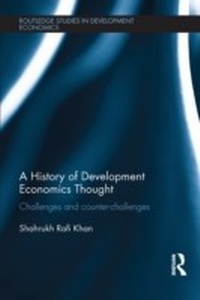
A History of Development Economics Thought
Challenges and Counter-challenges
1st Edition
Published on 14. March 2014
166 pages
978-1-317-81158-9 (ISBN)
Description

This book explores the history of economic development thought, with an emphasis on alternative approaches in macro development economics.
Given that the pioneers of development economics in the 1940s and 1950s drew inspiration from classical political economists, this book opens with a review of key classical scholars who wrote about the progress of the wealth of nations. In reviewing the thinking of the pioneers and those that followed, both their theories of development and underdevelopment are discussed. Overall, the book charts the evolution of development economic thought from the early developmentalists and structuralists, through to the neo-Marxist approach and radical development theory, the neo-liberal counter revolution, and the debate between new developmentalists and neo-liberal scholars. It ends with an assessment of the state of the field today.
This book will be of interest to all scholars and students interested in the evolution of development economics.
Given that the pioneers of development economics in the 1940s and 1950s drew inspiration from classical political economists, this book opens with a review of key classical scholars who wrote about the progress of the wealth of nations. In reviewing the thinking of the pioneers and those that followed, both their theories of development and underdevelopment are discussed. Overall, the book charts the evolution of development economic thought from the early developmentalists and structuralists, through to the neo-Marxist approach and radical development theory, the neo-liberal counter revolution, and the debate between new developmentalists and neo-liberal scholars. It ends with an assessment of the state of the field today.
This book will be of interest to all scholars and students interested in the evolution of development economics.
Reviews / Votes
"...I believe Khan has made a valuable contribution to the history of thought, and I do not hesitate to recommend it to both students and scholars, particularly as supplementary reading in courses on development economics."Farhad Rassekh, University of Hartford, Journal of the History of Economic Thought
More details
Series
Edition
1. Auflage
Language
English
Place of publication
London
United Kingdom
Publishing group
Taylor & Francis Ltd
Target group
College/higher education
File size
2,92 MB
ISBN-13
978-1-317-81158-9 (9781317811589)
Copyright in bibliographic data and cover images is held by Nielsen Book Services Limited or by the publishers or by their respective licensors: all rights reserved.
Schweitzer Classification
Other editions
Additional editions
Book
12/2019
1st Edition
Routledge
€67.80
Shipment within 15-20 days
Book
02/2014
1st Edition
Routledge
€217.50
Shipment within 15-20 days
Person
Shahrukh Rafi Khan is Visiting Professor of Economics at Mount Holyoke College, USA.
Content
1. The Classical and Marxist Roots Part I: Challenging the Mainstream on Underdevelopment and Development 2. Developmentalism 3. Neo-Marxism and the Political Economy of Development 4. Structuralism and Dependency Theory Part II: Heterodox Challenges from within the Fold 5. Market Friendly Heterodox Approaches Part III: The Neo-classical Counter-challenge 6. Neo-liberalism and the Washington Consensus Part IV: Neo-liberalism Challenged 7. Developmentalist Resurgence 8. Reflections
