

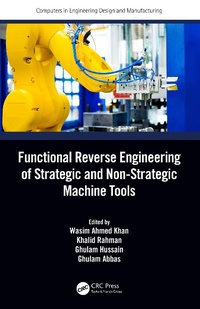
Functional Reverse Engineering of Strategic and Non-Strategic Machine Tools
1st Edition
Published on 20. June 2021
304 pages
978-1-000-40143-1 (ISBN)
Description

This book describes capacity building in strategic and non-strategic machine tool technology. It includes machine building in sectors such as machine tools, automobiles, home appliances, energy, and biomedical engineering, along with case studies.
The book offers guidelines for capacity building in academia, covering how to promote enterprises of functional reverse engineering enterprises. It also discusses machine tool development, engineering design, prototyping of strategic, and non-strategies machine tools, as well as presenting communication strategies and IoT, along with case studies.
Professionals from the CNC (Computer Numeric Control) machine tools industry, industrial and manufacturing engineers, and students and faculty in engineering disciplines will find interest in this book.
The book offers guidelines for capacity building in academia, covering how to promote enterprises of functional reverse engineering enterprises. It also discusses machine tool development, engineering design, prototyping of strategic, and non-strategies machine tools, as well as presenting communication strategies and IoT, along with case studies.
Professionals from the CNC (Computer Numeric Control) machine tools industry, industrial and manufacturing engineers, and students and faculty in engineering disciplines will find interest in this book.
More details
Series
Edition
1. Auflage
Language
English
Place of publication
London
United Kingdom
Publishing group
Taylor & Francis Ltd
Target group
Professional and scholarly
Illustrations
29 Tables, black and white; 108 Line drawings, black and white; 27 Halftones, black and white; 135 Illustrations, black and white
File size
9,81 MB
ISBN-13
978-1-000-40143-1 (9781000401431)
Copyright in bibliographic data and cover images is held by Nielsen Book Services Limited or by the publishers or by their respective licensors: all rights reserved.
Schweitzer Classification
Other editions
Additional editions
Wasim Ahmed Khan | Khalid Rahman | Ghulam Hussain
Functional Reverse Engineering of Strategic and Non-Strategic Machine Tools
Book
10/2024
1st Edition
CRC Press
€71.60
Shipment within 10-20 days
Wasim Ahmed Khan | Khalid Rahman | Ghulam Hussain
Functional Reverse Engineering of Strategic and Non-Strategic Machine Tools
Book
06/2021
1st Edition
CRC Press
€206.80
Shipment within 15-20 days
Persons
Wasim Ahmed Khan holds the first degree in Mechanical Engineering from NED University of Engineering and Technology, Karachi, Pakistan. He later obtained a PhD degree in Operations Research from the Department of Mechanical Engineering, University of Sheffield, England, UK. He is a life member of Pakistan Engineering Council. He is also a chartered engineer (CEng) of the Engineering Council, UK, and a fellow of the Institution of Mechanical Engineers, UK. Professor Khan was recently elected as the senior member of Institution of Electrical and Electronics Engineers, USA. He has diverse work experience including working with manufacturing industry, software development for local and overseas clients and teaching production engineering, business, and computer science students. Professor Dr. Wasim A. Khan is currently working as a Professor in the Faculty of Mechanical Engineering, GIK Institute of Engineering Sciences and Technology. He is a reviewer of several internationally reputed journals. He is also Senior Advisor, The Catalyst (The GIK Incubator), and Coordinator, GIK Institute Professional Education Program. Professor Khan is the founder of Advance Manufacturing Processes Laboratory (AMPL), Faculty of Mechanical Engineering, GIK Institute.
Khalid Rahman is an associate professor and Dean in the faculty of Mechanical Engineering at GIK Institute of Engineering Sciences and Technology where he has been a faculty member since 2012. He obtained his BS (Mechanical Engineering) from the GIK Institute and MS and Ph. D degree from Jeju National University, South Korea in 2012. He also has an industrial experience of 7 years in Engineering design and manufacturing. His research interests include direct wire technology for electronic devices and sensor fabrication and applications.
Ghulam Hussain is currently working as Professor at the Faculty of Mechanical Engineering, GIK Institute of Engineering Sciences & Technology, Pakistan. His research interests include advanced manufacturing processes, plasticity, energy modeling and industry 4.0. He is the author of numerous publications and stands among pioneers and top 10 leading researchers of die-less incremental forming process. Based on his scientific contributions, he is listed in "Who is Who", and has been ranked amongst top 10 National Productive Scientists. He is actively involved in doing research with renowned international universities. He has been also selected as a Foreign Expert on Manufacturing in China. Moreover, he is a reviewer and editorial board member of several international reputed journals.
Ghulam Abbas received the B.S. degree in computer science from University of Peshawar, Pakistan, in 2003, and the M.S. degree in distributed systems and the Ph.D. degree in computer networks from the University of Liverpool, U.K., in 2005 and 2010, respectively. From 2006 to 2010, he was Research Associate with Liverpool Hope University, U.K., where he was associated with the Intelligent & Distributed Systems Laboratory. Since 2011, he has been with the Faculty of Computer Sciences & Engineering, GIK Institute of Engineering Sciences and Technology, Pakistan. He is currently working as Associate Professor and Director Huawei Network Academy. Dr. Abbas is a Co-Founding Member of the Telecommunications and Networking (TeleCoN) Research Lab at GIK Institute. He is a Fellow of the Institute of Science & Technology, U.K., a Fellow of the British Computer Society, and a Senior Member of the IEEE. His research interests include computer systems architecture and wireless and mobile communications.
Khalid Rahman is an associate professor and Dean in the faculty of Mechanical Engineering at GIK Institute of Engineering Sciences and Technology where he has been a faculty member since 2012. He obtained his BS (Mechanical Engineering) from the GIK Institute and MS and Ph. D degree from Jeju National University, South Korea in 2012. He also has an industrial experience of 7 years in Engineering design and manufacturing. His research interests include direct wire technology for electronic devices and sensor fabrication and applications.
Ghulam Hussain is currently working as Professor at the Faculty of Mechanical Engineering, GIK Institute of Engineering Sciences & Technology, Pakistan. His research interests include advanced manufacturing processes, plasticity, energy modeling and industry 4.0. He is the author of numerous publications and stands among pioneers and top 10 leading researchers of die-less incremental forming process. Based on his scientific contributions, he is listed in "Who is Who", and has been ranked amongst top 10 National Productive Scientists. He is actively involved in doing research with renowned international universities. He has been also selected as a Foreign Expert on Manufacturing in China. Moreover, he is a reviewer and editorial board member of several international reputed journals.
Ghulam Abbas received the B.S. degree in computer science from University of Peshawar, Pakistan, in 2003, and the M.S. degree in distributed systems and the Ph.D. degree in computer networks from the University of Liverpool, U.K., in 2005 and 2010, respectively. From 2006 to 2010, he was Research Associate with Liverpool Hope University, U.K., where he was associated with the Intelligent & Distributed Systems Laboratory. Since 2011, he has been with the Faculty of Computer Sciences & Engineering, GIK Institute of Engineering Sciences and Technology, Pakistan. He is currently working as Associate Professor and Director Huawei Network Academy. Dr. Abbas is a Co-Founding Member of the Telecommunications and Networking (TeleCoN) Research Lab at GIK Institute. He is a Fellow of the Institute of Science & Technology, U.K., a Fellow of the British Computer Society, and a Senior Member of the IEEE. His research interests include computer systems architecture and wireless and mobile communications.
Content
SECTION 1: Functional Reverse Engineering Activities in Pakistan. 1. 3D Scanner: An Application of Functional Reverse Engineering. 2. Functional Reverse Engineering of Universal Testing Machine with Enhanced Positioning and Reduced Power Consumption. 3. Design, Modeling, Analysis, and Characterization of a Pin-on-Disk Tribometer with a Novel Spring Loading Mechanism. 4. Five Axes CNC Milling Machine. SECTION 2: Sensors, Tranducers, Printed Circuit Boards, and Control. 5. Sensors and Actuators: Selection and Interfacing. 6. PCB Design and Fabrication. 7. Vibration-Based Piezoelectric Energy Harvester for Wireless Sensor Node Application. 8. Reverse Engineering the LQR Controller to Find Equivalence with PID Controller. SECTION 3: Machine Tools and Computational Analysis. 9. Machine Tool Improvement through Reverse Engineering and Computational Analysis with an Emphasis on Sustainable Design. 10. A Coarse-to-Fine Classification Method for Aviation High Similarity Sheet Metal Parts Based on Machine Vision. 11. Combustion Timing Control of a Recompression HCCL Engine Using Negative Valve Overlap through Reverse Engineering. 12. Fabrication of Smart-Meter for Power Consumption Measurements of Machine Tools. SECTION 4: Modeling and Simulation. 13. A Six Degree of Freedom Machining Bed: Kinematic Model Development, Verification, and Validation. 14. Learning Fault-Tolerant Control Using a Table Sat Platform.
