

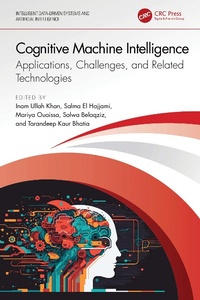
Cognitive Machine Intelligence
Applications, Challenges, and Related Technologies
1st Edition
Published on 28. August 2024
372 pages
978-1-040-09708-3 (ISBN)
Description

Cognitive Machine Intelligence: Applications, Challenges, and Related Technologies offers a compelling exploration of the transformative landscape shaped by the convergence of machine intelligence, artificial intelligence, and cognitive computing. In this book, the authors navigate through the intricate realms of technology, unveiling the profound impact of cognitive machine intelligence on diverse fields such as communication, healthcare, cybersecurity, and smart city development. The chapters present study on robots and drones to the integration of machine learning with wireless communication networks, IoT, quantum computing, and beyond. The book explores the essential role of machine learning in healthcare, security, and manufacturing. With a keen focus on privacy, trust, and the improvement of human lifestyles, this book stands as a comprehensive guide to the novel techniques and applications driving the evolution of cognitive machine intelligence. The vision presented here extends to smart cities, where AI-enabled techniques contribute to optimal decision-making, and future computing systems address end-to-end delay issues with a central focus on Quality-of-Service metrics. Cognitive Machine Intelligence is an indispensable resource for researchers, practitioners, and enthusiasts seeking a deep understanding of the dynamic landscape at the intersection of artificial intelligence and cognitive computing.
This book:
Covers a comprehensive exploration of cognitive machine intelligence and its intersection with emerging technologies such as federated learning, blockchain, and 6G and beyond.
Discusses the integration of machine learning with various technologies such as wireless communication networks, ad-hoc networks, software-defined networks, quantum computing, and big data.
Examines the impact of machine learning on various fields such as healthcare, unmanned aerial vehicles, cybersecurity, and neural networks.
Provides a detailed discussion on the challenges and solutions to future computer networks like end-to-end delay issues, Quality of Service (QoS) metrics, and security.
Emphasizes the need to ensure privacy and trust while implementing the novel techniques of machine intelligence.
It is primarily written for senior undergraduate and graduate students, and academic researchers in the fields of electrical engineering, electronics and communication engineering, and computer engineering.
This book:
Covers a comprehensive exploration of cognitive machine intelligence and its intersection with emerging technologies such as federated learning, blockchain, and 6G and beyond.
Discusses the integration of machine learning with various technologies such as wireless communication networks, ad-hoc networks, software-defined networks, quantum computing, and big data.
Examines the impact of machine learning on various fields such as healthcare, unmanned aerial vehicles, cybersecurity, and neural networks.
Provides a detailed discussion on the challenges and solutions to future computer networks like end-to-end delay issues, Quality of Service (QoS) metrics, and security.
Emphasizes the need to ensure privacy and trust while implementing the novel techniques of machine intelligence.
It is primarily written for senior undergraduate and graduate students, and academic researchers in the fields of electrical engineering, electronics and communication engineering, and computer engineering.
More details
Series
Edition
1. Auflage
Language
English
Place of publication
London
United Kingdom
Publishing group
Taylor & Francis Ltd
Target group
College/higher education
Professional and scholarly
Illustrations
32 Tables, black and white; 59 Line drawings, black and white; 5 Halftones, black and white; 64 Illustrations, black and white
ISBN-13
978-1-040-09708-3 (9781040097083)
Copyright in bibliographic data and cover images is held by Nielsen Book Services Limited or by the publishers or by their respective licensors: all rights reserved.
Schweitzer Classification
Other editions
Additional editions
Inam Ullah Khan | Salma El Hajjami | Mariya Ouaissa
Cognitive Machine Intelligence
Applications, Challenges, and Related Technologies
Book
approx. 06/2026
1st Edition
CRC Press
€82.50
Not yet published
Inam Ullah Khan | Salma El Hajjami | Mariya Ouaissa
Cognitive Machine Intelligence
Applications, Challenges, and Related Technologies
Book
08/2024
1st Edition
CRC Press
€242.70
Shipment within 10-20 days
Persons
Dr. Inam Ullah Khan is the Founder of AI-EYS. Recently, he is working as Global Mentor/ Guest Lecturer at Impact Xcelerator, IE School of Science and Technology, Madrid, Spain and SZABIST, Islamabad, Pakistan. Previously, he was working as Visiting researcher at King's College London, United Kingdom. He was faculty member at different universities in Pakistan which include Center for Emerging Sciences Engineering & Technology (CESET), Islamabad, Abdul Wali Khan University, Garden Campus, Timergara Campus, University of Swat & Shaheed Zulfikar Ali Bhutto Institute of Science and Technology (SZABIST), Islamabad Campus. He completed his Ph.D. in Electronics Engineering from Department of Electronic Engineering, Isra University, Islamabad Campus, School of Engineering & Applied Sciences (SEAS). Also, he did his M.S. degree in Electronic Engineering at Department of Electronic Engineering, Isra University, Islamabad Campus, School of Engineering & Applied Sciences (SEAS). He had done undergraduate degree in Bachelor of Computer Science from Abdul Wali Khan University Mardan, Pakistan. Apart from that his master's thesis is published as a book on topic "Route Optimization with Ant Colony Optimization (ACO)" in Germany which is available on Amazon. He authored/coauthored more than 60 research articles in reputable journals, conferences, and book chapters. More interestingly he recently introduced a novel routing protocol E-ANTHOCNET in Drones/ Unmanned Aerial Vehicles. His research interest includes Network System Security, Intrusion Detection, Intrusion Prevention, cryptography, Optimization techniques, WSN, IoT, Mobile Ad Hoc Networks (MANETS), Flying Ad Hoc Networks, and Machine Learning, AI, Unmanned aerial vehicles. He also served in many international conferences as technical program chair, session chair and technical program committee member. In addition, he served as editor in around 11 books on various topics. Also, he is Guest Editor, Review Editor, Associate Editor, Editorial Board member at reputed international journals. Last year he was General Chair at International Conference on Trends and Innovations in Smart Technologies (ICTIST'22), virtually from London, United Kingdom. More interestingly, he was invited as technology expert many times on Pakistan National Television.
Dr. Salma El Hajjami is an Assistant Professor and Researcher at Faculty of science, Ibn Zohr University, Agadir, Morocco since 2021. She is a Ph.D, graduated in 2021 in Computer Science, at the Laboratory of Artificial Intelligence, Data Science and Emerging Systems from ENSA, Sidi Mohammed Ben Abdellah University, Fez, Morocco. She is a Computer Science Engineer, graduated in 2015 from National School of Applied Sciences Fez, Morocco. She has previous expertise acting in Ministry of interior Morocco as Research and Development Engineer from 2017 to 2021. She is member of International Association of Engineers (IAENG) and International Association of Online Engineering. Dr. Salma has made contributions in the fields of Social Big Data, Semantics Analytics, Anomaly Detection, and Imbalanced Big Data published at international conferences and journals. Her main research topics are Machine Learning, Deep Learning, Imbalanced Big Data, Data Science and Blockchain. She has served and continues to serve on technical program and organizer committees of several conferences also as a reviewer of numerous international journals.
Dr. Mariya Ouaissa is currently a Professor in Cybersecurity and Networks at Faculty of Sciences Semlalia, Cadi Ayyad University, Marrakech, Morocco. She is a Ph.D. graduated in 2019 in Computer Science and Networks, at the Laboratory of Modelisation of Mathematics and Computer Science from ENSAM-Moulay Ismail University, Meknes, Morocco. She is a Networks and Telecoms Engineer, graduated in 2013 from National School of Applied Sciences Khouribga, Morocco. She is a Co-Founder and IT Consultant at IT Support and Consulting Center. She was working for School of Technology of Meknes Morocco as a Visiting Professor from 2013 to 2021. She is member of the International Association of Engineers and International Association of Online Engineering, and since 2021, she is an "ACM Professional Member". She is Expert Reviewer with Academic Exchange Information Centre (AEIC) and Brand Ambassador with Bentham Science. She has served and continues to serve on technical program and organizer committees of several conferences and events and has organized many Symposiums/Workshops/Conferences as a General Chair also as a reviewer of numerous international journals. Dr. Ouaissa has made contributions in the fields of information security and privacy, Internet of Things security, and wireless and constrained networks security. Her main research topics are IoT, M2M, D2D, WSN, Cellular Networks, and Vehicular Networks. She has published over 40 papers (book chapters, international journals, and conferences/workshops), 12 edited books, and 8 special issues as guest editor.
Dr. Salwa Belaqziz is a full Professor in Computer Science at the Faculty of Sciences, Ibn Zohr University in Agadir and an affiliate professor at the Center for Remote Sensing Applications of the Mohammed VI Polytechnic University. She received her PhD degree in Computer Science from Cadi Ayyad University of Marrakech in 2014, which focused on the development of a decision support approach for gravity irrigation systems management, based on the combination of multi-agent modeling, remote sensing and optimization by evolutionary algorithms. Salwa Belaqziz has worked at the National Institute of Agricultural Research in Toulouse as postdoctoral researcher, where she participated in the development of an agent-based modeling and simulation platform to assess the environmental, economic, and social impacts of various management strategies and policies regarding the management and uses of water resources. Her main research interests include irrigation scheduling, smart farming, and decision support systems development, based on approaches combining artificial intelligence, big data, data science, agent-based modeling, physics-based modeling, remote sensing, IoT and optimization algorithms for integrated water resources management. Salwa Belaqziz co-supervises three PhD students and participates in national and international research projects (ASSIWAT, MorSnow, GeanTech, PRIMA...). She has published papers in international peer-reviewed journals and participated in several international conferences.
Dr. Tarandeep Kaur Bhatia received her Ph.D. degree in Computer Science Engineering from Deakin University, Australia under Higher Degree by Research Scholarship. Currently, she is working as an Assistant Professor in University of Petroleum & Energy Studies (UPES) Bidholi, Dehradun, India. She is a Gold Medalist in her M.Tech, Computer Science & Engineering batch 2015-2017. She published many papers in reputed journals, presented several papers in many National/International conferences, and wrote many book chapters. Dr. T.K Bhatia filed 20 Patents. She triumphantly completed and conducted many Certified Faculty Development Programmes (FDP). She successfully completed many certified trainings from the Queensland University of Technology, Australia, University of Leeds (England), and Murdoch University, Australia. Dr. Tarandeep Kaur is a "Member of reviewer committee" for the IEEE Communications Standards Magazine Journal, IEEE Access, IEEE Transactions on Vehicular Technology, Journal of Supercomputing, IET Communications, Physical Communications, and many more. She is also serving as an "Editorial and Review Board Member" for LC International Journal of STEM (LC-JSTEM) and Panel Member of the Technical Program Committee (TPC) of the COMS2-2021 conference. Her areas of interest are Vehicular Ad-hoc NETworks (VANETs), Data Congestion, Networking, Software Engineering, Artificial Intelligence. Recently working with various simulators and tools such as NS-2, MATLAB, Omnet++, SUMO, VEINS for her research work.
Dr. Salma El Hajjami is an Assistant Professor and Researcher at Faculty of science, Ibn Zohr University, Agadir, Morocco since 2021. She is a Ph.D, graduated in 2021 in Computer Science, at the Laboratory of Artificial Intelligence, Data Science and Emerging Systems from ENSA, Sidi Mohammed Ben Abdellah University, Fez, Morocco. She is a Computer Science Engineer, graduated in 2015 from National School of Applied Sciences Fez, Morocco. She has previous expertise acting in Ministry of interior Morocco as Research and Development Engineer from 2017 to 2021. She is member of International Association of Engineers (IAENG) and International Association of Online Engineering. Dr. Salma has made contributions in the fields of Social Big Data, Semantics Analytics, Anomaly Detection, and Imbalanced Big Data published at international conferences and journals. Her main research topics are Machine Learning, Deep Learning, Imbalanced Big Data, Data Science and Blockchain. She has served and continues to serve on technical program and organizer committees of several conferences also as a reviewer of numerous international journals.
Dr. Mariya Ouaissa is currently a Professor in Cybersecurity and Networks at Faculty of Sciences Semlalia, Cadi Ayyad University, Marrakech, Morocco. She is a Ph.D. graduated in 2019 in Computer Science and Networks, at the Laboratory of Modelisation of Mathematics and Computer Science from ENSAM-Moulay Ismail University, Meknes, Morocco. She is a Networks and Telecoms Engineer, graduated in 2013 from National School of Applied Sciences Khouribga, Morocco. She is a Co-Founder and IT Consultant at IT Support and Consulting Center. She was working for School of Technology of Meknes Morocco as a Visiting Professor from 2013 to 2021. She is member of the International Association of Engineers and International Association of Online Engineering, and since 2021, she is an "ACM Professional Member". She is Expert Reviewer with Academic Exchange Information Centre (AEIC) and Brand Ambassador with Bentham Science. She has served and continues to serve on technical program and organizer committees of several conferences and events and has organized many Symposiums/Workshops/Conferences as a General Chair also as a reviewer of numerous international journals. Dr. Ouaissa has made contributions in the fields of information security and privacy, Internet of Things security, and wireless and constrained networks security. Her main research topics are IoT, M2M, D2D, WSN, Cellular Networks, and Vehicular Networks. She has published over 40 papers (book chapters, international journals, and conferences/workshops), 12 edited books, and 8 special issues as guest editor.
Dr. Salwa Belaqziz is a full Professor in Computer Science at the Faculty of Sciences, Ibn Zohr University in Agadir and an affiliate professor at the Center for Remote Sensing Applications of the Mohammed VI Polytechnic University. She received her PhD degree in Computer Science from Cadi Ayyad University of Marrakech in 2014, which focused on the development of a decision support approach for gravity irrigation systems management, based on the combination of multi-agent modeling, remote sensing and optimization by evolutionary algorithms. Salwa Belaqziz has worked at the National Institute of Agricultural Research in Toulouse as postdoctoral researcher, where she participated in the development of an agent-based modeling and simulation platform to assess the environmental, economic, and social impacts of various management strategies and policies regarding the management and uses of water resources. Her main research interests include irrigation scheduling, smart farming, and decision support systems development, based on approaches combining artificial intelligence, big data, data science, agent-based modeling, physics-based modeling, remote sensing, IoT and optimization algorithms for integrated water resources management. Salwa Belaqziz co-supervises three PhD students and participates in national and international research projects (ASSIWAT, MorSnow, GeanTech, PRIMA...). She has published papers in international peer-reviewed journals and participated in several international conferences.
Dr. Tarandeep Kaur Bhatia received her Ph.D. degree in Computer Science Engineering from Deakin University, Australia under Higher Degree by Research Scholarship. Currently, she is working as an Assistant Professor in University of Petroleum & Energy Studies (UPES) Bidholi, Dehradun, India. She is a Gold Medalist in her M.Tech, Computer Science & Engineering batch 2015-2017. She published many papers in reputed journals, presented several papers in many National/International conferences, and wrote many book chapters. Dr. T.K Bhatia filed 20 Patents. She triumphantly completed and conducted many Certified Faculty Development Programmes (FDP). She successfully completed many certified trainings from the Queensland University of Technology, Australia, University of Leeds (England), and Murdoch University, Australia. Dr. Tarandeep Kaur is a "Member of reviewer committee" for the IEEE Communications Standards Magazine Journal, IEEE Access, IEEE Transactions on Vehicular Technology, Journal of Supercomputing, IET Communications, Physical Communications, and many more. She is also serving as an "Editorial and Review Board Member" for LC International Journal of STEM (LC-JSTEM) and Panel Member of the Technical Program Committee (TPC) of the COMS2-2021 conference. Her areas of interest are Vehicular Ad-hoc NETworks (VANETs), Data Congestion, Networking, Software Engineering, Artificial Intelligence. Recently working with various simulators and tools such as NS-2, MATLAB, Omnet++, SUMO, VEINS for her research work.
Content
I. AI Trends and Challenges. 1. AI based Computing Applications in Future Communication. 2. Advances of Deep Learning and related Applications. 3. Machine Learning for Big Data and Neural Networks. II. Machine Intelligence in Network Technologies. 4. Deformation Prediction and Monitoring using Real-Time WSN and Machine Learning Algorithms: A Review. 5. Unmanned Aerial Vehicle: Integration in Healthcare Sector for Transforming Interplay among Smart Cities. 6. Blockchain Technologies Using Machine Learning. 7. Q-learning and Deep Q Networks for Securing IoT Networks, Challenges and Solution. 8. The Application of Artificial Intelligence and Machine Learning in Network Security using a Bibliometric Study. 9. Machine Learning Approaches for Intrusion Detection: Enhancing Cybersecurity and Threat Mitigation. III. Cognitive Machine Intelligence Applications. 10. The Rise of AI in the Field of Healthcare. 11. A Comprehensive Survey of Machine Learning Applications in Healthcare. 12. A Deep Learning Approach for the Early Diagnosis of Melanoma Cancer: Study and Analysis. 13. A Study and Analysis on Nowcasting: Forms of Precipitation using Improvised Random Forest Classifier. 14. A Study and Comparative Analysis on Prediction of Tsunami Using Convolutional Neural Network. 15. Towards Smarter Chatbots: Unravelling the Capabilities of ChatGPT.
