

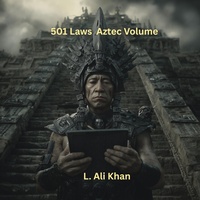
501 Laws #5 Aztec Volume
Description

This volume, the fifth in the 501 Law series, offers another 100 laws on various topics, ranging from barbarism to beyondism. The Aztec volume captures the dynamic tension between the creation script and human civilization. Humans fight animals, nature, and among themselves. But they create beautiful cultures and civilizations. The Aztecs sacrificed humans to please gods they trusted and worshipped. Pleasing gods or a single God is a notable human impulse. The Aztecs also built pyramids, sophisticated engineering structures, and aqueducts to harness swamps and waters. They battled the conquistadors, who did not think highly of the Aztecs. The killings were ferocious on both sides, even though the Aztecs carried the cross to the Mount. The human civilization is progressing toward leaving the Earth and discovering something more powerful than the human brain.
More details
Person
L. Ali Khan initially trained as a civil engineer. He later switched to law, obtaining a law degree from Punjab University, Lahore. In 1976, Khan immigrated to the United States and studied law at New York University School of Law, where he received his LL.M. and J.S.D. Khan is a member of the New York and Kansas Bars.
Khan is the founder of Legal Scholar Academy and Emeritus Professor of Law.
Khan has authored several books, including The Extinction of Nation-States (1996), A Theory of Universal Democracy (2003), A Theory of International Terrorism (2006), Contemporary Ijtihad: Limits and Controversies (2011), New Iliad (2013), Flexibility under Islamic Law (2015), and Islam Enters America(2015). Over the years, he has written numerous law review articles and essays on Islamic law, international law, commercial law, creative writing, legal humor, jurisprudence, the U.S. Constitution, comparative constitutional law, human rights, and foreign policy. His academic writings are used as part of the course materials in universities worldwide.
Khan has devoted a significant portion of his academic scholarship to Islamic law and conflicts involving Muslim communities. He has participated in Islamic law symposia held at the law schools of Samford University, University of St. Thomas, Barry University, Michigan State University, and Brigham Young University, contributing ground-breaking articles on Islamic jurisprudence.
In addition to law articles and academic books, Khan also writes for the popular press in the United States, the Middle East, and the Indian subcontinent. His legal and foreign affairs commentaries are published worldwide, and international media seek his comments on world events. Khan's legal and political commentaries have been published in Counterpunch, Huffington Post, JURIST, The Hindu, Dawn (Pakistan), Taipei Times, Asia Times, and numerous other publications.
He comments on world affairs on international radio and television media, including BBC, Press TV, and NPR.
He writes book reviews for the New York Journal of Books.
In 2007, Khan was a resident legal scholar with the Organization of Islamic Conference in Saudi Arabia. He taught law for thirty-five years at Washburn University School of Law.
