

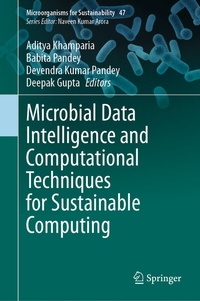
Microbial Data Intelligence and Computational Techniques for Sustainable Computing
Description

This book offers information on intelligent and computational techniques for microbial data associated with plant microbes, human microbes etc. The main focus of this book is to provide an insight on building smart sustainable solutions for microbial technology using intelligent computational techniques.
Microbes are ubiquitous in nature, and their interactions among each other are important for colonizing diverse habitats. The core idea of sustainable computing is to deploy algorithms, models, policies and protocols to improve energy efficiency and management of resources, enhancing ecological balance, biological sustenance and other services on societal contexts. Chapters in this book explore the conventional methods as well as the most recently recognized high-throughput technologies which are important for productive agroecosystems to feed the growing global population. This book is of interest to teachers, researchers, microbiologist, computer bioinformatics scientists,plant and environmental scientist, and those interested in environment stewardship around the world. The book also serves as an advanced textbook material for undergraduate and graduate students of computer science, biomedicine, agriculture, human science, forestry, ecology, soil science, and environmental sciences and policy makers.
More details
Other editions
Additional editions
Persons
Dr. Aditya Khamparia has expertise in teaching, entrepreneurship, and research and development of a decade. He is currently working as an assistant professor and coordinator of Department of Computer Science, Babasaheb Bhimrao Ambedkar University, India. He received his Ph.D. degree from Lovely Professional University, Punjab in May 2018. He has completed his M. Tech. from VIT University and B. Tech. from RGPV, Bhopal. He has completed his PDF from UNIFOR, Brazil. He has more than 100 research papers along with book chapters including more than 20 papers in top journals with cumulative impact factor of above 100 to his credit. Additionally, he has authored and edited a cumulative of 11 books. His research interest includes machine learning, deep learning, educational technologies and computer vision.
Dr. Deepak Gupta
received a B.Tech. degree in 2006 from the Guru Gobind Singh Indraprastha University, India. He received M.E. degree in 2010 from Delhi Technological University, India and Ph. D. degree in 2017 from Dr. APJ Abdul Kalam Technical University, India. He has completed his Post-Doc from Inatel, Brazil. With 13 years of rich expertise in teaching and two years in the industry, he focuses on rational and practical learning. He has contributed massive literature to the fields of intelligent data analysis, biomedical engineering, artificial intelligence, and soft computing. He has served as editor-in-chief, guest editor, associate editor in various reputed journals. He has actively been organizing various reputed international conferences. He has authored/edited 43 books. He has published 200 scientific research publications including more than 100 SCI Indexed Journals.
Dr. Babita Pandey working as an associate professor in Department of Computer Science, Babasaheb Bhimrao Ambedkar University, Lucknow, India. Her research interests include biomedical engineering, e-learning, computational intelligence andsecurity systems. She has published more than 100 publications and conferences including more than 40 SCI Indexed Journals.
Dr. Devendra Kumar Pandey is currently working as a professor at Lovely Professional University, India. He obtained his Ph.D. in biochemical engineering from Indian Institute of Technology, India. His main area of interest related to pharmacology and toxicology, plant and soil sciences, and molecular sciences. His area of expertise includes plant biotechnology, plant-microbe interaction, chromatography techniques i.e., HPTLC, HPLC, LC-MS, molecular markers and bioactive compounds markers for medicinal plants, and bioactive compounds. He has published more than 100 articles in international journals with papers also in national and international conferences contributed as author/co-author.
