

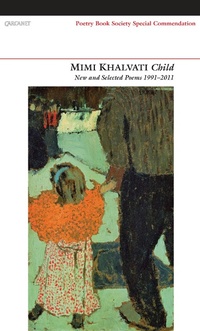
Child
New and Selected Poems 1991-2011
Published on 24. November 2011
180 pages
978-1-84777-915-1 (ISBN)
Description

Child:New and Selected Poems 1991-2011 combines a generous collation of poems from Mimi Khalvati's five Carcanet volumes with previously uncollected sequences. She orders her work autobiographically, telling the stories of her life in four sections: childhood and early adulthood; motherhood; meditations on light; and love and art, circling back to childhood in her celebrated final sequence ('The Meanest Flower'). The figure of the child stands at the centre of the book, appearing in many guises: the poet as a schoolgirl on the Isle of Wight, or in half-remembered later years living with her grandmother in Tehran; her two children, now grown up; children in art; and an enduring sense of oneself as a child that is never left behind.
Here is the essential Khalvati: exquisitely nuanced, formally accomplished, Romantic in sensibility; rapturous and tender in response to nature, family and love. Her poems, David Constantine writes, 'say what it feels like being human, the good and the ill of it, with passion, tact and lightness.'
Here is the essential Khalvati: exquisitely nuanced, formally accomplished, Romantic in sensibility; rapturous and tender in response to nature, family and love. Her poems, David Constantine writes, 'say what it feels like being human, the good and the ill of it, with passion, tact and lightness.'
Reviews / Votes
This wonderful selection, drawing on Khalvati's five previous books as well as new material, is full of moving, quietly insightful meditations on family and domestic spaces, on routines and daily rhythms.One of the outstanding pieces, 'Sundays', has a typically accomplished intimacy and directness. There's a sense here of poetry as something restorative, a means of gauging a fragile balance between safety and threat ('And suddenly / there's sunshine, brightness and a bounce / and his fingers are dancing. Voices / might bedevil him but voices also // save him').
Other more wide-ranging poems provide explorations of history and nationality, but these are frequently rooted in the near at hand, the glimpse of sudden, elusive perspectives. The sonnet sequence 'The Meanest Flower', for example, relishes such shifting intimate dynamics as it swerves between images of childhood and motherhood.
The book is divided into five parts, the first four ordered autobiographically (rather than by date of composition). And it is the pieces about Khalvati's childhood on the Isle of Wight that, in many ways, are the most successful - the isolation conjured in 'Writing Home' and 'Writing Letters', the use of landscape and careful symbolism in 'The Chine', the clarity and poise of 'Rubaiyat', an elegy for her grandmother.
'Iowa Daybreak', one of the more recent works from the book's last section, provides a sustained and thoughtful exploration of Khalvati's approach. The lyricism has a tremendous delicacy and self-awareness. At its centre she contrasts her own close-range aesthetic with Emily Dickinson's visions of 'the dark and deep' - 'Depths were never truths I reached. / More, the quiet monotony I never // thought of as monotony / but peace. Nothing I loved more / than making torn things whole.' Mimi Khalvati's work has long been admired by other poets, and by her many students at the Poetry School and Arvon Foundation. But she has always had a wide general readership too, drawn to her poems by their rare blend of emotional power, lyrically beauty and formal control. Her accomplishment in traditional forms - from the sonnet to the ghazal - is more than a shaping or structural principle. The intricate tracery of thought and feeling in her work is discovered in and through the rhyme schemes, the metre, the patterns of repetition.
This timely publication of her New and Selected Poems will delight those who already admire her poetry, but it deserves to win her many new readers too. Born in Tehran and educated in Switzerland, Mimi Khalvati worked as a theatre director, actor and translator before publishing her first book - In White Ink - at the age of 47. The body of work gathered here covers the twenty years since that first publication. Reviewing The Chine in 2002, Marilyn Hacker commented that Mimi Khalvati had produced 'a lifetime's body of work in a short decade'. Now, a decade later, that body of work includes perhaps her finest individual collection - the T S Elliot Prize shortlisted The Meanest Flower - and a remarkable batch of new poems.
The poems in this New and Selected volume range from tender poems of home and childhood (many set up on the Isle of Wight where she grew up) to poems of motherhood, love and grief. This is work of great delicacy and poise, intimate and brave, subtle and honest, in which - as David Morley said - we readers find 'the living hand of the poem held always towards us.' The section of new poems that concludes the book is built on powerful sequences, including the impressive: 'The Streets of La Roue', and 'Iowa Daybook', but the centrepiece is a beautiful elegiac sequence - 'Afterword' - on the loss of her partner. This is courageous and haunting poetry: 'Look how solid our buildings are,/ how material the sky.// Paris is where you left it,/ so am I,/ I, small as a single hair,// the infinite divisible./ You the indivisible nowhere,/ whole, entire.'
More details
Language
English
Place of publication
NYC
United Kingdom
Publishing group
Carcanet Press Ltd
File size
0,58 MB
ISBN-13
978-1-84777-915-1 (9781847779151)
Copyright in bibliographic data and cover images is held by Nielsen Book Services Limited or by the publishers or by their respective licensors: all rights reserved.
Schweitzer Classification
Other editions
Additional editions
Book
11/2011
Carcanet Poetry
€16.50
Shipment within 3-4 weeks
Person
Mimi Khalvati was born in Tehran, Iran, and grew up on the Isle of Wight. She has lived most of her life in London. After training at Drama Centre London, she worked as an actor in the UK and as a director at the Theatre Workshop Tehran and on the fringe in London. She has published nine poetry collections with Carcanet Press, including The Meanest Flower, shortlisted for the T.S. Eliot Prize 2007, Child: New and Selected Poems 1991-2011, a Poetry Book Society Special Commendation, The Weather Wheel, a PBS Commendation and a book of the year in The Independent, and Afterwardness, a book of the year in The Sunday Times and The Guardian. She was a co-winner of the Poetry Business Pamphlet Competition 1989 and her Very Selected Poems appeared from Smith/Doorstop in 2017. She has been Poet in Residence at the Royal Mail and has held fellowships at the International Writing Program in Iowa as the recipient of the William B. Quarton International Writing Program Scholarship, at the American School in London and at the Royal Literary Fund, City University. She is the founder of The Poetry School and has co-edited its three anthologies of new writing published by Enitharmon Press. Her awards include a Cholmondeley Award from the Society of Authors, a major Arts Council Award and she is a Fellow of the Royal Society of Literature and of The English Society. In 2023 she was awarded the King's Gold Medal for Poetry.
Content
Selected Poems
I
Shanklin Chine
Writing Home
The Alder Leaf
Writing Letters
Villanelle
Sadness
Listening to Strawberry
The Chine
Nostalgia
Earls Court
Baba Mostafa
Coma
The Bowl
Ghazal: The Servant
Rubaiyat
from Interiors
II
Needlework
The Woman in the Wall
Stone of Patience
Overblown Roses
from Plant Care
River Sonnet
Come Close
Blue Moon
Boy in a Photograph
The Piano
from The Inwardness of Elephants
Soapstone Creek
Soapstone Retreat
The Robin and the Eggcup
Motherhood
Apology
Sundays
Tintinnabuli
Ghazal: The Children
III
from Entries on Light
Sunday. I woke from a raucous night
Today's grey light
Scales are evenly weighed
The heavier, fuller, breast and body grow
I hear myself in the loudness of overbearing waves
Speak to me as shadows do
It's all very well
Light's taking a bath tonight
With finest needles
Dawn paves its own way
Everywhere you see her
Don't draw back
Light comes between us and our grief:
One sky is a canvas for jets and vapour trails
Black fruit is sweet, white is sweeter.
And had we ever lived in my country
I loved you so much
This book is a seagull whose wings you hold
: that sky and light and colour
An Iranian professor I know asked me
All yellow has gone from the day.
It's the eye of longing that I tire of
It is said God created a peacock of light
Why does the aspen tremble
And suppose I left behind
Finally, in a cove
IV
Vine Leaves
The Love Barn
Ghazal after Hafez
Ghazal: To Hold Me
Ghazal: Lilies of the Valley
Ghazal: It's Heartache
Ghazal: Of Ghazals
Love in an English August
Ghazal: Who'd Argue?
Just to Say
Song
Don't Ask Me, Love, for that First Love
On Lines from Paul Gauguin
Ghazal: The Candles of the Chestnut Trees
The Mediterranean of the Mind
The Middle Tone
On a Line from Forough Farrokhzad
Scorpion-grass
The Meanest Flower
New and Uncollected Poems
Iowa Daybook
The Streets of La Roue
Afterword
Night Sounds
River Sounding
Cretan Cures
The Poet's House
Notes
I
Shanklin Chine
Writing Home
The Alder Leaf
Writing Letters
Villanelle
Sadness
Listening to Strawberry
The Chine
Nostalgia
Earls Court
Baba Mostafa
Coma
The Bowl
Ghazal: The Servant
Rubaiyat
from Interiors
II
Needlework
The Woman in the Wall
Stone of Patience
Overblown Roses
from Plant Care
River Sonnet
Come Close
Blue Moon
Boy in a Photograph
The Piano
from The Inwardness of Elephants
Soapstone Creek
Soapstone Retreat
The Robin and the Eggcup
Motherhood
Apology
Sundays
Tintinnabuli
Ghazal: The Children
III
from Entries on Light
Sunday. I woke from a raucous night
Today's grey light
Scales are evenly weighed
The heavier, fuller, breast and body grow
I hear myself in the loudness of overbearing waves
Speak to me as shadows do
It's all very well
Light's taking a bath tonight
With finest needles
Dawn paves its own way
Everywhere you see her
Don't draw back
Light comes between us and our grief:
One sky is a canvas for jets and vapour trails
Black fruit is sweet, white is sweeter.
And had we ever lived in my country
I loved you so much
This book is a seagull whose wings you hold
: that sky and light and colour
An Iranian professor I know asked me
All yellow has gone from the day.
It's the eye of longing that I tire of
It is said God created a peacock of light
Why does the aspen tremble
And suppose I left behind
Finally, in a cove
IV
Vine Leaves
The Love Barn
Ghazal after Hafez
Ghazal: To Hold Me
Ghazal: Lilies of the Valley
Ghazal: It's Heartache
Ghazal: Of Ghazals
Love in an English August
Ghazal: Who'd Argue?
Just to Say
Song
Don't Ask Me, Love, for that First Love
On Lines from Paul Gauguin
Ghazal: The Candles of the Chestnut Trees
The Mediterranean of the Mind
The Middle Tone
On a Line from Forough Farrokhzad
Scorpion-grass
The Meanest Flower
New and Uncollected Poems
Iowa Daybook
The Streets of La Roue
Afterword
Night Sounds
River Sounding
Cretan Cures
The Poet's House
Notes
