

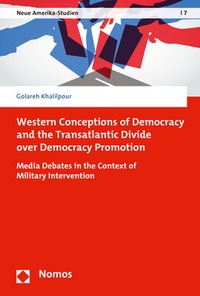
Western Conceptions of Democracy and the Transatlantic Divide over Democracy Promotion
Media Debates in the Context of Military Intervention
1st Edition
Published on 28. April 2020
278 pages
978-3-7489-0563-9 (ISBN)
Description

Do liberal Western democracies share a common understanding of democracy? If so, why is there a transatlantic divide over the promotion of democracy? While the US applies a bottom-up strategy in this respect, the European Union pursues a top-down approach. While there is consensus as to the desirability of the external promotion of democracy, disagreement persists as to what kinds of strategies work more effectively.
This book suggests that differences between the US and Europe in terms of the promotion of democracy derive from different historical backgrounds, experiences with political modernisation and, hence, historically embedded conceptions of democracy. Democracy promoters choose instruments that advance their vision of an ideal transition and that are congruent with their respective understandings of democracy. This book's analysis of media debates in four Western democracies reveals different understandings with regard to the key aspects of democracy across the Atlantic and contributes to research on the transatlantic divide in this regard.
More details
Other editions
Additional editions
Golareh Khalilpour
Western Conceptions of Democracy and the Transatlantic Divide over Democracy Promotion
Media Debates in the Context of Military Intervention
Book
04/2020
1st Edition
Nomos
€59.00
Shipment within 7-9 days
Person
Content
- Cover
- Chapter 1 - Introduction
- 1.1 Research Question and Central Argument
- 1.2 Media Coverage on Wars and Military Interventions
- 1.3 Added Value and Structure of Book
- Chapter 2 - The Road to Democracy: What has the West been doing?
- 2.1 Conceptualizing Democracy Promotion
- 2.2 Democratization and Democracy Promotion in Academic Discourse
- 2.3 The Evolution of Democracy Promotion in the West
- 2.4 Transatlantic Tendencies in Democracy Promotion: Bottom up versus Top Down
- 2.5 How Democracies emerge - A Question of Sequence: State Institutions first, Citizen Participation second, or the other way round?
- 2.6 The Divide Across The Atlantic
- 2.7 Four Events, Two Readings
- 2.7.1 The Collapse of the Soviet Union
- 2.7.2 The 2003 Iraq Invasion
- 2.7.3 The Orange Revolution and the Maidan Protests of 2014
- 2.7.4 The Arab Spring and Libya's failed democratic transition
- 2.7.5 Interim Conclusion: Transatlantic Divide over Assumptions about Democratization
- Chapter 3 - The Relationship between the Conception of Democracy and its Promotion
- 3.1 Early Debates about the Extent and Limitations of State Power
- 3.1.1 America's Founding Principles: From the Town Halls to the Beacon of Freedom
- 3.1.1.1 Antiquated Institutions and Modern Participation in New England
- 3.1.1.2 Andrew Jackson's Anti-Institutionalist Legacy
- 3.1.2 Europe's Path to Political Modernization: Revolutions, Wars, and Institutional Safeguards against the Siren's Call
- 3.1.2.1 Revolution and Liberation
- 3.1.2.2 Ascendent Institutions and Outdistanced Civil Society
- 3.2 The Conceptions underlying Western Democracy Promotion
- 3.2.1 Hamilton, Madison, and Jefferson: Three Conceptions of Democracy
- 3.2.2 Theorizing the Impact of Conceptions of Democracy on Democracy Promotion
- 3.2.3 Hypotheses about Conceptions of Democracy in Media Debates
- Hypothesis 1
- Hypothesis 2
- Hypothesis 3
- Hypothesis 4
- Chapter 4 - Conceptions of Democracy in Media Debates on War and Military Intervention: Research Design
- 4.1 Content Analysis as a Tool to Trace Conceptions
- 4.2 Data, Country Selection, and Period of Study
- 4.3 Operationalization: Variables
- 4.3.1 Confronting Word Sense Ambiguity
- 4.3.2 Outcome Variables: Conception of Democracy
- Chapter 5 - Revealing the Transatlantic Divide over Conceptions of Democracy: Analysis
- 5.1 Data Preparation
- 5.2 Time-Series Plots: Conceptions of Democracy in Media Discourse
- 5.3 Accounting for the Political Leanings of Newspapers
- 5.4 Time-Series Diagnostics: Democracy in Media Discourse
- 5.5 Time-Series Analysis: Democracy in Media Discourse
- Chapter 6 - Conclusion: Democracy Promotion and Conceptions of Democracy in Transatlantic Discourse
- 6.1 Summary of the Empirical Findings
- 6.2 Implications for the Future of Transatlantic Democracy Promotion
- 6.3 Open Questions and Perspectives for Future Research
- Bibliography
- Appendix
- Appendix A: Summary Statistics for Democracy Series
- A) United States of America: 276 Observations
- B) Germany: 238 Observations
- C) United Kingdom: 275 Observations
- D) France: 192 Observations
- Appendix B: Augmented Dickey-Fuller Tests For Units Roots
- Appendix C: Time-Series Diagnostic Plots
