

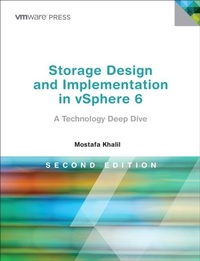
Storage Design and Implementation in vSphere 6
A Technology Deep Dive
2nd Edition
Published on 10. July 2017
1280 pages
978-0-13-426928-3 (ISBN)
Description

This is the eBook of the printed book and may not include any media, website access codes, or print supplements that may come packaged with the bound book.
Now fully updated: The authoritative, comprehensive guide to vSphere 6 storage implementation and management
Effective VMware virtualization storage planning and management has become crucial-but it can be extremely complex. Now, VMware's leading storage expert thoroughly demystifies the "black box" of vSphere 6 storage and provides illustrated, step-by-step procedures for performing every key task associated with it. Mostafa Khalil presents techniques based on years of personal experience helping customers troubleshoot storage in their vSphere production environments. Drawing on more experience than anyone else in the field, he combines expert guidelines, insights for better architectural design, best practices for planning and management, common configuration details, and deep dives into both vSphere and third-party storage. Storage Design and Implementation in vSphere 6, Second Edition will give you the deep understanding you need to make better upfront storage decisions, quickly solve problems if they arise, and keep them from occurring in the first place.
Coverage includes:
Planning and implementing Fibre Channel, FCoE, and iSCSI storage in vSphere virtualized environments
Implementing vSphere Pluggable Storage Architecture native multipathing, SATP, PSP, plug-ins, rules, registration, and more
Working with Active/Passive and Pseudo-Active/Active ALUA SCSI-3 storage arrays
Maximizing availability with multipathing and failover
Improving efficiency and value by unifying and centrally managing heterogeneous storage configurations
Understanding Storage Virtualization Devices (SVDs) and designing storage to take advantage of them
Implementing VMware Virtual Machine File System (VMFS) to maximize performance and resource utilization
Working with virtual disks and raw device mappings (RDMs)
Managing snapshots in VMFS and Virtual Volumes environments
Implementing and administering NFS, VAAI, Storage vMotion, VisorFS, and VASA
Integrating VSAN core and advanced features
Using Virtual Volumes to streamline storage operations and gain finer VM-level control over external storage
Now fully updated: The authoritative, comprehensive guide to vSphere 6 storage implementation and management
Effective VMware virtualization storage planning and management has become crucial-but it can be extremely complex. Now, VMware's leading storage expert thoroughly demystifies the "black box" of vSphere 6 storage and provides illustrated, step-by-step procedures for performing every key task associated with it. Mostafa Khalil presents techniques based on years of personal experience helping customers troubleshoot storage in their vSphere production environments. Drawing on more experience than anyone else in the field, he combines expert guidelines, insights for better architectural design, best practices for planning and management, common configuration details, and deep dives into both vSphere and third-party storage. Storage Design and Implementation in vSphere 6, Second Edition will give you the deep understanding you need to make better upfront storage decisions, quickly solve problems if they arise, and keep them from occurring in the first place.
Coverage includes:
Planning and implementing Fibre Channel, FCoE, and iSCSI storage in vSphere virtualized environments
Implementing vSphere Pluggable Storage Architecture native multipathing, SATP, PSP, plug-ins, rules, registration, and more
Working with Active/Passive and Pseudo-Active/Active ALUA SCSI-3 storage arrays
Maximizing availability with multipathing and failover
Improving efficiency and value by unifying and centrally managing heterogeneous storage configurations
Understanding Storage Virtualization Devices (SVDs) and designing storage to take advantage of them
Implementing VMware Virtual Machine File System (VMFS) to maximize performance and resource utilization
Working with virtual disks and raw device mappings (RDMs)
Managing snapshots in VMFS and Virtual Volumes environments
Implementing and administering NFS, VAAI, Storage vMotion, VisorFS, and VASA
Integrating VSAN core and advanced features
Using Virtual Volumes to streamline storage operations and gain finer VM-level control over external storage
More details
Series
Edition
2nd edition
Language
English
Place of publication
NJ
United States
Publishing group
Pearson Education (US)
Target group
College/higher education
ISBN-13
978-0-13-426928-3 (9780134269283)
Copyright in bibliographic data and cover images is held by Nielsen Book Services Limited or by the publishers or by their respective licensors: all rights reserved.
Schweitzer Classification
Other editions
Additional editions
Book
08/2017
2nd Edition
VMWare Press
€82.31
Article exhausted; check different version
Person
Mostafa Khalil is a senior staff engineer at VMware. He is a senior member of the VMware Engineering team and has worked for VMware for more than 18 years. Prior to joining VMware, he worked at Lotus/IBM. A native of Egypt, Mostafa graduated from the Al-Azhar University's School of Medicine and practiced medicine in Cairo. He became intrigued by the mini computer system used in his medical practice and began to educate himself about computing and networking technologies. After moving to the United States, Mostafa continued to focus on computing and acquired several professional certifications, including VCDX (3, 4, 5, and 6), VCAP (4, 5, and 6)-DCD, VCAP4-DCA, VCP (2, 3, 4, 5, and 6), MCSE, Master CNE, HP ASE, IBM CSE, and Lotus CLP.
As storage became a central element in the virtualization environment, Mostafa became an expert in this field. He has delivered several seminars and troubleshooting workshops at various VMware public events in the United States and elsewhere around the world.
As storage became a central element in the virtualization environment, Mostafa became an expert in this field. He has delivered several seminars and troubleshooting workshops at various VMware public events in the United States and elsewhere around the world.
Content
Introduction
Part I: Storage Protocols and Block devices
Chapter 1 Storage Types
Chapter 2 Fibre Channel Storage Connectivity
Chapter 3 FCoE Storage Connectivity
Chapter 4 iSCSI Storage Connectivity
Chapter 5 VMware Pluggable Storage Architecture (PSA)
Chapter 6 ALUA
Chapter 7 Multipathing and Failover
Chapter 8 3rd party Multipathing Plug-ins
Chapter 9 Using heterogeneous storage configurations
Chapter 10 Using VMDirectPath I/O
Chapter 11 Storage Virtualization Devices (SVDs)
Part 2: File Systems
Chapter 12 VMFS Architecture
Chapter 13 Virtual Disks and RDMs
Chapter 14 Distributed Locks
Chapter 15 Snapshot handling
Chapter 16 NFS
Chapter 17 VAAI
Chapter 18 Storage vMotion (including Enhanced Storage VMotion "aka X-vmotion")
Chapter 19 VisorFS
Chapter 20 VASA
Chapter 21 Storage Policies
Chapter 22 Virtual SAN
Chapter 23 Virtual Volumes (VVols)
Part 3: Storage Design Considerations
Chapter 24 Design for Success
Chapter 25 Performance Optimization and Monitoring
Chapter 26 LUN sizing design decisions and Best Practices
Chapter 27 Vendor specific Configuration
Chapter 28 Hyper Converged Storage and Storage Virtual Appliances (SVAs)
Chapter 29 Business Continuity / Disaster Recovery (BC/DR)
Part I: Storage Protocols and Block devices
Chapter 1 Storage Types
Chapter 2 Fibre Channel Storage Connectivity
Chapter 3 FCoE Storage Connectivity
Chapter 4 iSCSI Storage Connectivity
Chapter 5 VMware Pluggable Storage Architecture (PSA)
Chapter 6 ALUA
Chapter 7 Multipathing and Failover
Chapter 8 3rd party Multipathing Plug-ins
Chapter 9 Using heterogeneous storage configurations
Chapter 10 Using VMDirectPath I/O
Chapter 11 Storage Virtualization Devices (SVDs)
Part 2: File Systems
Chapter 12 VMFS Architecture
Chapter 13 Virtual Disks and RDMs
Chapter 14 Distributed Locks
Chapter 15 Snapshot handling
Chapter 16 NFS
Chapter 17 VAAI
Chapter 18 Storage vMotion (including Enhanced Storage VMotion "aka X-vmotion")
Chapter 19 VisorFS
Chapter 20 VASA
Chapter 21 Storage Policies
Chapter 22 Virtual SAN
Chapter 23 Virtual Volumes (VVols)
Part 3: Storage Design Considerations
Chapter 24 Design for Success
Chapter 25 Performance Optimization and Monitoring
Chapter 26 LUN sizing design decisions and Best Practices
Chapter 27 Vendor specific Configuration
Chapter 28 Hyper Converged Storage and Storage Virtual Appliances (SVAs)
Chapter 29 Business Continuity / Disaster Recovery (BC/DR)
