

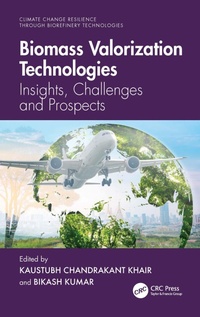
Biomass Valorization Technologies
Insights, Challenges and Prospects
1st Edition
Published on 24. October 2025
400 pages
978-1-040-43984-5 (ISBN)
Description

This book presents a multifaceted examination of biomass valorization, biofuel, and bioenergy across diverse sectors and seeks to address the fundamental aim of advancing sustainable energy solutions while mitigating environmental challenges. It delves into the promising realm of algal biofuel production, exploring novel cultivation techniques and the potential for algae to become a game-changing clean energy source. It addresses the challenges and insights within the bioenergy and biofuels sector, laying the groundwork for understanding the complex dynamics of this field.
Provides multifaceted examination of the rapidly evolving landscape of biomass valorization, biofuel, and bioenergy across diverse sectors
Explores lignocellulosic and algal biorefineries associated technologies and processes
Elaborates critical insight into challenges of the technologies and complex dynamics of this biorefinery field
Elucidates a holistic perspective on technological innovations, and economic viability for sustainable energy generation
Illustrates policy frameworks, social viability, and ethical concerns associated with biomass based biorefinery
This book is aimed at graduate students and researchers in environmental and bioengineering.
Provides multifaceted examination of the rapidly evolving landscape of biomass valorization, biofuel, and bioenergy across diverse sectors
Explores lignocellulosic and algal biorefineries associated technologies and processes
Elaborates critical insight into challenges of the technologies and complex dynamics of this biorefinery field
Elucidates a holistic perspective on technological innovations, and economic viability for sustainable energy generation
Illustrates policy frameworks, social viability, and ethical concerns associated with biomass based biorefinery
This book is aimed at graduate students and researchers in environmental and bioengineering.
More details
Series
Edition
1. Auflage
Language
English
Place of publication
London
United Kingdom
Publishing group
Taylor & Francis Ltd
Target group
College/higher education
Professional and scholarly
Illustrations
33 Tables, black and white; 48 Line drawings, black and white; 48 Illustrations, black and white
File size
6,34 MB
ISBN-13
978-1-040-43984-5 (9781040439845)
Copyright in bibliographic data and cover images is held by Nielsen Book Services Limited or by the publishers or by their respective licensors: all rights reserved.
Schweitzer Classification
Other editions
Additional editions
Book
10/2025
1st Edition
CRC Press
€208.70
Shipment within 10-20 days
Persons
Dr. Kaustubh Chandrakant Khaire has been an active researcher and scientific writer for over 7 years. He received a B.Sc. degree (2014) in Biotechnology from Dr. Babasaheb Ambedkar Marathwada University, Sambhajinagar (Maharashtra), and an M.Sc. degree (2016) in Biotechnology from Devi Ahilya Vishwavidhyalaya Indore (Madhya Pradesh), India after qualifying JNU-CEEB 2014. He received an Institute Fellowship (IIT Guwahati) in July 2017 for his PhD. He also earned his Ph.D. degree (2023) in Bioenergy from the Indian Institute of Technology Guwahati (Assam), India. He received the best poster award in BSAEH-2021, Jaipur. He is a life member of the Biotech Research Society of India (BRSI); the Association of Microbiologists of India (AMI); the Society of Biological Chemists (SBC) and the Association of Carbohydrate Chemists and Technologists, India (ACCTI). His research interests include Bioenergy, Waste to wealth, Bioremediation, Environmental Microbiology, Biodegradation & Industrial Biotechnology. His journey has been driven by a curiosity to address global challenges like climate change through sustainable energy solutions. Driven by this passion, they focus on converting lignocellulosic biomass, especially agricultural and food waste, into biofuels using enzymatic saccharification and fermentation processes. His expertise lies in optimizing the production of bioethanol at a larger scale through the use of recombinant enzymes. He has published more than 15 research papers and 5 book chapters in national and international journals of repute on various aspects of Bioenergy and Biofuels.
Dr. Bikash Kumar is currently working as Assistant Professor at the Amity Institute of Biotechnology, Amity University Chhattisgarh, Raipur, India. He received his BSc (Hons-2012) and MSc (Distinction-2014) in Biotechnology and Bioinformatics from Guru Ghasidas University, Bilaspur (A Central University) and Pondicherry Central University respectively. Later, in 2014 he worked as a Junior Research Fellow at the Department of Microbiology, Central University of Rajasthan, India. In 2015 he enrolled for PhD and started his research at the Bioprocess and Bioenergy Laboratory under the research supervision of Prof Pradeep Verma from the Department of Microbiology, Central University of Rajasthan, India. Prior to this, he served as National Post-Doctoral Fellow at the Department of Biosciences and Biomedical Engineering, Indian Institute of Technology, Indore, Madhya Pradesh, India. He also worked as Research Associate at the Department of Biosciences and Bioengineering, Indian Institute of Technology Guwahati, Assam, India. His work is focused on the development of biomass pretreatment technologies, and microbial enzyme production (cellulases, laccase, xylanases) for greener energy and environment. The work has resulted in publications of more than 46+ research articles, review papers, and book chapters. He has edited 2 books for Elsevier and Springer. He has provided Editorial assistance to his PhD supervisor Prof Pradeep Verma in 11 books for CRC Press, Elsevier, and Springer and has been acknowledged. His work has attracted significant impact which is evident from 2976 citations with h-index - 25, i-10- index-29. He is a life member of the Biotech Research Society of India (BRSI); the Association of Microbiologists of India (AMI); the Mycological Society of India (MSI) and the Association of Carbohydrate Chemists and Technologists, India (ACCTI). He has received several awards from CSIR-SRF, JNMF scholarship, DST-SERB N-PDF, and AMI-Young Scientist Award. He is a reviewer of 20+ peer-reviewed research journals for Elsevier, Wiley, MDPI, Springer, Taylor, and Francis. Dr. Kumar is Associate Editor in Frontiers in Energy Research, Guest Editor for Special Issue in Frontiers in Bioengineering and Biotechnology, BMC Biotechnology for Sustainable Materials, and Green Technology, Resilience, and Sustainability, Review Editor for Frontiers in Chemistry and Frontiers in Energy Research.
Dr. Bikash Kumar is currently working as Assistant Professor at the Amity Institute of Biotechnology, Amity University Chhattisgarh, Raipur, India. He received his BSc (Hons-2012) and MSc (Distinction-2014) in Biotechnology and Bioinformatics from Guru Ghasidas University, Bilaspur (A Central University) and Pondicherry Central University respectively. Later, in 2014 he worked as a Junior Research Fellow at the Department of Microbiology, Central University of Rajasthan, India. In 2015 he enrolled for PhD and started his research at the Bioprocess and Bioenergy Laboratory under the research supervision of Prof Pradeep Verma from the Department of Microbiology, Central University of Rajasthan, India. Prior to this, he served as National Post-Doctoral Fellow at the Department of Biosciences and Biomedical Engineering, Indian Institute of Technology, Indore, Madhya Pradesh, India. He also worked as Research Associate at the Department of Biosciences and Bioengineering, Indian Institute of Technology Guwahati, Assam, India. His work is focused on the development of biomass pretreatment technologies, and microbial enzyme production (cellulases, laccase, xylanases) for greener energy and environment. The work has resulted in publications of more than 46+ research articles, review papers, and book chapters. He has edited 2 books for Elsevier and Springer. He has provided Editorial assistance to his PhD supervisor Prof Pradeep Verma in 11 books for CRC Press, Elsevier, and Springer and has been acknowledged. His work has attracted significant impact which is evident from 2976 citations with h-index - 25, i-10- index-29. He is a life member of the Biotech Research Society of India (BRSI); the Association of Microbiologists of India (AMI); the Mycological Society of India (MSI) and the Association of Carbohydrate Chemists and Technologists, India (ACCTI). He has received several awards from CSIR-SRF, JNMF scholarship, DST-SERB N-PDF, and AMI-Young Scientist Award. He is a reviewer of 20+ peer-reviewed research journals for Elsevier, Wiley, MDPI, Springer, Taylor, and Francis. Dr. Kumar is Associate Editor in Frontiers in Energy Research, Guest Editor for Special Issue in Frontiers in Bioengineering and Biotechnology, BMC Biotechnology for Sustainable Materials, and Green Technology, Resilience, and Sustainability, Review Editor for Frontiers in Chemistry and Frontiers in Energy Research.
Content
Preface
Acknowledgement
About the Editors
About the Series Editor
List of Contributors
Chapter 1
Specialized energy crops for sustainable biofuel production
Tushar Singh, Nishtha Sood, Rajesh Bal, Shailja Chauhan, Ajay Kumar Chauhan
Chapter 2
Waste to Energy Technologies: Turning Trash into Power
Shruti S. Raut, Arpit Sharma, and Abha Mishra
Chapter 3
Recent Advances in Bioethanol Production from Lignocellulosic Biomass
Najya Jabeen Poolakkalodya, Suchithra Pallipratha, Kaviraj Ramesh, Chithra Manisseri
Chapter 4
Advanced Gasification Technologies for Biomass Conversion
Deepanshu Awasthi, Deepti, Tapas Kumar Patra, Nikhil Gakkhar, Amrit Pal Toor
Chapter 5
Sustainable Supercapacitors: Exploring Biochar as a Green Energy Solution
Akash Abhinav, Shreya Gupta, Amlan Das
Chapter 6
Use of Fat, Oil, and Grease Waste in Anaerobic Digestion for Biomethane Production
Ravichandra Patil, Venu Babu Borugadda, Lope Tabil, Bishnu Acharya, Ajay K. Dalai
Chapter 7
Lignocellulosic Waste Streams: A Promising Source for Novel Prebiotics via Enzymatic Conversion
Anurag R. Pujari, Rwivoo Baruah and Stephen R. Lindemann
Chapter 8
Metagenomics Applications in Enhancing Cellulase Production
Priyanka Nath* & Pooja Rana
Chapter 9
Advances in macroalgae (seaweed) biorefinery: Prospects and Challenges
Satish Kumar Nayak, S. Shek Mohamed Ibrahim, I. Eswar, S. Dinesh Kumar, Lakhya Jyoti Konwar
Chapter 10
Microalgae-Based Carbon Capture and Utilization (CCU) in Biorefineries
Thamarys Scapini, Adenise Lorenci Woiciechowski, Maria Clara Manzoki, Leonardo Jose Duda, Juliana Correa Cardoso, Walter Jose Martinez-Burgos, Helen Treichel, Julio Cesar de Carvalho, Carlos Ricardo Soccol
Chapter 11
Integrated Biorefinery Approaches for Macroalgal Biomass Valorization
Anurag AK. Sharma and Ravi S. Baghel
Chapter 12
Biofuels: Economics and Primary Challenges
Aditya Arvind Yadav, Kaustubh Chandrakant Khaire
Chapter 13
A Generalized Study on the Use of Membrane Technology for Hydrogen Gas Separation
Bhautik Gajera, Deepti1, Arghya Datta, Anil Kumar Sarma and Nikhil Gakkhar
Chapter 14
AI and Machine learning Tools for Optimization of Biomass Thermochemical Conversion and Bioprocesses
Leonardo Jose Duda, Adenise Lorenci Woiciechowski, Thamarys Scapini, Luis Alberto Junior Letti, Carlos Ricardo Soccol
Acknowledgement
About the Editors
About the Series Editor
List of Contributors
Chapter 1
Specialized energy crops for sustainable biofuel production
Tushar Singh, Nishtha Sood, Rajesh Bal, Shailja Chauhan, Ajay Kumar Chauhan
Chapter 2
Waste to Energy Technologies: Turning Trash into Power
Shruti S. Raut, Arpit Sharma, and Abha Mishra
Chapter 3
Recent Advances in Bioethanol Production from Lignocellulosic Biomass
Najya Jabeen Poolakkalodya, Suchithra Pallipratha, Kaviraj Ramesh, Chithra Manisseri
Chapter 4
Advanced Gasification Technologies for Biomass Conversion
Deepanshu Awasthi, Deepti, Tapas Kumar Patra, Nikhil Gakkhar, Amrit Pal Toor
Chapter 5
Sustainable Supercapacitors: Exploring Biochar as a Green Energy Solution
Akash Abhinav, Shreya Gupta, Amlan Das
Chapter 6
Use of Fat, Oil, and Grease Waste in Anaerobic Digestion for Biomethane Production
Ravichandra Patil, Venu Babu Borugadda, Lope Tabil, Bishnu Acharya, Ajay K. Dalai
Chapter 7
Lignocellulosic Waste Streams: A Promising Source for Novel Prebiotics via Enzymatic Conversion
Anurag R. Pujari, Rwivoo Baruah and Stephen R. Lindemann
Chapter 8
Metagenomics Applications in Enhancing Cellulase Production
Priyanka Nath* & Pooja Rana
Chapter 9
Advances in macroalgae (seaweed) biorefinery: Prospects and Challenges
Satish Kumar Nayak, S. Shek Mohamed Ibrahim, I. Eswar, S. Dinesh Kumar, Lakhya Jyoti Konwar
Chapter 10
Microalgae-Based Carbon Capture and Utilization (CCU) in Biorefineries
Thamarys Scapini, Adenise Lorenci Woiciechowski, Maria Clara Manzoki, Leonardo Jose Duda, Juliana Correa Cardoso, Walter Jose Martinez-Burgos, Helen Treichel, Julio Cesar de Carvalho, Carlos Ricardo Soccol
Chapter 11
Integrated Biorefinery Approaches for Macroalgal Biomass Valorization
Anurag AK. Sharma and Ravi S. Baghel
Chapter 12
Biofuels: Economics and Primary Challenges
Aditya Arvind Yadav, Kaustubh Chandrakant Khaire
Chapter 13
A Generalized Study on the Use of Membrane Technology for Hydrogen Gas Separation
Bhautik Gajera, Deepti1, Arghya Datta, Anil Kumar Sarma and Nikhil Gakkhar
Chapter 14
AI and Machine learning Tools for Optimization of Biomass Thermochemical Conversion and Bioprocesses
Leonardo Jose Duda, Adenise Lorenci Woiciechowski, Thamarys Scapini, Luis Alberto Junior Letti, Carlos Ricardo Soccol
