

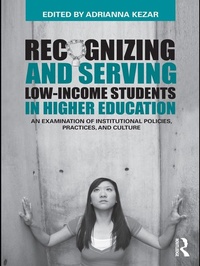
Recognizing and Serving Low-Income Students in Higher Education
An Examination of Institutional Policies, Practices, and Culture
Published on 13. September 2010
288 pages
978-1-136-96814-3 (ISBN)
Description

Written for administrators, faculty, and staff in Higher Education who are working with low income and first-generation college students, Recognizing and Serving Low-Income Students in Higher Education uncovers organizational biases that prevent post-secondary institutions from adequately serving these students. This volume offers practical guidance for adopting new or revised policies and practices that have the potential to help these students thrive.
This contributed volume is based on empirical studies that specifically examine the policies and practices of postsecondary institutions in the United States, England, and Canada. The contributing authors argue that discussions of diversity will be enriched by a better understanding of how institutional policies and practices affect low-income students. Unlike most studies on this topic, this volume focuses on institutional rather than federal, state and public policy. Institutional policies and practices have been largely ignored and this volume lifts the veil on processes that have remained hidden.
This contributed volume is based on empirical studies that specifically examine the policies and practices of postsecondary institutions in the United States, England, and Canada. The contributing authors argue that discussions of diversity will be enriched by a better understanding of how institutional policies and practices affect low-income students. Unlike most studies on this topic, this volume focuses on institutional rather than federal, state and public policy. Institutional policies and practices have been largely ignored and this volume lifts the veil on processes that have remained hidden.
Reviews / Votes
"[Recognizing and Serving Low-Income Students in Higher Education] is a valuable volume that utilizes theoretical concepts to identify, critique, and revise institutional policy and cultural practices rooted in middle and upper class traditions... this volume should be appreciated by policymakers, as well as practitioners, faculty, and graduate students...Overall, I would highly recommend this book."-Teachers College Record"The volume is an excellent addition to the library of anyone seeking a thoughtful analysis of this underappreciated topic."-Diversity & Democracy
"If the subject of equity and access for low-income students in higher education is of interest to you, this volume is essential to your collection as it challenges traditional concepts and theories, exposes new lines of inquiry, and provides suggestions for improving the lives and experiences of low-incomes students in higher education."-Education Review
More details
Language
English
Place of publication
London
United Kingdom
Publishing group
Taylor & Francis Ltd
Target group
College/higher education
Illustrations
10 s/w Tabellen, 4 s/w Zeichnungen
10 Tables, black and white; 4 Line drawings, black and white
File size
5,02 MB
ISBN-13
978-1-136-96814-3 (9781136968143)
Copyright in bibliographic data and cover images is held by Nielsen Book Services Limited or by the publishers or by their respective licensors: all rights reserved.
Schweitzer Classification
Other editions
Additional editions
Adrianna Kezar
Recognizing and Serving Low-Income Students in Higher Education
An Examination of Institutional Policies, Practices, and Culture
Book
07/2010
1st Edition
Routledge
€262.40
Shipment within 15-20 days
Adrianna Kezar
Recognizing and Serving Low-Income Students in Higher Education
An Examination of Institutional Policies, Practices, and Culture
Book
07/2010
1st Edition
Routledge
€72.50
Shipment within 15-20 days
Person
Adrianna Kezar is Associate Professor for Higher Education at the University of Southern California.
Content
Preface, Adrianna Kezar with assistance from MaryBeth Walpole
Part I: Background and Context
1. Rethinking Post-secondary Institutions for Low-Income Student Success: The Power of Post-structural Theory, Adrianna Kezar
Part II: Access to Postsecondary Institutions
2. Lesson Learned from Indiana's Twenty-first Century Scholars Program: Toward a Comprehensive Approach to Improving College Preparation and Access for Low-Income Students, Edward St. John
3. Chances and Choices of Low-Income Students in Canada and England: A Post-Structuralist Discussion of Early Intervention, Tony Chambers and Fiona Deller
4. Showing Them the Money: The Role of Institutional Financial Aid Policies and Communication Strategies in Attracting Low-Income Students, Laura Perna, Valerie Lundy-Wagner, April Yee, Leykia Brill, and Teran Tadal
Part III: Entering and Transitioning to College
5. Academics, Campus Administration, and Social Interaction: Examining Campus Structures using Post-Structural Theory, MaryBeth Walpole
6. Strangers in a Strange Land: Low-Income Students and the Transition to College, Julia Colyar
7. Welfare Students in Community Colleges: Policy and Policy Implementation as Barriers to Educational Attainment, John S. Levin, Virginia Montero-Hernandez, Christine Cerven, and Genevieve Shaker
Part IV: Persistence, Success, and Graduation
8. Demography is Not Destiny: What Colleges and Universities Can Do to Improve Persistence Among Low-Income Students, Jennifer Engle and Mary G. Lynch
9. Minority Serving Institutions - What Can We Learn? Alisa Cunningham and Lacey Leegwater
10. The Hidden Curriculum: The Difficulty of Infusing Financial Education, Adrianna Kezar and Hannah Yang
Part V: Transfer and Moving On To Graduate School
11. Rethinking Transfer Policy and Practices, Alicia Dowd
12. Post-Baccalaureate Preparation and Access for Low-Income Students and the Myth of a Level Playing Field, Alex Jun and Kristin Paredes-Collins
13. Re-Orienting Our Understanding of Low-Income Students, Adrianna Kezar
List of Contributors
Part I: Background and Context
1. Rethinking Post-secondary Institutions for Low-Income Student Success: The Power of Post-structural Theory, Adrianna Kezar
Part II: Access to Postsecondary Institutions
2. Lesson Learned from Indiana's Twenty-first Century Scholars Program: Toward a Comprehensive Approach to Improving College Preparation and Access for Low-Income Students, Edward St. John
3. Chances and Choices of Low-Income Students in Canada and England: A Post-Structuralist Discussion of Early Intervention, Tony Chambers and Fiona Deller
4. Showing Them the Money: The Role of Institutional Financial Aid Policies and Communication Strategies in Attracting Low-Income Students, Laura Perna, Valerie Lundy-Wagner, April Yee, Leykia Brill, and Teran Tadal
Part III: Entering and Transitioning to College
5. Academics, Campus Administration, and Social Interaction: Examining Campus Structures using Post-Structural Theory, MaryBeth Walpole
6. Strangers in a Strange Land: Low-Income Students and the Transition to College, Julia Colyar
7. Welfare Students in Community Colleges: Policy and Policy Implementation as Barriers to Educational Attainment, John S. Levin, Virginia Montero-Hernandez, Christine Cerven, and Genevieve Shaker
Part IV: Persistence, Success, and Graduation
8. Demography is Not Destiny: What Colleges and Universities Can Do to Improve Persistence Among Low-Income Students, Jennifer Engle and Mary G. Lynch
9. Minority Serving Institutions - What Can We Learn? Alisa Cunningham and Lacey Leegwater
10. The Hidden Curriculum: The Difficulty of Infusing Financial Education, Adrianna Kezar and Hannah Yang
Part V: Transfer and Moving On To Graduate School
11. Rethinking Transfer Policy and Practices, Alicia Dowd
12. Post-Baccalaureate Preparation and Access for Low-Income Students and the Myth of a Level Playing Field, Alex Jun and Kristin Paredes-Collins
13. Re-Orienting Our Understanding of Low-Income Students, Adrianna Kezar
List of Contributors
