

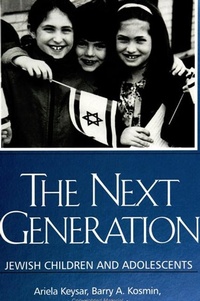
The Next Generation
Jewish Children and Adolescents
Published on 1. February 2012
170 pages
978-0-7914-9277-2 (ISBN)
Description

Focusing on the more than one million Jewish children and adolescents living in the United States, this book questions the future of the Jewish community's next generation. The Next Generation offers valuable analyses of the critical issues concerning the entire United States Jewish community. Drawing on the 1990 National Jewish Population Survey (NJPS), the book questions the future of the Jewish community's next generation. Children are the key to the future and continuity of any social, religious or ethnic group. But researchers point to some disturbing trends. A recent study shows that in families with a Jewish and a non-Jewish parent, only 31 percent of children are raised Jewish; only 24 percent of children living in a single-parent household have received any Jewish education; and only about half of all Jewish children today live with two Jewish parents. The authors probe topics that have crucial policy implications for dealing with the new conditions of the American Jewish populace including the demographic and social characteristics of American Jewish children; the effect on children's socialization due to differences in parental religious background; the role of household composition and family structure on the way Jewish children are raised; the impact of children on the Jewishness of their families; and the demographic projects for the younger Jewish population.
More details
Other editions
Additional editions
Ariela Keysar | Barry A. Kosmin | Jeffrey Scheckner
The Next Generation
Jewish Children and Adolescents
Book
06/2000
State University of New York Press
€109.91
Article exhausted; check different version

Ariela Keysar | Barry A. Kosmin | Jeffrey Scheckner
The Next Generation
Jewish Children and Adolescents
Book
06/2000
State University of New York Press
€33.00
Shipment within 10-20 days
Persons
Ariela Keysar is a Research Fellow at the North American Jewish Data Bank at the Graduate Center of the City University of New York. Jeffrey Scheckner is the administrator of this institution and is also Research Consultant for United Jewish Communities (formerly the Council of Jewish Federations.) Barry Kosmin is Director of the Institute for Jewish Policy Research in London, England. Formerly he was Director of Research at the Council of Jewish Federations and Director of the North American Jewish Data Bank.
Content
Tables and Figures
Foreword
Acknowledgments
Introduction and Plan for Analysis
Chapter One
Theory and Methodology
Religious SocializationChapter Two
Socialization of Children
Adolescent Development
Socialization into a Subculture
The 1990 NJPS Survey Methodology
Definitions and Qualifying Points
The Demography of the Jewish Child Population
IntroductionChapter Three
Age Distribution
Demographic Profile by Category of Jewishness
Age Distribution by Category of Jewishness
Age Distribution of the Core Jewish Child Population in Comparison with the White U.S. Child Population
Sex Ratios of Core Jewish Children
Geographic Distribution and Category of Jewishness by Census Region
Demographic Trends of the Jewish Child Population
Summary
The Impact of Home Background on the Socialization of Children
IntroductionChapter Four
Household Structure: Comparative Data of the Jewish and U.S. White Child Populations
Jewish Single-Parent Household Patterns
Parental Marriage Patterns and Custody Arrangements
Non-Normative Household Patterns
Household Composition and Per Capita Income
Working Mothers and Household Composition
Education of the Parents
Private versus Public Schooling for Children
Patterns of Jewish Education of the Children
Household Composition and Jewish Characteristics of the Family
Summary
Parental Decision Making Regarding Children's Religious Socialization
IntroductionChapter Five
The Jewish Child Population in Interfaith Families-the Data
Theoretical Framework
The Theory in Its Social Context
Data
Hypotheses
Methodology
Findings
Flowchart Analysis of CHAID Results
Multivariate Analysis
Beyond Religious Identity
Summary
Living in a Unique Jewish Environment: The Children of New York
IntroductionChapter Six
The Demographic Characteristics of the Children of New York
The Religious and Social Jewish Environment of Children in New York and the United States
Summary
It Takes a Whole Community to Raise Jewish Children
IntroductionChapter Seven
Day-Care and After-School Programs under Jewish and Non-Jewish Auspices
Adoptive Families
Participation in Jewish Camping
Participation in Jewish Youth Groups
Summary
Population Projections for U.S. Jewish Children
IntroductionChapter Eight
The Potential Jewish Child Population in 1990
Assumptions of the Demographic Projection Model
Projected Child Population: 1995-Demographic and Sociological Scenarios
1995 Projection-The Impact of Intermarriage
Year 2000 Projection-The Impact of Intermarriage
The Decline in Potential Mothers
Raising "Effectively" Jewish Children in Mixed Households in 1995 and 2000
Summary
Conclusion
From a Community PerspectiveAppendix
The Methodology of the National Jewish Population Survey
by Joseph Waksberg
Notes
Works Cited
About the Authors
Subject Index
Index of Names
