

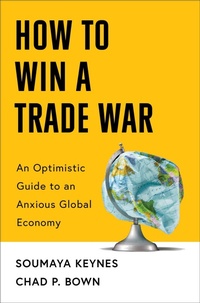
How to Win a Trade War
An Optimistic Guide to an Anxious Global Economy
Published on 26. May 2026
288 pages
978-1-6682-2133-4 (ISBN)
Description

An irreverent and invaluable guide to our new era of economic competition, written by Financial Times columnist and podcaster Soumaya Keynes and Chad P. Bown of the Peterson Institute for International Economics.
We used to take trade for granted. Trillions of dollars of goods and services crossed borders each year, made possible by a global, rules-based system. Nobody paid too much attention to supply chains: they just worked.
Now we are in an era of trade conflict and can no longer avoid the fight. Trump's latest tariff announcement can jolt markets, push prices up, and sour decades-long alliances. China's export restrictions on rare earths could bring the West's car production to a halt. Curbs on trade in cutting-edge chips could determine who wins the AI race.
Keynes and Bown argue that the rules of the game have been abandoned, and a different strategy is needed. Yearning for the old approach to start working again isn't an option. Countries must adapt, which means learning from history, economics, and from each other?including China. The stakes couldn't be higher.
The authors explore the history, the players, and the rules of trade, and consider how we can prepare for what the future might hold. What would all-out economic warfare look like? Could trade wars lead to hot wars? What can the West learn from China?
Accessible and leavened with an appealing wit, this book explains how to win a trade war, where ?winning? might mean minimizing the losses, and the weapons that we wield?subsidies, stockpiles, export restrictions and, of course, tariffs?have the potential to hurt us, too.
How to Win a Trade War is the guide to one of the global economy's biggest challenges.
We used to take trade for granted. Trillions of dollars of goods and services crossed borders each year, made possible by a global, rules-based system. Nobody paid too much attention to supply chains: they just worked.
Now we are in an era of trade conflict and can no longer avoid the fight. Trump's latest tariff announcement can jolt markets, push prices up, and sour decades-long alliances. China's export restrictions on rare earths could bring the West's car production to a halt. Curbs on trade in cutting-edge chips could determine who wins the AI race.
Keynes and Bown argue that the rules of the game have been abandoned, and a different strategy is needed. Yearning for the old approach to start working again isn't an option. Countries must adapt, which means learning from history, economics, and from each other?including China. The stakes couldn't be higher.
The authors explore the history, the players, and the rules of trade, and consider how we can prepare for what the future might hold. What would all-out economic warfare look like? Could trade wars lead to hot wars? What can the West learn from China?
Accessible and leavened with an appealing wit, this book explains how to win a trade war, where ?winning? might mean minimizing the losses, and the weapons that we wield?subsidies, stockpiles, export restrictions and, of course, tariffs?have the potential to hurt us, too.
How to Win a Trade War is the guide to one of the global economy's biggest challenges.
More details
Other editions
Additional editions
Soumaya Keynes | Chad P. Bown
How to Win a Trade War
An Optimistic Guide to an Anxious Global Economy
Book
05/2026
Simon & Schuster
€28.50
Shipment within 3-4 weeks
Persons
Soumaya Keynes is an economics columnist at the Financial Times and host of the podcast The Economics Show with Soumaya Keynes. Before joining the Financial Times in July 2023, she spent eight years at The Economist, where she won an award from the Association of Business Journalists for her commentary on the first Trump administration's trade policy. She cofounded the Trade Talks podcast during the Trump administration's first term and cohosted The Economist's Money Talks podcast. She started her career as an economist working at the UK Treasury and then as a researcher at the Institute for Fiscal Studies. She has an undergraduate degree and masters in economics from the University of Cambridge.
Chad Bown is the Reginald Jones Senior Fellow at the Peterson Institute for International Economics and host of the Trade Talks podcast. He has performed public service in two US administrations, as Chief Economist at the Department of State in the Biden-Harris administration and as Senior Economist in the White House on President Obama's Council of Economic Advisors. He has also been on the research staff at the World Bank and World Trade Organization, and was on the faculty at Brandeis University for twelve years and was a tenured professor of economics. He received a BA magna cum laude in economics and international relations from Bucknell University and a PhD in economics from the University of Wisconsin-Madison.
Chad Bown is the Reginald Jones Senior Fellow at the Peterson Institute for International Economics and host of the Trade Talks podcast. He has performed public service in two US administrations, as Chief Economist at the Department of State in the Biden-Harris administration and as Senior Economist in the White House on President Obama's Council of Economic Advisors. He has also been on the research staff at the World Bank and World Trade Organization, and was on the faculty at Brandeis University for twelve years and was a tenured professor of economics. He received a BA magna cum laude in economics and international relations from Bucknell University and a PhD in economics from the University of Wisconsin-Madison.
