
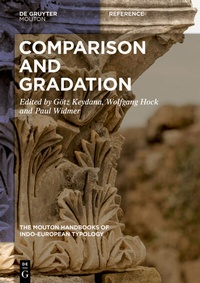
Comparison and Gradation in Indo-European
Description
Alles über E-Books | Antworten auf Fragen rund um E-Books, Kopierschutz und Dateiformate finden Sie in unserem Info- & Hilfebereich.
The ability to compare is fundamental to human cognition. Expressing various types of comparison is thus essential to any language. The present volume presents detailed grammatical descriptions of how comparison and gradation are expressed in ancient Indo-European languages. The detailed chapters devoted to the individual languages go far beyond standard handbook knowledge. Each chapter is structured the same way to facilitate cross-reference and (typological) comparison. The data are presented in a top-down fashion and in a format easily accessible to the linguistic community.
The topics covered are similatives, equatives, comparatives, superlatives, elatives, and excessives. Each type of comparison is illustrated with glossed examples of all its attested grammatical realizations.
The book is an indispensable tool for typologists, historical linguists, and students of the syntax and morphosyntax of comparison.
More details
Other editions
Additional editions
Persons
Götz Keydana , Georg-August-University Göttingen; Wolfgang Hock , Humboldt-University Berlin; Paul Widmer , University of Zurich.

System requirements
File format: ePUB
Copy protection: Watermark-DRM (Digital Rights Management)
System requirements:
- Computer (Windows; MacOS X; Linux): Use a reading software that can process the file format ePUB: e.g., Adobe Digital Editions or FBReader – both free (see eBook Help).
- Tablet/Smartphone (Android; iOS): Before downloading, install the free app Adobe Digital Editions (see eBook Help).
- E-reader: Bookeen, Kobo, Pocketbook, Sony, Tolino and many more (not Kindle).
The file format ePUB works well for novels and non-fiction books – i.e., „flowing” text without complex layout. On an e-reader or smartphone, line and page breaks automatically adjust to fit the small displays.
This eBook uses Watermark-DRM, a „soft” copy protection. This means that there are no technical restrictions to prevent illegal distribution. However, there is a personalised watermark embedded in the eBook that can be used to identify the purchaser of the eBook in the event of misuse and to provide evidence for legal purposes.
For more information, see our eBook Help page.