

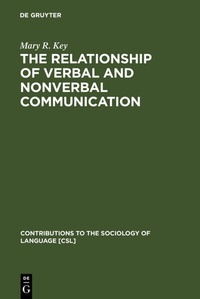
The Relationship of Verbal and Nonverbal Communication
Relationship of Verbal and Nonverbal Communication
1st Edition
Published on 2. August 2011
XVI, 388 pages
978-3-11-081309-8 (ISBN)
Description

No detailed description available for "The Relationship of Verbal and Nonverbal Communication".
More details
Series
Edition
2nd printing 1981. Reprint 2011
Language
English
Place of publication
Berlin/Boston
Germany
Publishing group
de Gruyter Mouton
Target group
Professional and scholarly
US School Grade: College Graduate Student
Illustrations
21 Abbildungen, 12 s/w Tabellen
21 ill., 12 tbl.
File size
15,53 MB
ISBN-13
978-3-11-081309-8 (9783110813098)
Schweitzer Classification
Other editions
Additional editions
Book
09/1980
1st Edition
De Gruyter Mouton
€119.95
Shipment within 10-20 days
Book
09/1980
1st Edition
De Gruyter Mouton
€99.95
Article exhausted; check for reprint
Book
01/1980
1st Edition
De Gruyter Mouton
€169.95
Article exhausted; check different version
Content
- Intro
- Preface
- List of Contributors
- PART I. LANGUAGE AND NONVERBAL BEHAVIOR AS ORGANIZERS OF SOCIAL SYSTEMS
- Language and Nonverbal Behavior as Organizers of Social Systems
- A. Behavioral Aspects of Interaction
- B. The Suprasegmentals of Interaction
- C. Organization of Language and Nonverbal Behavior
- D. Acquisition of Communicative Behavior
- E. Theoretical Approaches to Human Interaction
- PART II. THE SUPRASEGMENTALS OF INTERACTION
- Accents That Determine Stress
- The Relation of Interactional Synchrony to Cognitive and Emotional Processes
- The Rhythmic Basis of Interactional Micro-Synchrony
- Proto-Rhythms from Nonverbal to Language and Musical Acquisition
- A Method for Film Analysis of Ethnic Communication Style
- Chronemics and the Verbal-Nonverbal Interface
- The Role of Rhythm in 'Cementing' Meaning in Piman Songs
- PART III. ORGANIZATION OF LANGUAGE AND NONVERBAL BEHAVIOR
- Some Notes on Analyzing Data on Face-to-Face Interaction
- Requesting, Giving, and Taking: The Relationship Between Verbal and Nonverbal Behavior in the Speech Community of the Eipo, Irian Jaya (West New Guinea)
- Preverbal Communication and Linguistic Evolution
- Interruptions of Continuity and Other Features Characteristic of Spontaneous Talk
- The Nonverbal Context of Verbal Listener Responses
- Gesticulation and Speech: Two Aspects of the Process of Utterance
- Things and Words
- PART IV. ACQUISITION OF COMMUNICATIVE BEHAVIOR
- The Infant's Communicative Competencies and the Achievement of Intersubjectivity
- 'Acquisition' of Communication Competence: Is Language Enough?
- Silence is Golden? The Changing Role of Non-Talk in Preschool Conversations
- PART V. THEORETICAL APPROACHES TO HUMAN INTERACTION
- Dionysians and Apollonians
- The Analogy of Linguistics with Chemistry
- Why Electromagnetism is the Only Causal 'Spook' Required to Explain Completely Any Human Behavior or Institution
- Bibliography
- Index
