
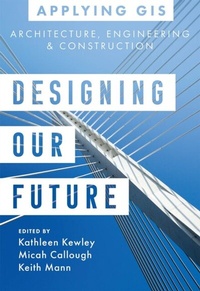
Designing Our Future
Description
Alles über E-Books | Antworten auf Fragen rund um E-Books, Kopierschutz und Dateiformate finden Sie in unserem Info- & Hilfebereich.
APPLYING GIS
DESIGNING OUR FUTURE
GIS FOR ARCHITECTURE, ENGINEERING & CONSTRUCTION
Apply the geographic approach to architecture, engineering, and construction (AEC).
Location intelligence is changing how land development and large infrastructure undertakings take shape. From new residential construction to planning a modern urban experience to building a high-speed rail system, a geographic approach helps pave the way to better, more sustainable designs.
In Designing Our Future: GIS for AEC, see how the AEC industry is implementing geographic information systems (GIS) to improve workflows, bring context to projects, and increase collaboration between governments, contractors, partners, and the public. With GIS, architects, engineers, and construction professionals are discovering new efficiencies, gaining deeper insights about complex projects, and transforming the way they plan, design, build, and operate in the built and natural environment.
Edited by Kathleen Kewley and Micah Callough, Esri Global Business Development, and Keith Mann, Esri Press.
Applying GIS
The Applying GIS series explains how to become a spatial thinker, with ideas and strategies for building location intelligence into your profession, industry, or discipline. Each pocket-size book is divided into relevant topic areas that include set of case studies and a roadmap for getting started with GIS.
All prices
More details
Other editions
Additional editions
Persons
Content
Introduction
Stories and strategies
How to use this book
Part 1: Environment and sustainability
Part 2: Design and engineering
Part 3: Health equity
Part 4: Construction and performance
Part 5: Assets and infrastructure
Next steps
Contributors

System requirements
File format: ePUB
Copy protection: Adobe-DRM (Digital Rights Management)
System requirements:
- Computer (Windows; MacOS X; Linux): Install the free reader Adobe Digital Editions prior to download (see eBook Help).
- Tablet/smartphone (Android; iOS): Install the free app Adobe Digital Editions or the app PocketBook before downloading (see eBook Help).
- E-reader: Bookeen, Kobo, Pocketbook, Sony, Tolino and many more (not Kindle).
The file format ePub works well for novels and non-fiction books – i.e., „flowing” text without complex layout. On an e-reader or smartphone, line and page breaks automatically adjust to fit the small displays.
This eBook uses Adobe-DRM, a „hard” copy protection. If the necessary requirements are not met, unfortunately you will not be able to open the eBook. You will therefore need to prepare your reading hardware before downloading.
Please note: We strongly recommend that you authorise using your personal Adobe ID after installation of any reading software.
For more information, see our ebook Help page.
File format: ePUB
Copy protection: Watermark-DRM (Digital Rights Management)
System requirements:
- Computer (Windows; MacOS X; Linux): Use a reading software that can process the file format ePUB: e.g., Adobe Digital Editions or FBReader – both free (see eBook Help).
- Tablet/Smartphone (Android; iOS): Before downloading, install the free app Adobe Digital Editions (see eBook Help).
- E-reader: Bookeen, Kobo, Pocketbook, Sony, Tolino and many more (not Kindle).
The file format ePUB works well for novels and non-fiction books – i.e., „flowing” text without complex layout. On an e-reader or smartphone, line and page breaks automatically adjust to fit the small displays.
This eBook uses Watermark-DRM, a „soft” copy protection. This means that there are no technical restrictions to prevent illegal distribution. However, there is a personalised watermark embedded in the eBook that can be used to identify the purchaser of the eBook in the event of misuse and to provide evidence for legal purposes.
For more information, see our eBook Help page.