

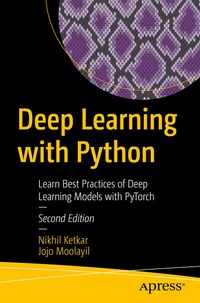
Deep Learning with Python
Learn Best Practices of Deep Learning Models with PyTorch
2nd Edition
Published on 9. April 2021
XVII, 306 pages
978-1-4842-5364-9 (ISBN)
Description

Master the practical aspects of implementing deep learning solutions with PyTorch, using a hands-on approach to understanding both theory and practice. This updated edition will prepare you for applying deep learning to real world problems with a sound theoretical foundation and practical know-how with PyTorch, a platform developed by Facebook's Artificial Intelligence Research Group.
You'll start with a perspective on how and why deep learning with PyTorch has emerged as an path-breaking framework with a set of tools and techniques to solve real-world problems. Next, the book will ground you with the mathematical fundamentals of linear algebra, vector calculus, probability and optimization. Having established this foundation, you'll move on to key components and functionality of PyTorch including layers, loss functions and optimization algorithms.
You'll also gain an understanding of Graphical Processing Unit (GPU) based computation, which is essential for training deep learning models. All the key architectures in deep learning are covered, including feedforward networks, convolution neural networks, recurrent neural networks, long short-term memory networks, autoencoders and generative adversarial networks. Backed by a number of tricks of the trade for training and optimizing deep learning models, this edition of Deep Learning with Python explains the best practices in taking these models to production with PyTorch.
What You'll Learn
Beginners with a working knowledge of Python who want to understand Deep Learning in a practical, hands-on manner.
You'll start with a perspective on how and why deep learning with PyTorch has emerged as an path-breaking framework with a set of tools and techniques to solve real-world problems. Next, the book will ground you with the mathematical fundamentals of linear algebra, vector calculus, probability and optimization. Having established this foundation, you'll move on to key components and functionality of PyTorch including layers, loss functions and optimization algorithms.
You'll also gain an understanding of Graphical Processing Unit (GPU) based computation, which is essential for training deep learning models. All the key architectures in deep learning are covered, including feedforward networks, convolution neural networks, recurrent neural networks, long short-term memory networks, autoencoders and generative adversarial networks. Backed by a number of tricks of the trade for training and optimizing deep learning models, this edition of Deep Learning with Python explains the best practices in taking these models to production with PyTorch.
What You'll Learn
- Review machine learning fundamentals such as overfitting, underfitting, and regularization.
- Understand deep learning fundamentals such as feed-forward networks, convolution neural networks, recurrent neural networks, automatic differentiation, and stochastic gradient descent.
- Apply in-depth linear algebra with PyTorch
- Explore PyTorch fundamentals andits building blocks
- Work with tuning and optimizing models
Beginners with a working knowledge of Python who want to understand Deep Learning in a practical, hands-on manner.
More details
Series
Edition
2nd ed.
Language
English
Place of publication
Berkeley
United States
Publishing group
APRESS
Target group
Professional and scholarly
Product notice
Reflowable
Illustrations
XVII, 306 p. 82 illus.
File size
5,51 MB
ISBN-13
978-1-4842-5364-9 (9781484253649)
DOI
10.1007/978-1-4842-5364-9
Schweitzer Classification
Other editions
Additional editions
Nikhil Ketkar | Jojo Moolayil
Deep Learning with Python
Learn Best Practices of Deep Learning Models with PyTorch
Book
04/2021
2nd Edition
APress
€37.44
Shipment within 15-20 days
Previous edition
E-Book
04/2017
APress
€79.99
Available for download
Persons
Nikhil S. Ketkar currently leads the Machine Learning Platform team at Flipkart, India's largest e-commerce company. He received his Ph.D. from Washington State University. Following that he conducted postdoctoral research at University of North Carolina at Charlotte, which was followed by a brief stint in high frequency trading at Transmaket in Chicago. More recently he led the data mining team in Guavus, a startup doing big data analytics in the telecom domain and Indix, a startup doing data science in the e-commerce domain. His research interests include machine learning and graph theory.
Jojo Moolayil is an artificial intelligence, deep learning, machine learning, and decision science professional with over five years of industrial experience and is a published author of the book Smarter Decisions - The Intersection of IoT and Decision Science. He has worked with several industry leaders on high-impact and critical data science and machine learning projects across multiple verticals. He is currently associated with Amazon Web Services as a research scientist. He was born and raised in Pune, India and graduated from the University of Pune with a major in Information Technology Engineering. He started his career with Mu Sigma Inc., the world's largest pure-play analytics provider and worked with the leaders of many Fortune 50 clients. He later worked with Flutura - an IoT analytics startup and GE. He currently resides in Vancouver, BC. Apart from writing books on decision science and IoT, Jojo has also been a technical reviewer for various books on machine learning, deep learning and business analytics with Apress and Packt publications. He is an active data science tutor and maintains a blog at http://blog.jojomoolayil.com.
Jojo Moolayil is an artificial intelligence, deep learning, machine learning, and decision science professional with over five years of industrial experience and is a published author of the book Smarter Decisions - The Intersection of IoT and Decision Science. He has worked with several industry leaders on high-impact and critical data science and machine learning projects across multiple verticals. He is currently associated with Amazon Web Services as a research scientist. He was born and raised in Pune, India and graduated from the University of Pune with a major in Information Technology Engineering. He started his career with Mu Sigma Inc., the world's largest pure-play analytics provider and worked with the leaders of many Fortune 50 clients. He later worked with Flutura - an IoT analytics startup and GE. He currently resides in Vancouver, BC. Apart from writing books on decision science and IoT, Jojo has also been a technical reviewer for various books on machine learning, deep learning and business analytics with Apress and Packt publications. He is an active data science tutor and maintains a blog at http://blog.jojomoolayil.com.
Content
Chapter 1 - Introduction Deep Learning.- Chapter 2 - Introduction to PyTorch.- Chapter 3- Feed Forward Networks.- Chapter 4 - Automatic Differentiation in Deep Learning.- Chapter 5 - Training Deep Neural Networks.- Chapter 6 - Convolutional Neural Networks.- Chapter 7 - Recurrent Neural Networks.- Chapter 8 - Recent advances in Deep Learning.
