

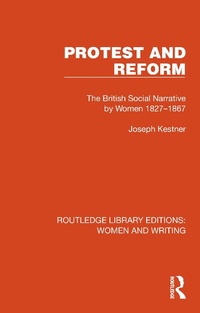
Protest and Reform
The British Social Narrative by Women 1827-1867
1st Edition
Published on 12. September 2022
254 pages
978-1-000-65305-2 (ISBN)
Description

The social novel in nineteenth-century Britain has been considered the effort of a predominantly male canon of writers. In this ground-breaking study, originally published in 1985, Joseph Kestner challenges that assumption, arguing that it was a succession of female writers - women often meriting only a footnote in literary history - who initiated and advanced the tradition of using narrative fiction to register protest, expose abuses, and promote reform.
Kestner explores the contributions to Victorian social policy by the fiction of these neglected authors (Hannah More, Elizabeth Stone, Frances Trollope, Charlotte Tonna, Camilla Toulmin, Geraldine Jewsbury, Fanny Mayne, Julia Kavanagh, Dinah Mulock Craik) as well as more prominent female authors (Maria Edgeworth, Harriet Martineau, Elizabeth Gaskell, Charlotte Bronte, George Eliot) and male writers (Charles Dickens, Benjamin Disraeli, G. M. W. Reynolds, John Galt, Charles Kingsley).
This is an important work for every scholar, student, and reader of nineteenth-century literature and history, women's studies, and sociology. Kestner's book will encourage a reappraisal of women writers and their role in Victorian Britain and advance a long-needed reassessment of the traditional canon of nineteenth-century literature.
In rediscovering the literary and social contribution of these undervalued writers, Kestner provides a chronological assessment of the female social narrative. Tracing the form from its inception in the late eighteenth century to its evolution in the 1830s and 1840s and to its maturation in the 1850s and 1860s, he reveals the continuity of a developing literary tradition that included early writers like More and later practitioners like Tonna, Stone, Jewsbury, and Mayne. In the process Kestner establishes a new basis for assessing major writers such as Eliot and Gaskell. In consciously using fiction for social protest purposes, these novelists were responding to a society marked by transition. Their common emphasis was on the plight of the disenfranchised in a new era and the need for manifold reforms in such areas as housing, labor legislation, education, childcare, access to employment, sanitation, and marital law. Reform was necessary as England evolved from an agricultural to an industrial economic system.
Kestner uses evidence such as Parliamentary investigations and early social reporting by James Kay, William Cooke Taylor, Peter Gaskell, and others to assess the validity of the protests of these novelists. Their impassioned novels supplemented the legislative findings of male-dominated Parliamentary committees and reached an audience, often specifically addressed as female, that government documents could not. Galvanizing readers through their narratives, the socially conscious female writers gained new political influence that contributed to legislative process.
These writers also won artistic ground, commanding a serious literary attention and respect never before accorded women writers. It is that serious literary status, Kestner argues, unjustly neglected for so long, that must be reclaimed today as we rethink and revise our view of Victorian fiction.
Kestner explores the contributions to Victorian social policy by the fiction of these neglected authors (Hannah More, Elizabeth Stone, Frances Trollope, Charlotte Tonna, Camilla Toulmin, Geraldine Jewsbury, Fanny Mayne, Julia Kavanagh, Dinah Mulock Craik) as well as more prominent female authors (Maria Edgeworth, Harriet Martineau, Elizabeth Gaskell, Charlotte Bronte, George Eliot) and male writers (Charles Dickens, Benjamin Disraeli, G. M. W. Reynolds, John Galt, Charles Kingsley).
This is an important work for every scholar, student, and reader of nineteenth-century literature and history, women's studies, and sociology. Kestner's book will encourage a reappraisal of women writers and their role in Victorian Britain and advance a long-needed reassessment of the traditional canon of nineteenth-century literature.
In rediscovering the literary and social contribution of these undervalued writers, Kestner provides a chronological assessment of the female social narrative. Tracing the form from its inception in the late eighteenth century to its evolution in the 1830s and 1840s and to its maturation in the 1850s and 1860s, he reveals the continuity of a developing literary tradition that included early writers like More and later practitioners like Tonna, Stone, Jewsbury, and Mayne. In the process Kestner establishes a new basis for assessing major writers such as Eliot and Gaskell. In consciously using fiction for social protest purposes, these novelists were responding to a society marked by transition. Their common emphasis was on the plight of the disenfranchised in a new era and the need for manifold reforms in such areas as housing, labor legislation, education, childcare, access to employment, sanitation, and marital law. Reform was necessary as England evolved from an agricultural to an industrial economic system.
Kestner uses evidence such as Parliamentary investigations and early social reporting by James Kay, William Cooke Taylor, Peter Gaskell, and others to assess the validity of the protests of these novelists. Their impassioned novels supplemented the legislative findings of male-dominated Parliamentary committees and reached an audience, often specifically addressed as female, that government documents could not. Galvanizing readers through their narratives, the socially conscious female writers gained new political influence that contributed to legislative process.
These writers also won artistic ground, commanding a serious literary attention and respect never before accorded women writers. It is that serious literary status, Kestner argues, unjustly neglected for so long, that must be reclaimed today as we rethink and revise our view of Victorian fiction.
More details
Series
Edition
1. Auflage
Language
English
Place of publication
London
United Kingdom
Publishing group
Taylor & Francis Ltd
Target group
College/higher education
Professional and scholarly
Product notice
Reflowable
ISBN-13
978-1-000-65305-2 (9781000653052)
Copyright in bibliographic data and cover images is held by Nielsen Book Services Limited or by the publishers or by their respective licensors: all rights reserved.
Schweitzer Classification
Other editions
Additional editions

Book
09/2024
1st Edition
Routledge
€49.80
Shipment within 10-20 days

Book
09/2022
1st Edition
Routledge
€166.60
Shipment within 10-20 days
Person
Joseph Kestner
Content
Acknowledgments, 1. The Social Narrative, 2. The Early Decades, 3. The Eighteen Forties, 4. The Eighteen Fifties, 5. The Achievement, Bibliography, Index
