

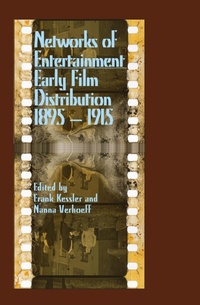
Networks of Entertainment
Early Film Distribution 1895-1915
Published on 5. February 2008
300 pages
978-0-86196-937-1 (ISBN)
Description

Essays by prominent scholars examining film distribution in the early years of cinema.
This collection of essays explores the complex issue of film distribution from the invention of cinema into the 1910s. From regional distribution networks to international marketing strategies, from the analysis of distribution catalogs to case studies on individual distributors, these essays written by well-known specialists in the field discuss the intriguing question of how films came to meet their audiences.
Contributors include Richard Abel, Marta Braun, Joseph Garncarz, André Gaudreault, François Jost, Charlie Keil, Martin Loiperdinger, Viva Paci, Wanda Strauven, Gregory Waller, and many more.
This collection of essays explores the complex issue of film distribution from the invention of cinema into the 1910s. From regional distribution networks to international marketing strategies, from the analysis of distribution catalogs to case studies on individual distributors, these essays written by well-known specialists in the field discuss the intriguing question of how films came to meet their audiences.
Contributors include Richard Abel, Marta Braun, Joseph Garncarz, André Gaudreault, François Jost, Charlie Keil, Martin Loiperdinger, Viva Paci, Wanda Strauven, Gregory Waller, and many more.
More details
Language
English
Place of publication
New York
United States
Target group
Professional and scholarly
US School Grade: College Graduate Student and over
File size
17,63 MB
ISBN-13
978-0-86196-937-1 (9780861969371)
Copyright in bibliographic data and cover images is held by Nielsen Book Services Limited or by the publishers or by their respective licensors: all rights reserved.
Schweitzer Classification
Other editions
Additional editions
Book
02/2008
John Libbey Publishing Ltd
€26.50
Shipment within 3-4 weeks
Person
Frank Kessler is Professor of Film History at Utrecht University and one of the founders and editors of KINtop: Jahrbuch zur Erforschung des frühen Films. He is the president of Domitor, an international association for research on early cinema.
Nanna Verhoeff is Assistant Professor in the Department for Media and Culture Studies at Utrecht University, the Netherlands. She is author of The West in Early Cinema: After the Beginning.
Content
- Intro
- Cover
- Title Page
- Copyright
- Contents
- Acknowledgements
- Introduction: Distribution - preliminary notes
- Notes
- Part I Networks: Distribution across borders
- Chapter 1 Rethinking Boundaries. The first moving images between Spain and Portugal
- Issues pertaining to the map
- So far, so near: cross-border logics
- From where and how
- English engineers and French geniuses
- Notes
- Chapter 2 What imports may not be able to tell us about the emergence of the last-minute rescue narrative in the American cinema
- Distribution & film history
- Rescue of the Nickelodeon
- Now the question: Did Pathé provide the formula for the rescue of the American film industry?
- Notes
- Chapter 3 'Avoid giving wine to children': George Kleine's correspondence with Cines and the discourse of uplift
- Notes
- Chapter 4 Film colour and national cinema before WWI: Pathécolor in the United States and Great Britain
- National film style circa 1910
- Pathé as world leader in film colour
- The orthochromatic alternative
- Film colour and the practice of "branding"
- Conclusion
- Notes
- Part II Networks: Regional distribution and the problem of the national
- Chapter 5 La distribution dans la région Lyonnaise: entre spécificités locales et stratégies nationales (1908-1914)
- Une distribution balbutiante: la prédominance des exploitants locaux (1908-1911)
- L'émergence d'une distribution contrôlée (1912-1914)
- Notes
- Chapter 6 Une diffusion "nationale"? De la circulation d'images locales ou nationales à Lausanne 1896-1914
- Les premières projections lausannoises
- La période foraine
- L'installation des salles cinématographiques et la présence de vues locales
- L'approvisionnement en films
- L'approvisionnement local
- Notes
- Chapter 7 De l'indépendance à l'absorption : le cas québécois
- 1897-1906: Les années d'implantation américaine ou étrangère
- 1906-1910: Les années d'appropriation québécoise
- 1911-1924: Les années de reprise en main américaine ou étrangère
- Conclusion
- Notes
- Chapter 8 Araignées et mouches : la formation du « système cinéma » et les débuts de la distribution cinématographique en Espagne, 1906-1921
- Un travelogue du va-et-vient de la formation du « système cinéma »
- Les loueurs de films, les entrepreneurs de spectacles et leurs mauvaises pratiques
- La formation excentrique du système national du cinéma espagnol
- Notes
- Chapter 9 Censorship and film distribution in Russia: 1908-1914
- Notes
- Chapter 10 The "backbone" of the business: Scanning signs of US film distribution in the newspapers, 1911-1914
- Notes
- Chapter 11 Mapping the moving picture world: distribution in the United States circa 1915
- Exchanges and exchangemen
- The materiality of distribution
- Exchanges in the public sphere
- Exchanges and exhibitors
- Distributing the non-theatrical
- Notes
- Part III Networks: Local actors
- Chapter 12 'Mr. Elliot Books Chaplins Direct': Essanay's Exclusive's Strategy in Southampton 1915
- Mr. Elliot and the Carlton
- Notes
- Chapter 13 "Zeppelin über Berlin" - on the distribution of an early media event
- Notes
- Chapter 14 "The Audience Feels rather at Home .": Peter Marzen's 'Localisation' of Film Exhibition in Trier
- Lecturing in Trier dialect
- Local views of Trier and recognition
- "The audience feels rather at home ."
- Local films and the portrait vivant
- Notes
- Chapter 15 Local distribution: The case of Jens Christian Gundersen in Norway
- Gundersen and film distribution in Norway
- Éclair in Norway and Scandinavia
- Conclusion
- References and literature
- Notes
- Chapter 16 Infrastructure, open system and the take-off phase. Jean Desmet as a case for early distribution in the Netherlands
- The last machine
- Holland as open system
- Müller
- Comparing Holland with Germany and Belgium
- Notes
- Part IV Practices: Distribution strategies
- Chapter 17 Politics, steam and scopes
- marketing the Biograph
- Notes
- Chapter 18 The price of independence: The Rolin Film Company's quest for distribution
- Distributor #1: Sawyer, Inc.
- Distributor #2: United Film Service
- Distributor #3: Pathé
- Notes
- Chapter 19 Distribution sérielle et synchronisation du spectateur aux premiers temps du cinéma
- Distribution sérielle et synchronisation du spectateur
- Les prémisses du modèle sériel
- Séries thématiques ou de l'infinie réitération
- Notes
- Chapter 20 Monopolizing episodic adventures: series and seriality in Germany, 1914-20
- Exclusive Monopol-films
- Vanishing adventures
- Irregular monopolizations
- The creation of serial life
- Power of distribution
- Mistress of the world
- Conclusion
- Notes
- Part V Practices: Distribution paratexts
- Chapter 21 Les consignes de l'« éditeur » pour l'assemblage des vues dans les catalogues de distribution
- Les activités d'assemblage au niveau de l'éditeur
- Les catalogues comme antichambre de la « pluriponctualité »
- Comment l'éditeur entre dans la sphère de l'exhibiteur
- Notes
- Chapter 22 Cataloging contingency
- Notes
- Chapter 23 Comparing catalogues
- Notes
- Chapter 24 "As pleasing as it is incomprehensible": film catalogues as paratext
- Notes
- Chapter 25 "Liste für gebrauchte Films zum Verkauf": Used Films for Sale in Germany and Austro-Hungary (1911-13)
- Notes
- Part VI Practices: Non-theatrical distribution
- Chapter 26 Sunday and Holy Days
- The Lecturer (1896-1905)
- List of Public Halls (1897-1905)
- Variety Halls (1900-07)
- Cinematograph Agencies (1899-1907)
- Salvation Army
- Conclusion
- Notes
- Chapter 27 Local entertainment and national patriotism: the distribution of colonial films in Early German cinema
- Traveling the colonies
- Variety and faked films
- Colonial films for the masses
- Regional strategies: the Woermann Company
- The 'Kinemtographenkampagne': 1907/08 - 1908/09
- Notes
- Chapter 28 Early forms of film distribution in Germany, 1896-1905
- The film distribution system of variety theatres
- The film distribution system of travelling shows
- The influence of cinemas on the film distribution systems of variety theatres and travelling shows
- Notes
- Chapter 29 'Just like a Public Library maintained for public welfare': 28mm as a comprehensive service strategy for non-theatrical clientele, 1912-23
- Introduction
- An attempt at outlining some of the general amateur and educational market circumstances using Germany as an example
- The fire risk from a German perspective
- Great Britain's approach to safe projection circumstances
- Marketing of the Cinematographe de Salon "Kok" in France and the consequences of war on the international relations of film business
- The US and 28mm standardized safety
- The Pathéscope Company of America
- Pathéscope versus Kodascope
- Notes
- Chapter 30 Bringing movies into the home: distribution strategies for 17.5 mm film (1903-08)
- The 'Kino'
- The network
- The films
- The catalogues
- Conclusion
- Notes
- Part VII Practices: Distribution into the future
- Chapter 31 'Avant-guerre' and the international avant-garde. Circulation and programming of early films in the European avant-garde programs in the 1920s and 1930s
- Film theater De Uitkijk
- Paris: Le Vieux Colombier, Studio des Ursulines and Studio 28
- London: the Film Society
- Counter programs, early film and the process of canonization
- Notes
- Chapter 32 The imagination of wireless distribution
- Telecinema in vogue
- Distribution, diffusion
- Transmission, translation
- Futurological modes of distribution
- Notes
- Chapter 33 Les films impossibles ou les possibilités du cinéma
- Nouveaux journaux pour un nouveau marché
- Le cas singulier et symptomatique d'une nouvelle relation avec le public: Les Films impossibles
- Notes
- Chapter 34 Any ID? Building a database out of the Jean Desmet archive
- Introduction
- Overview of Desmet's purchases
- Renting
- Distribution database
- The database application
- Search example 1
- Search example 2
- Issues during database design
- Definition of the dataset
- Identification (ID) Numbers
- Notes
- Chapter 35 Des fragments des premiers temps à l'esthétique de la ruine
- L'imaginaire de la ruine : premières remarques
- Les artisans de la ruine
- Le champ discursif d'un imaginaire
- Notes
- Conclusion: Distribuer les films ou distribuer les rôles?
- Sous la distribution, une idée de la communication
- Identité du public : de l'émotion au formatage
- À la recherche de l'aura perdue
- Afterthoughts: Beyond distribution: some thoughts on the future of archival films
- Distribution of archival films
- Archival distribution or archives online?
- Beyond the Rocks: an example of archival distribution
- The internet archive: an example of archives online
- Beyond distribution
- Notes
- The Authors
