

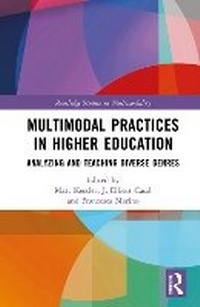
Multimodal Practices in Higher Education
Analyzing and Teaching Diverse Genres
1st Edition
Will be published approx. on 29. April 2026
256 pages
E-Book
978-1-040-59323-3 (ISBN)
Description

Featuring perspectives from established and emerging scholars, this collection examines the intersection of multimodality and genre in higher education.
Given the growing prevalence of multimodal genres, this book presents a range of studies to support researchers and educators in analyzing and teaching multimodal genres. The first section highlights empirical studies exploring different features of multimodal genres commonly used in higher education, such as tweetorials, presentations, and video abstracts. The second section spotlights pedagogy through studies on teaching multimodal genres in a variety of higher education classroom contexts. Taken together, the volume sets out a new research agenda for multimodal genre studies, one which brings together analysis and implementation toward facilitating a better understanding of multimodal texts and the impact of multimodal genre pedagogies on learning.
This book will appeal to students and researchers in fields such as applied linguistics, composition, second language writing, and English for Academic Purposes, as well as those interested in multimodality in higher education more broadly.
Given the growing prevalence of multimodal genres, this book presents a range of studies to support researchers and educators in analyzing and teaching multimodal genres. The first section highlights empirical studies exploring different features of multimodal genres commonly used in higher education, such as tweetorials, presentations, and video abstracts. The second section spotlights pedagogy through studies on teaching multimodal genres in a variety of higher education classroom contexts. Taken together, the volume sets out a new research agenda for multimodal genre studies, one which brings together analysis and implementation toward facilitating a better understanding of multimodal texts and the impact of multimodal genre pedagogies on learning.
This book will appeal to students and researchers in fields such as applied linguistics, composition, second language writing, and English for Academic Purposes, as well as those interested in multimodality in higher education more broadly.
More details
Series
Edition
1. Auflage
Language
English
Place of publication
London
United Kingdom
Publishing group
Taylor & Francis Ltd
Target group
College/higher education
Illustrations
15 Tables, black and white; 8 Line drawings, black and white; 30 Halftones, black and white; 38 Illustrations, black and white
ISBN-13
978-1-040-59323-3 (9781040593233)
Copyright in bibliographic data and cover images is held by Nielsen Book Services Limited or by the publishers or by their respective licensors: all rights reserved.
Schweitzer Classification
Other editions
Additional editions
Matt Kessler | J. Elliott Casal | Francesca Marino
Multimodal Practices in Higher Education
Analyzing and Teaching Diverse Genres
Book
approx. 04/2026
1st Edition
Routledge
€191.50
Not yet published
Persons
Matt Kessler is Associate Professor of Applied Linguistics at the University of South Florida.
J. Elliott Casal is Assistant Professor of Applied Linguistics and affiliate faculty with the Institute for Intelligent Systems at the University of Memphis.
Francesca Marino is Visiting Assistant Professor of Applied Linguistics at Ohio University.
J. Elliott Casal is Assistant Professor of Applied Linguistics and affiliate faculty with the Institute for Intelligent Systems at the University of Memphis.
Francesca Marino is Visiting Assistant Professor of Applied Linguistics at Ohio University.
Content
Chapter 1: Introduction: Multimodal genres in higher education Matt Kessler, J. Elliott Casal, Francesca Marino, Part 1: Researching Multimodal Genres, Chapter 2: Macro-moves, gestures, and questions: Multimodal engagement in three-minute thesis presentations Christine M. Tardy, Dilara Avci, Chapter 3: A genre analysis of tweetorials for medical education: Harnessing the interactive and multimodal features of Twitter/X for pedagogical purposes Maria-Jose Luzon, Maria-Angeles Velilla Sanchez, Chapter 4: Communicating Chinese culture through student-led digital multimodal composing: A social semiotic and phenomenological interpretive approach Jie Bao, Dezheng (William) Feng, Chapter 5: Assessing L2 interaction: Gaze, preference, and word searches Stephen Daniel Looney, Part 2: Teaching Multimodal Genres, Chapter 6: Students' emotional changes in image-GenAI-assisted picture book making: A qualitative case study Lanxuan Xie, Baoyi Ou, Lianjiang Jiang, Chapter 7: Collaborative construction and assessment of infographics in the French as a foreign language classroom: Students' perceptions Miriam Akoto, Mimi Li, Chapter 8: From page to podcast: Cultivating critical thinking through multimodal composition Xiao Tan, Chapter 9: A coaching model to raise teachers' multimodal interactional competence awareness in live online lectures Mercedes Querol-Julian, Alexandra Santamaria-Urbieta, Chapter 10: Multimodal and digital literacy in EMI: The case of a business administration course Julia Valeiras-Jurado, Inmaculada Fortanet-Gomez, Chapter 11: Researching multimodal genres in higher education: Future directions Francesca Marino, J. Elliott Casal, Matt Kessler, Index
