

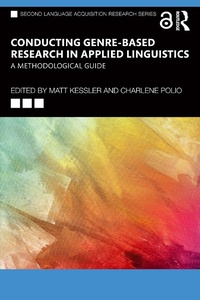
Conducting Genre-Based Research in Applied Linguistics
A Methodological Guide
1st Edition
Published on 29. September 2023
260 pages
978-1-000-96162-1 (ISBN)
Description

This collection is a comprehensive resource on conducting research in applied linguistics involving written genres that is distinctive in its coverage of a multiplicity of interdisciplinary perspectives.
The volume explores the central approaches, methodologies, analyses, and tools used in conducting genre-based research, extending the traditional focus on a single framework for defining genres by explicating the major approaches that have been invoked in applied linguistics. Chapters address a mix of commonly used methodologies (e.g., case studies, ethnographic approaches), types of analyses (e.g., metadiscourse, rhetorical move-step analysis, multidimensional analysis, lexical bundles and phrase frames, CALF measures, multimodal analysis), and studies that focus on other areas of second language (L2) teaching and learning (e.g., multilingualism, the Teaching and Learning Cycle). Taken together, the volume provides a theoretically and methodologically diverse introduction to foundational topics in genre-related research, supported by detailed discussions of the challenges and practical considerations to take into account when conducting research involving written genres.
This book is a valuable resource for graduate students, faculty, and researchers in applied linguistics, particularly those working in second language acquisition, L2 writing, and genre theory and pedagogy.
Chapter 2 of this book is freely available as a downloadable Open Access PDF at http://www.taylorfrancis.com under a Creative Commons Attribution-Non Commercial-No Derivatives (CC-BY-NC-ND) 4.0 license.
The volume explores the central approaches, methodologies, analyses, and tools used in conducting genre-based research, extending the traditional focus on a single framework for defining genres by explicating the major approaches that have been invoked in applied linguistics. Chapters address a mix of commonly used methodologies (e.g., case studies, ethnographic approaches), types of analyses (e.g., metadiscourse, rhetorical move-step analysis, multidimensional analysis, lexical bundles and phrase frames, CALF measures, multimodal analysis), and studies that focus on other areas of second language (L2) teaching and learning (e.g., multilingualism, the Teaching and Learning Cycle). Taken together, the volume provides a theoretically and methodologically diverse introduction to foundational topics in genre-related research, supported by detailed discussions of the challenges and practical considerations to take into account when conducting research involving written genres.
This book is a valuable resource for graduate students, faculty, and researchers in applied linguistics, particularly those working in second language acquisition, L2 writing, and genre theory and pedagogy.
Chapter 2 of this book is freely available as a downloadable Open Access PDF at http://www.taylorfrancis.com under a Creative Commons Attribution-Non Commercial-No Derivatives (CC-BY-NC-ND) 4.0 license.
More details
Series
Edition
1. Auflage
Language
English
Place of publication
London
United Kingdom
Publishing group
Taylor & Francis Ltd
Target group
College/higher education
Product notice
Reflowable
Illustrations
13 Tables, black and white; 2 Line drawings, black and white; 2 Illustrations, black and white
ISBN-13
978-1-000-96162-1 (9781000961621)
Copyright in bibliographic data and cover images is held by Nielsen Book Services Limited or by the publishers or by their respective licensors: all rights reserved.
Schweitzer Classification
Other editions
Additional editions
Matt Kessler | Charlene Polio
Conducting Genre-Based Research in Applied Linguistics
A Methodological Guide
Book
09/2023
1st Edition
Routledge
€63.40
Shipment within 10-20 days
Matt Kessler | Charlene Polio
Conducting Genre-Based Research in Applied Linguistics
A Methodological Guide
Book
09/2023
1st Edition
Routledge
€231.80
Shipment within 10-20 days
Persons
Matt Kessler is Assistant Professor of Applied Linguistics at the University of South Florida, where he teaches in the MA Applied Linguistics and PhD Linguistics and Applied Language Studies programs. Matt's research focuses on issues pertaining to second language writing, genre-based teaching and learning, and computer-assisted language learning. His work has appeared in journals such as the Journal of Second Language Writing, Language Learning, System, TESOL Quarterly, and more.
Charlene Polio is Professor in Linguistics, Languages, and Cultures at Michigan State University, where she teaches in the MA TESOL and PhD Second Language Studies programs. Her research focuses on methods used in second language writing research, and she is the co-author of Understanding, Evaluating, and Conducting Second Language Writing Research (Routledge). She is also the co-editor of the journal TESOL Quarterly.
Charlene Polio is Professor in Linguistics, Languages, and Cultures at Michigan State University, where she teaches in the MA TESOL and PhD Second Language Studies programs. Her research focuses on methods used in second language writing research, and she is the co-author of Understanding, Evaluating, and Conducting Second Language Writing Research (Routledge). She is also the co-editor of the journal TESOL Quarterly.
Content
About the Editors
About the Contributing Authors
Chapter 1: Introduction
Matt Kessler, Charlene Polio
Section I: Research Methods
Chapter 2: Case Studies
Raffaella Negretti, Baraa Khuder
Chapter 3: Ethnographic Research
Christine M. Tardy
Section II: Analyses, Tools, and Topics
Chapter 4: Metadiscourse
Ken Hyland
Chapter 5: Rhetorical Move-Step Analysis
J. Elliott Casal, Matt Kessler
Chapter 6: Lexical Bundles and Phrase Frames
Viviana Cortes
Chapter 7: Multidimensional Analysis
Larissa Goulart, Shelley Staples
Chapter 8: Complexity, Accuracy, and Fluency (CALF) Measures
Charlene Polio, Hyung-Jo Yoon
Chapter 9: Multimodal Analysis
Larissa D'Angelo, Francesca Marino
Section III: Focus on the Learner and Learning
Chapter 10: Multilingualism and Multicompetence
Bruna Sommer-Farias
Chapter 11: Systemic Functional Linguistics and the (Expanded) Teaching and Learning Cycle
Kathryn Accurso, Jennifer Walsh Marr
Index
About the Contributing Authors
Chapter 1: Introduction
Matt Kessler, Charlene Polio
Section I: Research Methods
Chapter 2: Case Studies
Raffaella Negretti, Baraa Khuder
Chapter 3: Ethnographic Research
Christine M. Tardy
Section II: Analyses, Tools, and Topics
Chapter 4: Metadiscourse
Ken Hyland
Chapter 5: Rhetorical Move-Step Analysis
J. Elliott Casal, Matt Kessler
Chapter 6: Lexical Bundles and Phrase Frames
Viviana Cortes
Chapter 7: Multidimensional Analysis
Larissa Goulart, Shelley Staples
Chapter 8: Complexity, Accuracy, and Fluency (CALF) Measures
Charlene Polio, Hyung-Jo Yoon
Chapter 9: Multimodal Analysis
Larissa D'Angelo, Francesca Marino
Section III: Focus on the Learner and Learning
Chapter 10: Multilingualism and Multicompetence
Bruna Sommer-Farias
Chapter 11: Systemic Functional Linguistics and the (Expanded) Teaching and Learning Cycle
Kathryn Accurso, Jennifer Walsh Marr
Index
