

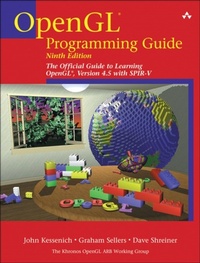
OpenGL Programming Guide
The Official Guide to Learning OpenGL, Version 4.5 with SPIR-V
9th Edition
Published on 25. July 2016
976 pages
978-0-13-449553-8 (ISBN)
Description

Complete Coverage of OpenGL (R) 4.5-the Latest Version (Includes 4.5, 4.4, SPIR-V, and Extensions)
The latest version of today's leading worldwide standard for computer graphics, OpenGL 4.5 delivers significant improvements in application efficiency, flexibility, and performance. OpenGL 4.5 is an exceptionally mature and robust platform for programming high-quality computer-generated images and interactive applications using 2D and 3D objects, color images, and shaders.
OpenGL (R) Programming Guide, Ninth Edition, presents definitive, comprehensive information on OpenGL 4.5, 4.4, SPIR-V, OpenGL extensions, and the OpenGL Shading Language. It will serve you for as long as you write or maintain OpenGL code.
This edition of the best-selling "Red Book" fully integrates shader techniques alongside classic, function-centric approaches, and contains extensive code examples that demonstrate modern techniques. Starting with the fundamentals, its wide-ranging coverage includes drawing, color, pixels, fragments, transformations, textures, framebuffers, light and shadow, and memory techniques for advanced rendering and nongraphical applications. It also offers discussions of all shader stages, including thorough explorations of tessellation, geometric, and compute shaders.
New coverage in this edition includes
Thorough coverage of OpenGL 4.5 Direct State Access (DSA), which overhauls the OpenGL programming model and how applications access objects
Deeper discussions and more examples of shader functionality and GPU processing, reflecting industry trends to move functionality onto graphics processors
Demonstrations and examples of key features based on community feedback and suggestions
Updated appendixes covering the latest OpenGL libraries, related APIs, functions, variables, formats, and debugging and profiling techniques
The latest version of today's leading worldwide standard for computer graphics, OpenGL 4.5 delivers significant improvements in application efficiency, flexibility, and performance. OpenGL 4.5 is an exceptionally mature and robust platform for programming high-quality computer-generated images and interactive applications using 2D and 3D objects, color images, and shaders.
OpenGL (R) Programming Guide, Ninth Edition, presents definitive, comprehensive information on OpenGL 4.5, 4.4, SPIR-V, OpenGL extensions, and the OpenGL Shading Language. It will serve you for as long as you write or maintain OpenGL code.
This edition of the best-selling "Red Book" fully integrates shader techniques alongside classic, function-centric approaches, and contains extensive code examples that demonstrate modern techniques. Starting with the fundamentals, its wide-ranging coverage includes drawing, color, pixels, fragments, transformations, textures, framebuffers, light and shadow, and memory techniques for advanced rendering and nongraphical applications. It also offers discussions of all shader stages, including thorough explorations of tessellation, geometric, and compute shaders.
New coverage in this edition includes
Thorough coverage of OpenGL 4.5 Direct State Access (DSA), which overhauls the OpenGL programming model and how applications access objects
Deeper discussions and more examples of shader functionality and GPU processing, reflecting industry trends to move functionality onto graphics processors
Demonstrations and examples of key features based on community feedback and suggestions
Updated appendixes covering the latest OpenGL libraries, related APIs, functions, variables, formats, and debugging and profiling techniques
All prices
More details
Series
Edition
9th edition
Language
English
Place of publication
Boston
United States
Publishing group
Pearson Education (US)
Target group
College/higher education
File size
54,61 MB
ISBN-13
978-0-13-449553-8 (9780134495538)
Copyright in bibliographic data and cover images is held by Nielsen Book Services Limited or by the publishers or by their respective licensors: all rights reserved.
Schweitzer Classification
Other editions
Additional editions
John Kessenich | Graham Sellers | Dave Shreiner
OpenGL Programming Guide
The Official Guide to Learning OpenGL, Version 4.5 with SPIR-V
Book
10/2016
9th Edition
Addison Wesley
€63.50
Shipment within 15-20 days
Persons
John M. Kessenich, staff software engineer at Google and creator of SPIR-V, has been active in OpenGL and GLSL Khronos standards' development since 1999. He is the primary editor of the SPIR-V and GLSL specifications, and creates shader compiler tools and translators to promote portability of those standards.
Graham Sellers, AMD Software Architect and Engineering Fellow, is a Khronos API lead and represents AMD at the OpenGL ARB. He has contributed to the core Vulkan and OpenGL specs and extensions, and holds several graphics and image processing patents.
Dave Shreiner is a twenty-five year veteran of the computer graphics industry, where he's worked almost exclusively with programming interfaces like OpenGL. In addition to having written and taught instructional courses on using computer graphics APIs, he was also the lead author for almost ten years on several Addison-Wesley publications relating to computer graphics.
Graham Sellers, AMD Software Architect and Engineering Fellow, is a Khronos API lead and represents AMD at the OpenGL ARB. He has contributed to the core Vulkan and OpenGL specs and extensions, and holds several graphics and image processing patents.
Dave Shreiner is a twenty-five year veteran of the computer graphics industry, where he's worked almost exclusively with programming interfaces like OpenGL. In addition to having written and taught instructional courses on using computer graphics APIs, he was also the lead author for almost ten years on several Addison-Wesley publications relating to computer graphics.
Content
Chapter 1: Introduction to OpenGL
Chapter 2: Shader Fundamentals
Chapter 3: Drawing with OpenGL
Chapter 4: Color, Pixels, and Fragments
Chapter 5: Viewing Transformations, Culling, Clipping, and Feedback
Chapter 6: Textures and Framebuffers
Chapter 7: Light and Shadow
Chapter 8: Procedural Texturing
Chapter 9: Tessellation Shaders
Chapter 10: Geometry Shaders
Chapter 11: Memory
Chapter 12: Compute Shaders
Appendix A: Support Libraries
Appendix B: OpenGL ES and WebGL
Appendix C: Built-in GLSL Variables and Functions
Appendix D: State Variables
Appendix E: Homogeneous Coordinates and Transformation Matrices
Appendix F: Floating-Point Formats for Textures, Framebuffers, and Renderbuffers
Appendix G: Debugging and Profiling OpenGL
Appendix H: Buffer Object Layouts
Chapter 2: Shader Fundamentals
Chapter 3: Drawing with OpenGL
Chapter 4: Color, Pixels, and Fragments
Chapter 5: Viewing Transformations, Culling, Clipping, and Feedback
Chapter 6: Textures and Framebuffers
Chapter 7: Light and Shadow
Chapter 8: Procedural Texturing
Chapter 9: Tessellation Shaders
Chapter 10: Geometry Shaders
Chapter 11: Memory
Chapter 12: Compute Shaders
Appendix A: Support Libraries
Appendix B: OpenGL ES and WebGL
Appendix C: Built-in GLSL Variables and Functions
Appendix D: State Variables
Appendix E: Homogeneous Coordinates and Transformation Matrices
Appendix F: Floating-Point Formats for Textures, Framebuffers, and Renderbuffers
Appendix G: Debugging and Profiling OpenGL
Appendix H: Buffer Object Layouts
