

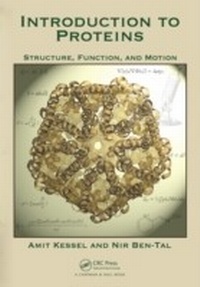
Introduction to Proteins
Structure, Function, and Motion
1st Edition
Published on 17. December 2010
654 pages
978-1-4398-1072-9 (ISBN)
Description

As the tools and techniques of structural biophysics assume greater roles in biological research and a range of application areas, learning how proteins behave becomes crucial to understanding their connection to the most basic and important aspects of life. With more than 350 color images throughout, Introduction to Proteins: Structure, Function,
Reviews / Votes
"I've just lately used this textbook for a presentation on electrostatics. Although I have an organic background, I discovered that the explanations of electrostatic interactions are very clear and informative. The language isn't too technical and may be easily understood by biology students. The textbook covers numerous examples and colorful illustrations, which made it easy to understand the principles discussed. The book is well organized in chapters for all the fundamental topics. I feel this book would be appropriate for any undergraduate and graduate scholar who's keen on proteins. ... It's complete, easy to observe and (something I at least discover uncommon for textbooks) pleasing to read. The authors don't shrink back from any subjects, but clarify things in a straightforward method supported by ample examples. Highly recommended."-Physics Book Reviews at dowdawgs.com, May 2013
Introduction to Proteins is an excellent, state-of-the-art choice for students, faculty, or researchers needing a monograph on protein structure. ...The book is clear, well organized, aptly illustrated in color, and a pleasure to read. The first two chapters are an impressive textbook unto themselves ... The book is thoroughly documented with citations to the literature gathered at the end of each chapter. ... Overall, this is an immensely informative, thoroughly researched, up-to-date text, with broad coverage and remarkable depth. Introduction to Proteins would provide an excellent basis for an upper level or graduate course on protein structure, and a valuable addition to the libraries of professionals interested in this centrally important field.
-Eric Martz, Biochemistry and Molecular Biology Education, Vol. 40, 2012
This is an important book. ... This book captures in a very accessible way a growing body of literature on the structure, function and motion of proteins, and links this to more established paradigms such as a reader might find in a mainstream biochemistry text. ... The text is littered with excellent examples of the wider relevance of the material covered ... . The book is exceptionally well written ... I learned new things from each chapter. ... a superb publication that would be very useful to undergraduates, graduate students, postdoctoral researchers and instructors involved in structural biology or biophysics courses or in research on protein structure-function relationships. I would recommend it highly.
-David Sheehan, ChemBioChem, 2011
The book by Kessel and Ben-Tal offers a unique combination of structure, thermodynamics and biology. I was impressed both by the breadth of the topics covered and by the depth in which they are treated. General principles are made intuitively clear based on well-chosen examples, many of them having relevance to disease. The book could fit well as a textbook in structural biology and molecular biophysics courses.
-Barry Honig, Columbia University, New York, New York, USA
... the book provides general guidelines for understanding protein structure and demonstrates how we can use the structure to phrase testable hypotheses about biological function. ... The repeated use of the same example makes it easier for the reader to grasp the general principles. The book gives a coherent picture of each topic ... [and] includes ample references, making it possible for the interested reader to dig deeply into various topics. The book also covers structural aspects of intrinsically unstructured proteins and how this property facilitates their biological function. ... The book provides background in cell biology, basic chemistry and thermodynamics, making it useful for newcomers to the protein structure field who want to catch up quickly. ... it [is also] easy for experts to dive into the more specialized aspects quickly. ... The book provides references to user-friendly web tools in the field. The publisher's website provides exercises on both theory and practice. Sample solutions and PowerPoint presentations are available for qualified teachers. These make the book attractive as the main textbook in an undergraduate course on protein structure. Perhaps also for parts of freshman biochemistry. ... useful as supplement for many undergraduate and graduate courses.
-Burkhard Rost, Technische Universitaet Muenchen, Germany
More details
Series
Language
English
Place of publication
Baton Rouge
United States
Publishing group
Taylor & Francis Inc
Target group
Professional and scholarly
Graduate and advanced undergraduate students and researchers in biophysics, biochemistry, bioinformatics, and life sciences.
Illustrations
375 s/w Abbildungen, 8 s/w Tabellen
375 b/w images, 8 tables and 29 Equations
ISBN-13
978-1-4398-1072-9 (9781439810729)
Copyright in bibliographic data and cover images is held by Nielsen Book Services Limited or by the publishers or by their respective licensors: all rights reserved.
Schweitzer Classification
Other editions
New editions
E-Book
03/2018
2nd Edition
Chapman & Hall/CRC
€125.99
Available for download
Additional editions
Book
12/2010
1st Edition
CRC Press
€92.99
Article exhausted; check different version
Persons
Amit Kessel is co-founder of Es-is Technologies Ltd., which designs biocatalysts for the pharmaceutical industry. He also teaches protein biochemistry and biophysics at the Tel Aviv-Yaffo Academic College. During his postdoctoral research at Columbia University, Dr. Kessel focused on various physicochemical aspects of protein-protein interactions at the molecular level.
Nir Ben-Tal is a professor in the Department of Biochemistry and Molecular Biology at Tel-Aviv University. His research in computational biology has involved predicting the three-dimensional structures of transmembrane proteins and developing the ConSurf web server for the detection of functional regions by mapping evolutionary data on protein structures.
Nir Ben-Tal is a professor in the Department of Biochemistry and Molecular Biology at Tel-Aviv University. His research in computational biology has involved predicting the three-dimensional structures of transmembrane proteins and developing the ConSurf web server for the detection of functional regions by mapping evolutionary data on protein structures.
Content
Introduction. Protein Structure. Methods of Structure Determination and Prediction. Energetics and Protein Stability. Protein Structural Dynamics. Non-Globular Proteins. Membrane Proteins. Protein-Ligand Interactions. Index.
