

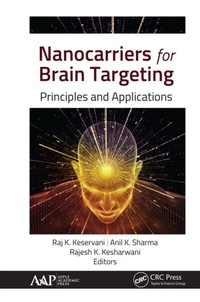
Nanocarriers for Brain Targeting
Principles and Applications
1st Edition
Published on 5. August 2019
534 pages
978-0-429-87753-7 (ISBN)
Description

This new volume, Nanocarriers for Brain Targeting: Principles and Applications, covers recent research on brain physiology and the development of drug delivery systems. It explores a diverse variety of strategies that can be employed to achieve drug targeting to the brain. The nanocarriers that are discussed include nanoparticles, vesicular carriers, carriers having carbon as a core constituent, dispersed systems, and more.
The inherent anatomy and physiology of the brain renders it different from other organs. The past few decades have witnessed significant research on brain ailments in response to a majority of hospitalizations that occur due to age-related central nervous system disorders. The prevalence of diverse diseases such as Alzheimer's disease, Parkinson's disease, amyotrophic lateral sclerosis, multiple sclerosis, HIV-dementia, etc., affect about 1.5 billion people globally, which is further anticipated to reach 1.9 billion by the year 2020. Nanocarriers for drug delivery to the brain are seen as one of the answers to this growing problem.
The inherent anatomy and physiology of the brain renders it different from other organs. The past few decades have witnessed significant research on brain ailments in response to a majority of hospitalizations that occur due to age-related central nervous system disorders. The prevalence of diverse diseases such as Alzheimer's disease, Parkinson's disease, amyotrophic lateral sclerosis, multiple sclerosis, HIV-dementia, etc., affect about 1.5 billion people globally, which is further anticipated to reach 1.9 billion by the year 2020. Nanocarriers for drug delivery to the brain are seen as one of the answers to this growing problem.
More details
Edition
1. Auflage
Language
English
Place of publication
London
United Kingdom
Publishing group
Taylor & Francis Ltd
Target group
College/higher education
Professional and scholarly
Product notice
Reflowable
Illustrations
37 Tables, black and white; 12 Illustrations, color; 72 Illustrations, black and white
ISBN-13
978-0-429-87753-7 (9780429877537)
Copyright in bibliographic data and cover images is held by Nielsen Book Services Limited or by the publishers or by their respective licensors: all rights reserved.
Schweitzer Classification
Other editions
Additional editions
Raj K. Keservani | Anil K. Sharma | Rajesh K. Kesharwani
Nanocarriers for Brain Targeting
Principles and Applications
Book
03/2021
1st Edition
Apple Academic Press Inc.
€108.50
Shipment within 3-4 weeks
Raj K. Keservani | Anil K. Sharma | Rajesh K. Kesharwani
Nanocarriers for Brain Targeting
Principles and Applications
Book
08/2019
1st Edition
Apple Academic Press Inc.
€206.84
Shipment within 3-4 weeks
Nanocarriers for Brain Targeting
Principles and Applications
Book
04/2019
Apple Academic Press
Unfortunately, price unknown
Article exhausted; check different version
Persons
Raj K. Keservani, MPharm, is a faculty of pharmaceutics at Sagar Institute of Research and Technology-Pharmacy, Bhopal, India. He has more than seven years of academic (teaching) experience from various institutes of India in pharmaceutical education. He has published 30 peer-reviewed papers in the field of pharmaceutical sciences in national and international journals, fifteen book chapters, two co-authored books, and two edited books. He is also active as a reviewer for several international scientific journals. Mr. Keservani graduated with a pharmacy degree from the Department of Pharmacy, Kumaun University, Nainital (UA), India. He received his Master of Pharmacy (MPharm) (specialization in pharmaceutics) from the School of Pharmaceutical Sciences, Rajiv Gandhi Proudyogiki Vishwavidyalaya, Bhopal, India. His research interests include nutraceutical and functional foods, novel drug delivery systems (NDDS), transdermal drug delivery/ drug delivery, health science, cancer biology, and neurobiology.
Anil K. Sharma, MPharm, is working as a lecturer at the Delhi Institute of Pharmaceutical Sciences and Research, University of Delhi, India. He has more than six years of academic experience in pharmaceutical sciences. He has published 26 peer-reviewed papers in the field of pharmaceutical sciences in national and international journals as well as 12 book chapters. He received a bachelor's degree in pharmacy from the University of Rajasthan, Jaipur, India, and a Master of Pharmacy degree from the School of Pharmaceutical Sciences, Rajiv Gandhi Proudyogiki Vishwavidyalaya, Bhopal, India, with a specialization in pharmaceutics. His research interests encompass nutraceutical and functional foods, novel drug delivery systems (NDDS), drug delivery, nanotechnology, health science/life science, and biology/cancer biology/neurobiology.
Rajesh K. Kesharwani, PhD, is affiliated with the Department of Advanced Science & Technology, NIET, Nims University Rajasthan, Jaipur, India. He has more than seven years of research and two years of teaching experience in various institutes of India, imparting bioinformatics and biotechnology education. He has received several awards, including the NASI-Swarna Jayanti Puruskar-2013 by The National Academy of Sciences of India. He has authored over 32 peer-reviewed articles and ten book chapters. He has been a member of many scientific communities as well as a reviewer for many international journals. Dr. Kesharwani received a BSc in biology from Ewing Christian College, Allahabad, India, an autonomous college of the University of Allahabad; his MSc (Biochemistry) from Awadesh Pratap Singh University, Rewa, Madhya Pradesh, India; and MTech-IT (specialization in Bioinformatics) from the Indian Institute of Information Technology, Allahabad, India. He earned his PhD from the Indian Institute of Information Technology, Allahabad, and received a Ministry of Human Resource Development (India) Fellowship and Senior Research Fellowship from the Indian Council of Medical Research, India. His research fields of interest are medical informatics, protein structure and function prediction, computer-aided drug designing, structural biology, drug delivery, cancer biology, and next-generation sequence analysis.
Anil K. Sharma, MPharm, is working as a lecturer at the Delhi Institute of Pharmaceutical Sciences and Research, University of Delhi, India. He has more than six years of academic experience in pharmaceutical sciences. He has published 26 peer-reviewed papers in the field of pharmaceutical sciences in national and international journals as well as 12 book chapters. He received a bachelor's degree in pharmacy from the University of Rajasthan, Jaipur, India, and a Master of Pharmacy degree from the School of Pharmaceutical Sciences, Rajiv Gandhi Proudyogiki Vishwavidyalaya, Bhopal, India, with a specialization in pharmaceutics. His research interests encompass nutraceutical and functional foods, novel drug delivery systems (NDDS), drug delivery, nanotechnology, health science/life science, and biology/cancer biology/neurobiology.
Rajesh K. Kesharwani, PhD, is affiliated with the Department of Advanced Science & Technology, NIET, Nims University Rajasthan, Jaipur, India. He has more than seven years of research and two years of teaching experience in various institutes of India, imparting bioinformatics and biotechnology education. He has received several awards, including the NASI-Swarna Jayanti Puruskar-2013 by The National Academy of Sciences of India. He has authored over 32 peer-reviewed articles and ten book chapters. He has been a member of many scientific communities as well as a reviewer for many international journals. Dr. Kesharwani received a BSc in biology from Ewing Christian College, Allahabad, India, an autonomous college of the University of Allahabad; his MSc (Biochemistry) from Awadesh Pratap Singh University, Rewa, Madhya Pradesh, India; and MTech-IT (specialization in Bioinformatics) from the Indian Institute of Information Technology, Allahabad, India. He earned his PhD from the Indian Institute of Information Technology, Allahabad, and received a Ministry of Human Resource Development (India) Fellowship and Senior Research Fellowship from the Indian Council of Medical Research, India. His research fields of interest are medical informatics, protein structure and function prediction, computer-aided drug designing, structural biology, drug delivery, cancer biology, and next-generation sequence analysis.
Content
Part 1: Introduction To Carriers In Brain Targeting 1. Carriers for Brain Targeting: Recent Advances and Challenges 2. The Blood-Brain Barrier and Advanced Carriers for Brain Drug Delivery and Targeting 3. Nanotechnology for Brain Targeting 4. Nanocarriers for Brain Targeting: An Overview 5. Natural Biopolymeric Nanoformulations for Brain Drug Delivery Part 2: Particulate Carriers 6. Nanoparticulate Drug Delivery Systems for Brain Targeting 7. Nanocapsules in Brain Targeting 8. Solid Lipid Nanoparticles for Brain Targeting 9. An Introductory Note on Quantum Dots for Brain Targeting 10. Graphene for Brain Targeting Part 3: Vesicular Carriers 11. A Brief Account of Liposomes for Brain Delivery 12. Liposomal Drug Carriers: Principles, Formulation Perspectives, and Potentials for Brain Drug Delivery 13. Niosomes for Brain Targeting Part 4: Other Issues 14. Nanoemulsions for Brain Targeting 15. Nanogels for Brain Targeting: Introduction, Formulation Aspects, and Applications 16. Applications of Nanocarriers in Emerging and Re-Emerging CNS Tropical Infections
