

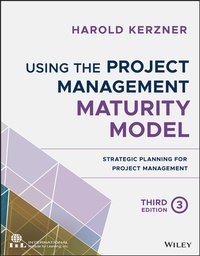
Using the Project Management Maturity Model
Description

Using the Project Management Maturity Model offers assessment tools for organizations of all sizes to evaluate their progress in effectively integrating project management along the maturity curve. This Third Edition includes maturity metrics, examples of Project Management Maturity Model (PMMM) reports, a new chapter on the characteristics of effective PMMM, assessment questions that align with the PMBOK® Guide--Sixth Edition, all-new illustrations that define advanced levels of maturity, assessment tools for organizations using traditional PM methods, and detailed guidance for organizations using Agile and Scrum.
Using the Project Management Maturity Model: Strategic Planning for Project Management, Third Edition is broken down into three major parts. The first part discusses the principles of strategic planning and how it relates to project management, the definition of project management maturity, and the need for customization. The second part details the Project Management Maturity Model (PMMM), which provides organizations with general guidance on how to perform strategic planning for project management. The third part of the book looks at some relatively new concepts in project management such as how assessments can be made to measure the firm's growth using PM 2.0 and PM 3.0.
* Features customizable maturity model assessment tools for organizations of all sizes
* Includes assessment questions updated to line up with PMBOK® Guide--6th Edition
* Offers detailed guidance on applying the maturity model for Agile and Scrum
* Includes PowerPoint decks to aid in teaching the maturity model
Using the Project Management Maturity Model: Strategic Planning for Project Management, Third Edition is an ideal book for senior level and middle level corporate managers, project and team managers, engineers, project team members, and business consultants. It also benefits both business and engineering students in courses on advanced project management.
More details
Other editions
Additional editions
Person
HAROLD KERZNER, PHD, is Senior Executive Director for Project Management at the International Institute for Learning, Inc. (IIL), a global learning solutions company offering professional training and consulting services worldwide. Dr. Kerzner's profound effect on the project management industry inspired IIL to establish, in coordination with PMI, the Kerzner International Project Manager of the Year Award, which is presented to a distinguished PMP® credential holder or global equivalent each year.
Content
Preface xi
Introduction xiii
Chapter 1 The Need for Strategic Planning for Project Management 1
Introduction 1
Misconceptions 1
Project Management Becomes a Strategic Competency 3
General Strategic Planning 4
Participation by the Project Manager in Strategic Planning 5
What Is Strategic Planning for Project Management? 7
Executive Involvement 13
Critical Success Factors for Strategic Planning 13
Identifying Strategic Resources 14
Why Does Strategic Planning for Project Management Sometimes Fail? 17
Concluding Remarks 19
Chapter 2 The Need to Plan for Project Management Maturity 21
Introduction 21
The Need for a PMMM 21
Other Purposes for the PMMM 23
Defining Project Management Maturity 24
Advantages of Using a PMMM 25
Disadvantages of Using a PMMM 26
Selecting a PMMM 27
Changing the Strategic Direction 27
Maturity and Core Competencies 28
Maturity and Assessment Timing 28
The Importance of Intangible Maturity Metrics 29
Chapter 3 Customizing the PMMM 31
The Need for PMMM Customization 31
Understanding Customization 31
Issues with Public-Sector Project Management Maturity 32
Olympic Games Project Management Maturity 35
Capturing Olympic Games Lessons Learned 36
Chapter 4 An Introduction to the Project Management Maturity Model (PMMM) 39
Introduction 39
The Foundation for Excellence 40
Overlap of Levels 41
Risks 43
Assessment Instruments 44
Chapter 5 Level 1: Common Language 45
Introduction 45
Roadblocks 46
Advancement Criteria 47
Risk 47
Assessment Instrument for Level 1 48
Questions 48
Answer Key 61
Explanation of Points for Level 1 63
Opportunities for Customizing Level 1 63
Chapter 6 Level 2: Common Processes 65
Introduction 65
Life Cycles for Level 2 66
Roadblocks 68
Advancement Criteria 69
Risk 69
Overlapping Levels 70
Assessment Instrument for Level 2 70
Questions 71
Explanation of Points for Level 2 74
Opportunities for Customizing Level 2 74
Chapter 7 Level 3: Singular Methodology 75
Introduction 75
Integrated Processes 76
Culture 78
Management Support 79
Informal Project Management 80
Training and Education 80
Behavioral Excellence 82
Roadblocks 83
Advancement Criteria 83
Risk 83
Overlapping Levels 84
Assessment Instrument for Level 3 84
Questions 84
Answer Key 92
Explanation of Points for Level 3 94
Opportunities for Customizing Level 3 95
Chapter 8 Level 4: Benchmarking 97
Introduction 97
Characteristics 98
The Project Office or Center of Excellence 99
Benchmarking Opportunities 100
Roadblocks 102
Advancement Criteria 103
Assessment Instrument for Level 4 103
Questions 103
Explanation of Points for Level 4 106
Opportunities for Customizing Level 4 107
Chapter 9 Level 5: Continuous Improvement 109
Characteristics 109
Continuous Improvement Areas 110
The Never-Ending Cycle 112
Examples of Continuous Improvement 113
Developing Effective Procedural Documentation 113
Project Management Methodologies 119
Continuous Improvement 120
Capacity Planning 121
Competency Models 122
Managing Multiple Projects 124
End-of-Phase Review Meetings 125
Strategic Selection of Projects 126
Portfolio Selection of Projects 129
Horizontal or Project Accounting 131
Organizational Restructuring 133
Career Planning 134
Assessment Instrument for Level 5 135
Questions 135
Explanation of Points for Level 5 137
Opportunities for Customizing Level 5 137
Chapter 10 Sustainable Competitive Advantage 139
Introduction 139
Strategic Thrusts 140
The Need for Continuous Improvement 143
Project Management Competitiveness 143
Products versus Solutions 144
Enterprise Project Management 145
Engagement Project Management 146
Chapter 11 Advanced Project Management Maturity Assessments 147
Introduction: Changing Times 147
Redefining Maturity from PM 1.0 to PM 2.0/3.0 147
Some Critical Issues with PM 1.0 149
The Need for PM 2.0 150
The Need for PM 3.0 153
Criticisms of PM 2.0 and PM 3.0 154
Implementing Continuous Improvement Changes 155
How to Update the Assessment Instruments 157
Changing Definitions for PM 2.0 and PM 3.0 158
Assessing Maturity for PM 2.0 and PM 3.0 159
Statements 159
Measuring Intangible Benefits and Value 164
Customizing PM 2.0 and PM 3.0 Assessments 165
PMMM and the Agile Environment 171
Chapter 12 How to Conduct a Project Management Maturity Assessment 173
Introduction 173
Find Ways to Bypass the Corporate Immune System 173
Explain Why You Are Doing This 174
Pick the Model that Is Best for Your Organization 175
Maturity Models: How Do They Compare? 176
Create the Right Fit 176
Choose an Appropriate Delivery Method 177
Establish Responsibility 180
Decide Who Should Participate 181
Turn the Results into an Action Plan 182
Develop a Remedial Training Curriculum 183
Keep Top Management Informed 183
Virtual Reporting 184
Benchmark Your Results to Others 184
Do It Again 185
Chapter 13 Using the PMMM to Extract Best Practices 187
Introduction 187
The Best Practices Process 188
Step 1: Definition of a Best Practice 189
Step 2: Seeking Out Best Practices 190
Step 3: Validating the Best Practice 191
Step 4: Levels of Best Practices 192
Step 5: Management of Best Practices 193
Step 6: Revalidating Best Practices 194
Step 7: What to Do with a Best Practice 194
Step 8: Communicating Best Practices Across the Company 195
Step 9: Ensuring Usage of the Best Practices 196
Common Beliefs 196
Best Practices Library 197
Best Practices and the PMMM 199
Chapter 14 Case Studies 201
Case 1: Simone Engineering Company 201
Case 2: NorthStar Software Company 202
Case 3: Colmar Automotive 203
Case 4: Ferris HealthCare, Inc. 204
Case 5: Clark Faucet Company 205
Case 6: Macon, Inc. 207
Case 7: The Blue Spider Project 209
Case 8: Corwin Corporation 221
Case 9: The Trophy Project 230
Appendix The Kerzner Project Management Maturity Model 235
XXXX KPMMM 235
Introduction 237
Respondents by Project Roles and Countries Represented 241
Executive Overview of the Assessment Results 242
Level 1: Common Language (Max 800) 244
Level 2: Common Processes (Max 60) 251
Level 3: Singular Methodology (Max 210) 256
Level 4: Benchmarking (Max 75) 260
Level 5: Continuous Improvement (Max 48) 262
A Study of Level 1 Performance 263
A Study of Level 2 Performance 267
A Study of Level 3 Performance 271
A Study of Level 4 Performance 275
A Study of Level 5 Performance 279
Suggested Actions 283
Index 285
Introduction
People often ask me how I came up with the idea for creating a project management maturity model (PMMM). In 1996, the International Institute for Learning (IIL) partnered with Microsoft and Nortel to sponsor a global videoconference where I discussed some of the project management best practices that companies were using. After the broadcast, I was flooded with questions, with conference participants asking me how "quickly" their company could implement some of these best practices and become good at project management. I responded to the participants that maturity and excellence in project management cannot be achieved easily or quickly without some type of strategic direction focusing on project management maturity. The direction soon became the PMMM.
In 1997, when I first prepared the foundation for the PMMM, there were very few maturity models in the marketplace. Today, there are more than 30. Every model has its pros and cons. Some models take a great deal of time to do the assessments, whereas others are fairly quick and cost-effective to use. Some models are more applicable to specific industries, such as construction or IT, whereas other models are more generic.
The PMMM was created to prepare companies for the future rather than the present. To understand this, you must first recognize what makes project management work well. Having an enterprise project management methodology does not necessarily lead to maturity. Having policies and procedures embedded throughout the methodology is also no guarantee that maturity will be forthcoming. Even following the PMBOK® Guide exactly cannot guarantee maturity.1
Before you start sending me nasty e-mails, let me state my position on the previous paragraph. Project management methodologies based on rather rigid policies and procedures were created because management wanted standardization in the way that projects were planned, scheduled, and controlled. This was a necessity because executives had concerns about the ability of their project managers to make the correct decisions. Some people have argued that these rigid approaches mandated "obedience to regulations" and limited the freedom that most project managers need. The problem with standardization is that it often pulls people out of their comfort zones, and they must work differently when assigned to projects. People who are asked to work outside of their comfort zone often dislike working on project teams and may look forward to the end of the project so they can return to their previous assignment. What I have observed in the past five decades is that project management excellence comes from four critical components:
- Effective communications
- Effective cooperation
- Effective teamwork
- Trust
With this in mind, the PMMM is significantly more behavioral than quantitative. People manage projects; methodologies function as supporting tools. You can have the greatest methodology in the world and still not reach a level of maturity, because the correct human behavior is not in place. Maturity in project management occurs when people work together correctly. The PMMM assessments focus on people interacting with other people rather than just tools.
Over the years, executives have seen the benefits of using project management correctly. As executives demonstrate more trust in project managers' capabilities, rigid methodologies are being replaced with forms, guidelines, templates, and checklists. Today, at the beginning of a project, the project manager will walk through the "cafeteria" and select from the shelves only those forms, guidelines, templates, and checklists that are appropriate for that project and that client. We now have flexible methodologies, or frameworks. If the project manager believes that this project is a very low risk, then the project manager may not want to follow or even use the "Risk Management" section of the PMBOK® Guide. Project managers are now being given more freedom over how to apply project management practices to satisfy the customer's needs. This leads to customer satisfaction and repeat business.
But even with this new freedom, project managers must still recognize the importance of the behavioral assessments in the PMMM, which focus on effective communication, cooperation, teamwork, and trust. Behavioral assessments indicate whether people believe that they are working within their comfort zone. If continuous improvements are made correctly (i.e., Level 5 of the PMMM) and people are happy with their comfort zone, some degree of project management maturity can be achieved quickly. The focus in the PMMM is that people manage projects; people manage tools; tools by themselves manage neither people nor projects. As a former Air Force lieutenant general stated, "You must never allow the tool to control the hand that's holding it." Maturity models should certainly include an assessment of whether the organization has the right tools and practices in place. But in my opinion, there should be an equal or possibly heavier emphasis on the necessary human behavior.
A few years ago, I was interviewed for an article on maturity models with an emphasis on the PMMM. Following are some of the questions I was asked.
- Q1: How much project management maturity does a company really need?
- The amount of maturity a company needs is quite often customer driven rather than internally driven. Whenever a contractor allows its customer to become more mature than it is, very unfavorable results can occur. Among them, (1) the customer tells the contractor how the work should be done, (2) the customer may perform the work by themselves, and (3) the customer may seek out a more mature contractor during competitive bidding. Therefore, companies that rely heavily on external customers for their revenue stream, such as project-driven companies, must never allow their customers to achieve a greater degree of maturity than theirs. For these companies, project management maturity is a necessity for survival, and the frequent use of a maturity model should be mandatory.
- Companies today should be willing to perform a frequent self-assessment to make sure that the firm is continuously improving and reaching some level of maturity. During competitive bidding activities, customers are now asking contractors to show how mature their organization is with regard to project management. Maturity assessments could be the difference between winning and losing a potential contract.
- Q2: Which industries are making the greatest strides toward maturity?
- First of all, it is questionable if maturity can ever be accurately defined or measured because saying that you are mature in project management might imply that there is no further room for improvement. This can lead to complacency and a loss of competitiveness. But if I were asked which industries appear to be more mature than others, I would begin with project-driven companies that rely on competitive bidding for their revenue stream and must sell their delivery system as well as the expected project outcomes. They have come to the realization that they must try to remain more mature in project management than their customers simply to stay in business. As companies become more mature, tremendous pressure is exerted on their supplier base to improve in project management, and organizational maturity assessment information is appearing as a requirement in the RFP. In fact, reaching certain maturity levels in project management has now become a competitive weapon during competitive bidding activities. In general, organizations where projects have profit expectations and the project manager is responsible for generating the profits appear to mature faster than organizations where there are no profit margins assigned to projects.
- Q3: What can companies just starting out on the maturity process learn from those leading the pack?
- It is always better to learn from the mistakes of others rather than from your own mistakes. Several lessons can be learned. First, strategic planning for project management maturity is essential, even a necessity. Without guidance from some sort of project management maturity (strategic planning) model, achieving maturity could take decades as you learn from your own mistakes. All project management maturity models, in my opinion, are a form of strategic planning. Second, there must be a corporate commitment (especially at the executive levels) for maturity to occur, and the executives must see the value in achieving a defined level of maturity in a reasonable time frame. There are assessment questions on this in the PMMM. Third, there must exist a dedicated organization that drives the maturity process, and this normally becomes the responsibility of the project management office (PMO). Companies where PMOs take the lead in the assessment and continuous improvement processes generally reach levels of maturity more quickly than those that do not have any involvement by the PMO.
- Q4: Should every company be pursuing maturity? What keeps some companies back?
- Given the fact that many executives today view their company as being a stream of projects, the project management approach permeates the entire organization, mandating that maturity is necessary. Only those companies that want to stay in business and remain competitive should pursue maturity. The alternative is rather unpleasant.
- Pursuing and even obtaining some degree of maturity does not guarantee that business will improve....
