

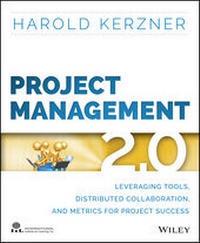
Project Management 2.0
Description

More details
Other editions
Additional editions
Person
Content
Preface ix
Acknowledgment xi
Foreword xiii
Why This Story Makes Sense xiv
Through The Looking Glass At A Chaotic Future Is It Half Empty Or Half Full Or Just Plain Complicated? xvi
So What Does All This Mean To You? xvii
Chapter 1 Project Management 2.0 1
1.0 Introduction: Changing Times 1
1.1 Characteristics of PM 1.0 1
1.2 Other Critical Issues with PM 1.0 2
1.3 Project Management 2.0 4
1.4 Criticism of PM 2.0 7
1.5 Project Management 2.0 : Technological Blessing or Curse? 7
1.6 Policing PM 2.0 12
1.7 Working with Stakeholders in PM 2.0 13
Today's View of Stakeholder Relations Management 14
Need for Meaningful Information 15
All That Glitters Is Not Gold 15
1.8 Finding the Information 16
1.9 Percent Complete Dilemma 17
1.10 Information Overload 18
1.11 Customer Satisfaction Headache 18
1.12 Determining Project Health 19
1.13 Dashboard Rules for Displaying Data 20
1.14 Reduction in Cost of Paperwork 21
1.15 Reduction in Executive Meddling 22
1.16 Project Management Skills 23
1.17 Contingency Planning 23
Discussion Questions 24
Chapter 2 A Peek into the Future of Project Management 25
2.0 Changing Times 25
2.1 Impact of Recessions 25
2.2 Executive View of Project Management 26
2.3 Engagement Project Management 28
2.4 Growth of More Complex Projects 30
2.5 Need for Additional Metrics 31
2.6 New Developments in Project Management 32
2.7 Project Manager's Tool Box 33
2.8 Need for Continuous Improvement 34
2.9 Conclusions 34
Discussion Questions 34
Chapter 3 Understanding Success and Failure 37
3.0 Introduction 37
3.1 Project Management-Early Years: 1945-1960 38
3.2 Project Management Begins to Grow: 1970-1985 39
3.3 Growth in Competing Constraints 40
3.4 Rule of Inversion 42
3.5 Growth in Measurement Techniques 43
3.6 Trade-Offs 44
3.7 Putting Together Components of Success 45
3.8 New Definition of Success 46
3.9 Understanding Project Failure 47
3.10 Causes of Project Failure 50
Discussion Questions 52
Chapter 4 Value-Driven Project Management 53
4.0 Introduction 53
4.1 Understanding Today's View of Value 54
4.2 Value Modeling 56
4.3 Value and Leadership Changes for PM 2.0 58
4.4 Value-Based Trade-Offs 62
4.5 Need for Value Metrics 64
4.6 Creating a Value Metric 64
4.7 Displaying Value Metrics in a Dashboard 71
4.8 Selecting Value Attributes 72
4.9 Additional Complexities with Value Metrics 73
Discussion Questions 76
Chapter 5 Growing Importance of Metrics with PM 2.0 77
5.0 Introduction 77
5.1 Enterprise Resource Planning 77
5.2 Need for Better Project Metrics 78
5.3 Causes for Lack of Support for Metrics Management 80
5.4 Characteristics of a Metric 81
5.5 Metrics Selection 82
5.6 Key Performance Indicators 83
Need for KPIs 84
Using KPIs 86
Anatomy of a KPI 86
KPI Characteristics 88
KPI Failures 89
5.7 Dashboards and Scorecards 90
5.8 Business Intelligence 93
5.9 Growth in Dashboard Information Systems 93
5.10 Selecting an Infographics Designer 94
5.11 Project Health Check Metrics 95
5.12 Maintaining Project's Direction 99
5.13 Metrics and Virtual Teams 99
5.14 Metric Mania 100
5.15 Metric Training Sessions 101
5.16 Metric Owners 102
5.17 Answering Metric Questions 103
Discussion Questions 103
Chapter 6 Project Management Methodologies: 1.0 versus 2.0 105
6.0 Introduction 105
6.1 PM 2.0 Definition of Project Management Excellence 105
6.2 Need for A Methodology 106
6.3 Need for AN Enterprisewide Methodology 108
Light Methodologies 109
Heavy Methodologies 110
6.4 Benefits of A Standardized Methodology 112
6.5 Critical Components 114
6.6 From Methodologies to Framework 116
6.7 Life-Cycle Phases 116
6.8 Drivers for PM 2.0 Client-Centered Flexibility 117
6.9 Understanding Moving Targets 118
6.10 Need for Client-Specific Metrics 119
6.11 Business Case Development 119
6.12 Validating Assumptions 120
Types of Assumptions 121
Documenting Assumptions 122
6.13 Design Freezes 123
6.14 Customer Approvals 124
6.15 Agile Project Management Methodology 125
6.16 Implementing Methodology 127
6.17 Implementation Blunders 128
6.18 Overcoming Development and Implementation Barriers 128
6.19 Using Crisis Dashboards with Methodologies 129
Understanding Targets 130
Defining a Crisis 131
Crisis Dashboard Images 134
Conclusions 138
6.20 Shutting Down the Project 138
Discussion Questions 139
Chapter 7 Project Governance 141
7.0 Introduction 141
7.1 Need for Governance 141
7.2 Defining Project Governance 142
7.3 Project versus Corporate Governance 143
7.4 Roles, Responsibilities, and Decision-Making Authority 144
7.5 Governance Frameworks 145
7.6 Three Pillars of Project Governance 146
Core Project Governance Principles 147
7.7 Misinterpretation of Information 151
7.8 Filtering the Information 152
7.9 Understanding Politics in Project Environment 152
Political Risks 153
Reasons for Playing Politics 154
Situations Where Political Games Will Occur 154
Governance Committee 155
Friends and Foes 156
Attack or Retreat 156
Need for Effective Communications 158
Power and Influence 158
Managing Project Politics 159
7.10 Managing Global Stakeholder Relations 160
7.11 Failure of Project Governance 161
7.12 Saving Distressed Projects 162
Discussion Questions 163
Chapter 8 Role of Project Manager in Strategic Planning and Portfolio Management 165
8.0 Introduction 165
8.1 Why Strategic Plans Often Fail 166
8.2 Project Management: Executive Perspective 167
8.3 Strategic Planning: Project Management Perspective 167
8.4 Generic Strategic Planning 169
8.5 Benefits of Project Management 172
8.6 Dispelling Myths 173
8.7 Ways That Project Management Helps Strategic Planning 176
8.8 Transformational Project Management Leadership 179
8.9 Project Manager's Role in Portfolio Management 183
8.10 Value Management and Benefits Realization 184
Understanding the Terminology 185
Life-Cycle Phases 186
Understanding Value 192
8.11 Benefits Realization Metrics 193
8.12 Portfolio Management Governance 195
Discussion Questions 197
Chapter 9 R&D Project Management 199
9.0 Introduction 199
9.1 Role of R&D in Strategic Planning 200
9.2 Product Portfolio Analysis 202
9.3 Marketing Involvement with R&D Project Managers 205
First to Market 205
Follow the Leader 206
Application Engineering 207
"Me Too" 207
9.4 Product Life Cycles 208
9.5 R&D Project Planning According to Market Share 208
9.6 Classification of R&D Projects 209
9.7 Research versus Development 210
9.8 R&D Ratio 211
Manufacturing and Sales 211
Human Behavior 212
9.9 Offensive-versus-Defensive R&D 212
9.10 Modeling R&D Planning Function 213
9.11 Priority Setting 216
Working with Marketing 216
9.12 Contract R&D 218
9.13 Nondisclosure Agreements, Secrecy Agreements, and Confidentiality Agreements 219
9.14 Government Influence 219
9.15 Sources of Ideas 220
9.16 Economic Evaluation of Projects 223
9.17 R&D Project Readjustments 225
9.18 Project Termination 227
9.19 Tracking R&D Performance 228
Discussion Questions 228
Chapter 10 Problem Solving and Decision Making 229
10.0 Introduction 229
10.1 Understanding Concepts 230
Necessity for Problem Solving and Decision Making 230
Research Techniques in Basic Decision-Making Process 230
Facts about Problem Solving and Decision Making 231
Information Overload 231
Getting Access to Right Information 232
Lack of Information 233
Project versus Business Problem Solving and Decision Making 233
10.2 Project Environment: Its Impact on Problem Solving and Decision Making 234
Impact of Constraints on Project Problem Solving and Decision Making 234
Impact of Assumptions on Project Problem Solving and Decision Making 235
Understanding Project Environment 235
Selecting Right Project Manager 236
10.3 Conceptual Problem-Solving and Decision-Making Process 236
Determining the Steps 237
10.4 Identifying and Understanding a Problem 238
Real Problems versus Personality Problems 238
Not All Problems Can Be Solved 239
Complexity of Problems 240
Technique for Problem Identification 240
Individual Problem Solving Conducted in Secret 241
Team Problem Solving Conducted in Secret 241
10.5 Gathering Problem-Related Data 242
Reason for Data Gathering 242
Data-Gathering Techniques 242
Setting Limits on Problem Solving and Decision Making 243
Identifying Boundary Conditions 243
Determining Who Should Attend Problem-Solving Meeting 244
Determining Who Should Attend Decision-Making Meeting 244
Creating Framework for Meeting 245
Understanding How People React in Meetings 245
Working with Participants during Meetings 246
Leadership Techniques during Meetings 246
Handling Problem-Solving and Decision-Making Conflicts 247
Continuous Solutions versus Enhancement Project Solutions 247
Problem Solving versus Scope Creep 248
Problem Solving and Decision Making during Crisis Projects 248
10.6 Analyzing Data 249
Questions to Ask 249
10.7 Developing Alternative Solutions 249
Variables to Consider during Alternative Analyses 250
Understanding Features That Are Part of Alternatives 251
Developing Hybrid Alternatives 251
Trade-Offs 251
Common Mistakes When Developing Alternatives 252
10.8 Problem-Solving Tools and Techniques 252
Root-Cause Analysis 252
General Principles of RCA 253
Corrective Actions Using RCA 254
RCA Techniques 254
Brainstorming 255
Rules for Brainstorming 255
Critical Steps in Brainstorming 256
Conducting Brainstorming Session: Process 257
Conducting Brainstorming Session: Evaluation 257
Brainstorming Sessions: Nominal Group Technique 257
Group-Passing Technique 258
Team Idea-Mapping Method 258
Electronic Brainstorming 258
Directed Brainstorming 259
Individual Brainstorming 259
Question Brainstorming 260
10.9 Creativity and Innovation 260
Creativity, Innovation, and Value 261
Negative Innovation 261
Types of Innovative Solutions 262
Problem-Solving and Decision-Making Attributes That Are Difficult to Teach 262
Creative Roadblocks 263
10.10 Decision Making: Selecting Best Solution 263
Understanding How Decisions Are Made 263
Routine Decision Making 264
Adaptive Decision Making 264
Innovative Decision Making 265
Pressured Decision Making 265
Decision-Making Meetings 266
Decision-Making Stages 266
Decision-Making Steps 266
Advantages of Group Decision Making 267
Disadvantages of Group Decision Making 267
Rational versus Intuitive Thinking 268
Divergent versus Convergent Thinking 268
Polarity Management 269
Fear of Decision Making: Mental Roadblocks 269
Danger of Hasty Decisions 270
Decision-Making Styles 270
Autocratic Decision Maker 271
Fearful Decision Maker 271
Circular Decision Maker 272
Democratic Decision Maker 272
Self-Serving Decision Maker 273
10.11 Decision Making: Tools and Methods 273
SWOT Analysis 274
Pareto Analysis 274
Multiple-Criteria Decision Analysis 275
Paired-Comparison Analysis 275
Influence Diagrams 276
Affinity Diagrams 276
Game Theory 277
Cost-Benefit Analysis 277
Nominal Work Groups 278
Delphi Techniques 278
Other Decision-Making Tools 279
10.12 Evaluating Decision and Taking Corrective Action 279
Time to Implement Solution 281
Discussion Questions 282
Chapter 11 Need for Project Management 283
11.0 Background to Project Management Maturity Models 283
11.1 Some Benefits of Using a Maturity Model 284
11.2 Determining Amount of Maturity Needed 284
11.3 Getting Started 285
11.4 Things Can Go Wrong 285
11.5 Choosing Right Maturity Model 285
11.6 Estimating Time to Reach Maturity 286
11.7 Strategic Planning for Project Management Maturity 286
11.8 Project Management Maturity Model 287
11.9 PM 2.0 Input into PMMM 291
Discussion Questions 292
Chapter 12 Using the PMO to Spearhead PM 2.0 295
12.0 Introduction 295
12.1 Traditional Project Office 295
12.2 Traditional PMO 296
12.3 Implementation Risks 297
12.4 Specialized PMO 298
12.5 Strategic PMO 299
12.6 Networking PMOs 300
12.7 Trust of Project Governance 300
12.8 Ways a PMO Can Fail 301
Unclear Mission Statement 301
Failing to Focus on Impact to Business 302
Failing to Gain Implementation Support 302
Discussion Questions 309
Index 311
FOREWORD
Knowledge is an unending adventure at the edge of uncertainty.
Jacob Bronowski
Story telling is one of the greatest ways of imparting knowledge and sharing traditions and culture. So let me start by sharing a personal story about my youthful obsession with reading. Science fiction writing has intrigued me since I was a very young boy. I read every sci-fi writer I could get my hands on and I could understand. To me, these writers allowed me to look through their eyes into the future. These writers were my first exposure to "futurists," showing me a future that might, and could, someday be played out. It made me dream big.
They were great dreamers, like Ray Bradbury, Isaac Asimov, and Arthur C. Clarke. Even before the industrial age got into full swing, Jules Verne, in 1865, cast a wonderful story about our first journey to the moon, a dream that would come true 100 years later. They were a small group of writers who were instrumental in my first big dream about the future: I wanted to become an astronaut. From when I was 8 years old I had no other dream for a future except that I would ultimately be in a space suit, walking on another planet. Sadly, destiny intervened when, at age 20, a U.S. Air Force optometrist informed me that I would wear corrective lenses for the rest of my life! Well, pilots at that time had to have perfect vision, so my dream of becoming an astronaut was gone. And, the rest is, as they say, history.
To me, this seemed like a shock. For the next 2 years, I wandered through the Georgia Institute of Technology taking a variety of courses in literature, philosophy, and science, before landing on a major in industrial engineering. As I look back, I learned a lesson that it is like many things in life-it is about balancing our vision, personal expectations, and looming reality or we will be knocked back on our heels by the outcome. I should have known the outcome would be unlikely. In fact, if you saw an early picture of my family together, including parents, uncles, aunts, and some cousins, you would make an interesting observation. It was easy to see that everyone was wearing glasses, except for an 8-year-old, named Greg. Hmm, there was a "trend" going on that I ignored because of my deep-rooted, passionate belief about being an astronaut. Someone might even say I was ignoring the "inside" facts.
However, there was another "outside" trend that was happening, especially as I sat in college wondering what would happen to my interest in being in space and mapping it against a future career. It was a period just prior to the U.S. Apollo mission landing two astronauts on the moon. The war in Viet Nam was raging, the United States was embroiled in its own cultural revolution, and the U.S. congress was feverishly debating the funding for both swords and plowshares. Projections about the following 10 years were beginning to predict the end of the Space Race, an end to the war, and a looming recession. As a 20-year- old, I didn't see those "outside" trends resulting in the demise of the aerospace industry of the time. Within 5 years, employment in the aerospace industry collapsed from nearly 1 million professionals to fewer than 200,000. The war ended and the need for new military pilots collapsed. And the recession dried up opportunities in many career fields. Apparently, the "crushing blow" of losing the opportunity of becoming an astronaut may, in fact, have been a good result. I would have had a degree in aerospace engineering and no job potential in the field. In this case, the outside forces showed me that wearing glasses was not such a bad deal after all!
WHY THIS STORY MAKES SENSE
So, why would I share this story in a book on PM 2.0 by an esteemed and successful writer like Dr. Kerzner? Simply I wanted to demonstrate that an awareness of the inside, local, and outside forces under which we will work, whether 6 months or 5 years ahead, will be one of the most important contributors to our success as leaders. As recently as 2007, the world was flying high with the highest prosperity in our history. However, it was evident that a massive market adjustment was coming in the fall. No one knew how big, but by the end of 2007, the entire global economy receded greater and more abruptly than anything since the great global depression of 1929. More projects were canceled abruptly than any time in the history of tracking project execution. And, you guessed it, more project managers were out of work than ever before since the end of World War II.
Unfortunately, as project professionals, we recoil at the thought of uncertainty. Good project managers are driven to find the nodes of uncertainty and create a mitigation plan to continue to operate through these uncertain times. And, yet, the term "uncertain" is, by definition, not sharply defined and does not offer one clear answer for a strategy. My example above demonstrates that there was a certainty about my dream that I was unwilling or incapable of understanding as a child. Even as an adult, I didn't see the possible collapse of the aerospace industry. As project professionals, we don't have the luxury or the time to ignore reality and keep our heads down to the triple constraints of any project. As leaders, we must breed a culture of awareness of the world around us, under which we must operate.
THROUGH THE LOOKING GLASS AT A CHAOTIC FUTURE
We have all heard too many times in our recent past that we are in chaotic times, crazy times, and complex times. And, yet, we haven't faced the most chaotic in human history. Somehow, we have always managed to move our society ahead, with advances in technology to make our lives more manageable; new innovations in medical care to eradicate horrible diseases and provide a firewall to pandemics; and persistent and effective efforts to move more and more people out of poverty. However, the undercurrents in the twenty-first century are pointing to a very chaotic time. Let's take a closer look at the pending world in the mid-twenty-first century and see if our own expectations match the real world. More importantly, are we missing something that would affect the way we work and companies for which we work?
The first issue, and probably the most significant, is population growth and its impact on a global society. The global population at the end of 2014 is estimated to be 7.125 billion. It is a very dynamic number, with the global society adding a net increase of one person to the population every 13 seconds. At the current rate, it means that by the year 2050 we will exceed 9 billion in population. Let's put that in perspective. The first billion in population was reached in the first decade of the 1800s. That was the accumulated growth of all of human history. The second billion came 130 years later in the early 1930s. That is when things really changed. Since then, the average increase has been another billion every 14 years! This growth is making it much more difficult to provide food, water, clothes, housing, and amenities for the masses.
Another issue is that there is a rush to the cities. Earlier in the last decade, the world's demographic shifted in a subtle but dramatic way. For the first time in human history, slightly more than 50% of our population resided in cities, and by 2050, it is estimated by the United Nations (UN) that 70% of the world's population will live in cities. To put that into perspective, in 2014, approximately 3.5 billion are living in cities. In 2050, that number will be nearly 6.5 billion. These people will be living in cities that are not around in 2014. China alone wants to move more than 275 million people into cities from the agricultural regions by 2020.
Related to the growth in population and cities is the regional source for this growth. The growth is focused on Africa, Asia, China, and South America. These regions of the world are in turbulent development phases, while the developed regions are slowing in growth, and future demographics are balancing out. Regardless of what is done to slow the growth in developed nations, it will never offset the growth in the developing regions of the world.
And let's not forget climate change. This is an outlier that is finally being debated on a daily basis. Nearly every major company in the world sees climate change as the most serious environmental issue we face. Due to greenhouse gases discharged into the atmosphere through human activities such as the operation of transportation vehicles, electric power generation, manufacturing facilities, water treatment facilities, and more, the impact on climate is significant. The warming trend is causing an increase in the mean tidal height of the seas, estimated to be 39 inches higher on average, on the coastal regions of the United States alone. Bad news? Estimated financial damage in today's dollars is around $1.5 trillion. That same condition is causing shifts in climates affecting crop yields across the globe, whether it is for soft drink sweeteners, hops and barley for beer, vegetables and fruits, cocoa for chocolate, or crop sources for ethanol production.
The availability of fresh water is another critical condition that we face. In the developed world, we are spoiled by the fact we can open a water tap and get a glass of water with full confidence that we will get water that is safe and clean to consume. Perhaps it tastes odd because of some chemical such as chlorine, but by and large, we can drink it, cook...
