

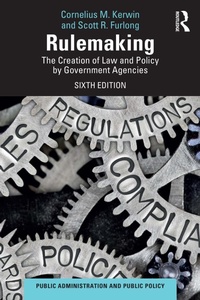
Rulemaking
The Creation of Law and Policy by Government Agencies
6th Edition
Published on 21. July 2025
396 pages
978-1-040-36428-4 (ISBN)
Description

Rulemaking refines, and in some instances defines, the mission of every government agency and affects the lives and activities of all citizens and often non-citizens. It provides directions and content for budgeting, program implementation, procurement, personnel management, dispute resolution, and other important government activities. In this substantially updated sixth edition, authors Kerwin and Furlong continue to offer the most comprehensive and accessible exploration of the most critical source of law and policy in the United States today. As they demonstrate, anyone interested in developing a sophisticated understanding of the operation of our political system or any aspect of the public policy process must develop a working knowledge of rulemaking. New to the sixth edition:
New examples and case studies incorporated throughout the text, including a thorough examination of West Virginia v. EPA to introduce the concept of rulemaking
New material that updates coverage of the Trump I and Biden presidencies, as well as the landmark Supreme Court decision in Loper Industries v. Raimondo that repudiates the Chevron Doctrine and calls for greater direction from Congress in delegations of rulemaking authority
A significantly reformulated chapter on Measures of Rulemaking Success from a policy analysis perspective with discussion on efficiency, effectiveness, equity, and more. It also addresses expectations that various stakeholders have for rulemaking, including quality, volume, timeliness, effectiveness, efficiency, and equity
Additional analysis of the use of alternatives to conventional rulemaking, including executive orders and related presidential communications and guidance documents of various sorts exploring the positive and negative effects of executive orders and presidential memoranda, guidance documents, technical corrections, and so-called "Dear Colleague" letters
An entirely new chapter, Information, that focuses on the different forms of information agencies need to write rules. The categories include information on the law, policy, implementation, impact, public participation, and management. In addition to defining and distinguishing these types, the authors cover the sources agencies rely on to secure each type of information
A significantly reformulated concluding chapter that continues to develop a theory of rulemaking and considers the influences on rulemaking and serious attempts at rulemaking reform from scholars, organizations, and institutions whose mission is the advancement of better government
The breadth of the authors' approach makes Rulemaking an essential primary text for advanced undergraduate and graduate courses on public policy, public administration, and political science. It also serves as an important supplementary text for related courses in schools of law and business.
New examples and case studies incorporated throughout the text, including a thorough examination of West Virginia v. EPA to introduce the concept of rulemaking
New material that updates coverage of the Trump I and Biden presidencies, as well as the landmark Supreme Court decision in Loper Industries v. Raimondo that repudiates the Chevron Doctrine and calls for greater direction from Congress in delegations of rulemaking authority
A significantly reformulated chapter on Measures of Rulemaking Success from a policy analysis perspective with discussion on efficiency, effectiveness, equity, and more. It also addresses expectations that various stakeholders have for rulemaking, including quality, volume, timeliness, effectiveness, efficiency, and equity
Additional analysis of the use of alternatives to conventional rulemaking, including executive orders and related presidential communications and guidance documents of various sorts exploring the positive and negative effects of executive orders and presidential memoranda, guidance documents, technical corrections, and so-called "Dear Colleague" letters
An entirely new chapter, Information, that focuses on the different forms of information agencies need to write rules. The categories include information on the law, policy, implementation, impact, public participation, and management. In addition to defining and distinguishing these types, the authors cover the sources agencies rely on to secure each type of information
A significantly reformulated concluding chapter that continues to develop a theory of rulemaking and considers the influences on rulemaking and serious attempts at rulemaking reform from scholars, organizations, and institutions whose mission is the advancement of better government
The breadth of the authors' approach makes Rulemaking an essential primary text for advanced undergraduate and graduate courses on public policy, public administration, and political science. It also serves as an important supplementary text for related courses in schools of law and business.
More details
Series
Edition
6th edition
Language
English
Place of publication
London
United Kingdom
Publishing group
Taylor & Francis Ltd
Target group
Professional and scholarly
Illustrations
22 Tables, black and white; 4 Line drawings, black and white; 12 Halftones, black and white; 16 Illustrations, black and white
File size
12,59 MB
ISBN-13
978-1-040-36428-4 (9781040364284)
Copyright in bibliographic data and cover images is held by Nielsen Book Services Limited or by the publishers or by their respective licensors: all rights reserved.
Schweitzer Classification
Other editions
Additional editions
Cornelius M. Kerwin | Scott R. Furlong
Rulemaking
The Creation of Law and Policy by Government Agencies
Book
07/2025
6th Edition
Routledge
€98.80
Shipment within 10-20 days
Cornelius M. Kerwin | Scott R. Furlong
Rulemaking
The Creation of Law and Policy by Government Agencies
Book
07/2025
6th Edition
Routledge
€207.50
Shipment within 10-20 days
Persons
Cornelius M. Kerwin is President Emeritus and Professor of Public Administration and Policy at American University in Washington, DC, United States. Prior to serving as President, he also served as the University's Provost and the Dean of its School of Public Affairs. He is a fellow of the National Academy of Public Administration and is a past president of the National Association of Schools of Public Affairs and Administration. In addition to this book, he is author or co-author of numerous scholarly articles and professional reports and has served as consultant to a number of federal agencies. He is currently a trustee of the University of Rhode Island, United States.
Scott R. Furlong is Provost and Vice President for Academic Affairs and Professor of Political Science at the State University of New York (SUNY) at Oswego, United States. Prior to serving as Provost, he was Dean of the College of Arts, Humanities and Social Science (previously Liberal Arts and Science) at the University of Wisconsin-Green Bay, United States. In addition to this book, he is co-author of the book Public Policy: Politics, Analysis, and Alternatives (with Michael E. Kraft) currently in its eighth edition. He is also author or co-author of numerous scholarly articles.
Scott R. Furlong is Provost and Vice President for Academic Affairs and Professor of Political Science at the State University of New York (SUNY) at Oswego, United States. Prior to serving as Provost, he was Dean of the College of Arts, Humanities and Social Science (previously Liberal Arts and Science) at the University of Wisconsin-Green Bay, United States. In addition to this book, he is co-author of the book Public Policy: Politics, Analysis, and Alternatives (with Michael E. Kraft) currently in its eighth edition. He is also author or co-author of numerous scholarly articles.
Content
1. The Substance of Rules and the Reasons for Rulemaking 2. Measures of Rulemaking Success 3. The Process of Rulemaking 4. Information 5. Participation in Rulemaking 6. Oversight of Rulemaking 7. The Management of Rulemaking 8. Rulemaking: Theory, Reform, and Resilience
