

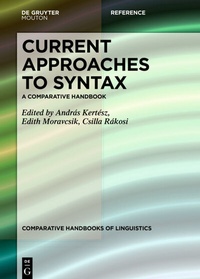
Current Approaches to Syntax
A Comparative Handbook
1st Edition
Published on 6. May 2019
XVI, 600 pages
978-3-11-053837-3 (ISBN)
Description

Even though the range of phenomena syntactic theories intend to account for is basically the same, the large number of current approaches to syntax shows how differently these phenomena can be interpreted, described, and explained. The goal of the volume is to probe into the question of how exactly these frameworks differ and what if anything they have in common.
Descriptions of a sample of current approaches to syntax are presented by their major practitioners (Part I) followed by their metatheoretical underpinnings (Part II). Given that the goal is to facilitate a systematic comparison among the approaches, a checklist of issues was given to the contributors to address. The main headings are Data, Goals, Descriptive Tools, and Criteria for Evaluation. The chapters are structured uniformly allowing an item-by-item survey across the frameworks. The introduction lays out the parameters along which syntactic frameworks must be the same and how they may differ and a final paper draws some conclusions about similarities and differences.
The volume is of interest to descriptive linguists, theoreticians of grammar, philosophers of science, and studies of the cognitive science of science.
Descriptions of a sample of current approaches to syntax are presented by their major practitioners (Part I) followed by their metatheoretical underpinnings (Part II). Given that the goal is to facilitate a systematic comparison among the approaches, a checklist of issues was given to the contributors to address. The main headings are Data, Goals, Descriptive Tools, and Criteria for Evaluation. The chapters are structured uniformly allowing an item-by-item survey across the frameworks. The introduction lays out the parameters along which syntactic frameworks must be the same and how they may differ and a final paper draws some conclusions about similarities and differences.
The volume is of interest to descriptive linguists, theoreticians of grammar, philosophers of science, and studies of the cognitive science of science.
More details
Other editions
Additional editions
Book
02/2024
1st Edition
De Gruyter Mouton
€400.00
Shipment within 7-9 days

Book
07/2019
1st Edition
De Gruyter Mouton
€339.00
The article will not be published
E-Book
05/2019
1st Edition
De Gruyter Mouton
€400.00
Available for download
Persons
András Kertész
, Debrecen, Hungary;
Edith Moravcsik
, Milwaukee, WI, USA;
Csilla Rákosi
, Debrecen, Hungary.
