

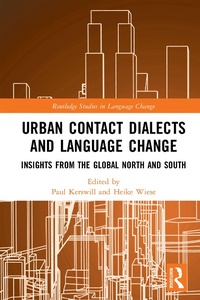
Urban Contact Dialects and Language Change
Insights from the Global North and South
1st Edition
Published on 30. March 2022
368 pages
978-0-429-94747-6 (ISBN)
Description

This volume provides a systematic comparative treatment of urban contact dialects in the Global North and South, examining the emergence and development of these dialects in major cities in sub-Saharan Africa and North-Western Europe.
The book's focus on contemporary urban settings sheds light on the new language practices and mixed ways of speaking resulting from large-scale migration and the intense contact that occurs between new and existing languages and dialects in these contexts. In comparing these new patterns of language variation and change between cities in both Africa and Europe, the volume affords us a unique opportunity to examine commonalities in linguistic phenomena as well as sociolinguistic differences in societally multilingual settings and settings dominated by a strong monolingual habitus.
These comparisons are reinforced by a consistent chapter structure, with each chapter presenting the linguistic and social context of the region, information on available data (including corpora), sociolinguistic and structural findings, a discussion of the status of the urban contact dialect, and its stability over time. The discussion in the book is further enriched by short commentaries from researchers contributing different theoretical and geographical perspectives.
Taken as a whole, the book offers new insights into migration-based linguistic diversity and patterns of language variation and change, making this ideal reading for students and scholars in general linguistics and language structure, sociolinguistics, creole studies, diachronic linguistics, language acquisition, anthropological linguistics, language education and discourse analysis.
The book's focus on contemporary urban settings sheds light on the new language practices and mixed ways of speaking resulting from large-scale migration and the intense contact that occurs between new and existing languages and dialects in these contexts. In comparing these new patterns of language variation and change between cities in both Africa and Europe, the volume affords us a unique opportunity to examine commonalities in linguistic phenomena as well as sociolinguistic differences in societally multilingual settings and settings dominated by a strong monolingual habitus.
These comparisons are reinforced by a consistent chapter structure, with each chapter presenting the linguistic and social context of the region, information on available data (including corpora), sociolinguistic and structural findings, a discussion of the status of the urban contact dialect, and its stability over time. The discussion in the book is further enriched by short commentaries from researchers contributing different theoretical and geographical perspectives.
Taken as a whole, the book offers new insights into migration-based linguistic diversity and patterns of language variation and change, making this ideal reading for students and scholars in general linguistics and language structure, sociolinguistics, creole studies, diachronic linguistics, language acquisition, anthropological linguistics, language education and discourse analysis.
More details
Series
Edition
1. Auflage
Language
English
Place of publication
London
United Kingdom
Publishing group
Taylor & Francis Ltd
Target group
College/higher education
Product notice
Reflowable
Illustrations
16 Tables, black and white; 8 Halftones, black and white; 8 Illustrations, black and white
ISBN-13
978-0-429-94747-6 (9780429947476)
Copyright in bibliographic data and cover images is held by Nielsen Book Services Limited or by the publishers or by their respective licensors: all rights reserved.
Schweitzer Classification
Other editions
Additional editions
Paul Kerswill | Heike Wiese
Urban Contact Dialects and Language Change
Insights from the Global North and South
Book
01/2024
1st Edition
Routledge
€64.20
Shipment within 10-20 days
Paul Kerswill | Heike Wiese
Urban Contact Dialects and Language Change
Insights from the Global North and South
Book
03/2022
1st Edition
Routledge
€207.30
Shipment within 10-20 days
Persons
Paul Kerswill is Emeritus Professor of Sociolinguistics at the University of York, UK. His research focuses particularly on dialect and language contact resulting from migration. With Jenny Cheshire, Sue Fox and Eivind Torgersen, he has published "Contact, the Feature Pool and the Speech Community: The emergence of Multicultural London English" (Journal of Sociolinguistics).
Heike Wiese is Professor of German in Multilingual Contexts and founder of the Centre "Language in Urban Diversity" at Humboldt-Universitaet in Berlin. Her 2012 monograph on Kiezdeutsch as a new German dialect received national and international media attention, and raised awareness of urban contact dialects as a legitimate part of the linguistic landscape.
Heike Wiese is Professor of German in Multilingual Contexts and founder of the Centre "Language in Urban Diversity" at Humboldt-Universitaet in Berlin. Her 2012 monograph on Kiezdeutsch as a new German dialect received national and international media attention, and raised awareness of urban contact dialects as a legitimate part of the linguistic landscape.
Content
Introduction, by Paul Kerswill and Heike Wiese
PART A: MULTILINGUAL SOCIETAL HABITUS
Chapter 1: Cameroon: Camfranglais, by Roland Kiessling
Chapter 2: Democratic Republic of the Congo: Lingala ya Bayankee/Yanke, by Nico Nassenstein
Chapter 3: Senegal: Urban Wolof then and now, by Fiona Mc Laughlin
Chapter 4: South Africa: Tsotsitaal and urban vernacular forms of South African languages, by Ellen Hurst-Harosh
Chapter 5: Ghana: Ghanaian Student Pidgin English, by Dorothy Pokua Agyepong and Nana Aba Appiah Amfo
Chapter 6: Kenya: Sheng and Engsh, by Maarten Mous and Sandra Barasa
Chapter 7: Finland: Old Helsinki slang, by Heini Lehtonen and Heikki Paunonen
Commentaries:
Chapter 8: Baby steps in decolonising linguistics: Urban language research, by Miriam Meyerhoff
Chapter 9: Variation, complexity and the richness of urban contact dialects, by Joseph Salmons
PART B: MONOLINGUAL SOCIETAL HABITUS
Chapter 10: Tanzania: Lugha ya Mitaani, by Uta Reuster-Jahn and Roland Kiessling
Chapter 11: Denmark: Danish urban contact dialects, by Pia Quist
Chapter 12: Norway: Contemporary urban speech styles, by Bente A. Svendsen
Chapter 13: The Netherlands: Urban contact dialects, by Frans Hinskens, Khalid Mourigh and Pieter Muysken
Chapter 14: Sweden: Suburban Swedish, by Johan Gross and Sally Boyd
Chapter 15: France: Youth vernaculars in Paris and surroundings, by Francoise Gadet
Chapter 16: United Kingdom: Multicultural London English, by Paul Kerswill
Chapter 17: Germany: Kiezdeutsch, by Yazguel Simsek and Heike Wiese
Commentaries:
Chapter 18: Ethnolects, multiethnolects and urban contact dialects: Looking forward, looking back, looking around, by David Britain
Chapter 19: Migrants and urban contact sociolinguistics in Africa and Europe, by Rajend Mesthrie
PART A: MULTILINGUAL SOCIETAL HABITUS
Chapter 1: Cameroon: Camfranglais, by Roland Kiessling
Chapter 2: Democratic Republic of the Congo: Lingala ya Bayankee/Yanke, by Nico Nassenstein
Chapter 3: Senegal: Urban Wolof then and now, by Fiona Mc Laughlin
Chapter 4: South Africa: Tsotsitaal and urban vernacular forms of South African languages, by Ellen Hurst-Harosh
Chapter 5: Ghana: Ghanaian Student Pidgin English, by Dorothy Pokua Agyepong and Nana Aba Appiah Amfo
Chapter 6: Kenya: Sheng and Engsh, by Maarten Mous and Sandra Barasa
Chapter 7: Finland: Old Helsinki slang, by Heini Lehtonen and Heikki Paunonen
Commentaries:
Chapter 8: Baby steps in decolonising linguistics: Urban language research, by Miriam Meyerhoff
Chapter 9: Variation, complexity and the richness of urban contact dialects, by Joseph Salmons
PART B: MONOLINGUAL SOCIETAL HABITUS
Chapter 10: Tanzania: Lugha ya Mitaani, by Uta Reuster-Jahn and Roland Kiessling
Chapter 11: Denmark: Danish urban contact dialects, by Pia Quist
Chapter 12: Norway: Contemporary urban speech styles, by Bente A. Svendsen
Chapter 13: The Netherlands: Urban contact dialects, by Frans Hinskens, Khalid Mourigh and Pieter Muysken
Chapter 14: Sweden: Suburban Swedish, by Johan Gross and Sally Boyd
Chapter 15: France: Youth vernaculars in Paris and surroundings, by Francoise Gadet
Chapter 16: United Kingdom: Multicultural London English, by Paul Kerswill
Chapter 17: Germany: Kiezdeutsch, by Yazguel Simsek and Heike Wiese
Commentaries:
Chapter 18: Ethnolects, multiethnolects and urban contact dialects: Looking forward, looking back, looking around, by David Britain
Chapter 19: Migrants and urban contact sociolinguistics in Africa and Europe, by Rajend Mesthrie
