

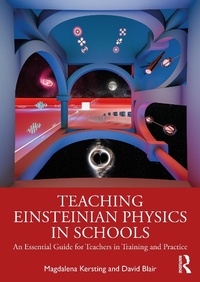
Teaching Einsteinian Physics in Schools
An Essential Guide for Teachers in Training and Practice
1st Edition
Published on 30. August 2021
450 pages
978-1-000-37410-0 (ISBN)
Description

In our world today, scientists and technologists speak one language of reality. Everyone else, whether they be prime ministers, lawyers, or primary school teachers speak an outdated Newtonian language of reality.
While Newton saw time and space as rigid and absolute, Einstein showed that time is relative - it depends on height and velocity - and that space can stretch and distort. The modern Einsteinian perspective represents a significant paradigm shift compared with the Newtonian paradigm that underpins most of the school education today. Research has shown that young learners quickly access and accept Einsteinian concepts and the modern language of reality. Students enjoy learning about curved space, photons, gravitational waves, and time dilation; often, they ask for more!
A consistent education within the Einsteinian paradigm requires rethinking of science education across the entire school curriculum, and this is now attracting attention around the world. This book brings together a coherent set of chapters written by leading experts in the field of Einsteinian physics education. The book begins by exploring the fundamental concepts of space, time, light, and gravity and how teachers can introduce these topics at an early age. A radical change in the curriculum requires new learning instruments and innovative instructional approaches. Throughout the book, the authors emphasise and discuss evidence-based approaches to Einsteinian concepts, including computer- based tools, geometrical methods, models and analogies, and simplified mathematical treatments.
Teaching Einsteinian Physics in Schools is designed as a resource for teacher education students, primary and secondary science teachers, and for anyone interested in a scientifically accurate description of physical reality at a level appropriate for school education.
While Newton saw time and space as rigid and absolute, Einstein showed that time is relative - it depends on height and velocity - and that space can stretch and distort. The modern Einsteinian perspective represents a significant paradigm shift compared with the Newtonian paradigm that underpins most of the school education today. Research has shown that young learners quickly access and accept Einsteinian concepts and the modern language of reality. Students enjoy learning about curved space, photons, gravitational waves, and time dilation; often, they ask for more!
A consistent education within the Einsteinian paradigm requires rethinking of science education across the entire school curriculum, and this is now attracting attention around the world. This book brings together a coherent set of chapters written by leading experts in the field of Einsteinian physics education. The book begins by exploring the fundamental concepts of space, time, light, and gravity and how teachers can introduce these topics at an early age. A radical change in the curriculum requires new learning instruments and innovative instructional approaches. Throughout the book, the authors emphasise and discuss evidence-based approaches to Einsteinian concepts, including computer- based tools, geometrical methods, models and analogies, and simplified mathematical treatments.
Teaching Einsteinian Physics in Schools is designed as a resource for teacher education students, primary and secondary science teachers, and for anyone interested in a scientifically accurate description of physical reality at a level appropriate for school education.
Reviews / Votes
Science doesn't stop moving; our curriculum must also keep up with the times. This book will help teachers convey to our children the fundamental principles of the machinery of our universe- Alan Simon Finkel, AO FAA FTSE, Australia's Chief ScientistMore than 75 years after his death, Albert Einstein remains a colossal figure in the scientific world, renowned not only for his scientific theories - which underpin almost every aspect of our modern understanding of the cosmos - but also for the way in which he thought about physics. Einstein combined mathematical rigour and logical clarity with a creativity and imagination that helped to revolutionise our concepts of space and time and the very nature of reality. This outstanding textbook takes the reader on a comprehensive exploration of Einstein's scientific legacy - arguing convincingly that both what Einstein discovered about physics, and how he made those discoveries, should be an essential ingredient of any modern science education- Martin Hendry, Professor of Gravitational Astrophysics and Cosmology and Head of the School of Physics and Astronomy at the University of Glasgow
There is a pressing need to modernise the school curriculum. It is over 100 years since Einstein published his theory of relativity, but it hardly features in school curricula. Perhaps it is because the concepts are complex and we are still finding ways to better teach classical ideas, but unless the curriculum can be modernised there is a danger that it will become outdated and disconnected from the complex ideas that students will encounter at university. Teaching Einsteinian Physics in Schools is an important book. The authors are experts in both relativity physics and education and this book brings together the evidence of their own experiences and researches collected over many years. I recommend this book to anyone aspiring to bring Einsteinian physics into the classroom- David Sands, PhD, FInstP, CPhys, NTF, PFHEA, Chair, Physics Education Division of the European Physical Society
If we want to teach kids about the world as we understand it, we need to teach them modern science - our most complete knowledge to date. Science literacy is extremely important in our media-filled world, and the scientific topics being discussed today are things like renewable energy and black holes, not old textbook concepts from the 19th century. And the best part - not only is modern science more accurate and comprehensive, it's also more exciting!- Dr. Derek Muller, creator of the Veritasium YouTube channel
More details
Edition
1. Auflage
Language
English
Place of publication
London
United Kingdom
Publishing group
Taylor & Francis Ltd
Target group
College/higher education
Illustrations
14 Tables, black and white; 27 Line drawings, color; 119 Halftones, color; 146 Illustrations, color
ISBN-13
978-1-000-37410-0 (9781000374100)
Copyright in bibliographic data and cover images is held by Nielsen Book Services Limited or by the publishers or by their respective licensors: all rights reserved.
Schweitzer Classification
Other editions
Additional editions
Magdalena Kersting | David Blair
Teaching Einsteinian Physics in Schools
An Essential Guide for Teachers in Training and Practice
Book
08/2021
1st Edition
Routledge
€179.81
Shipment within 15-20 days
Magdalena Kersting | David Blair
Teaching Einsteinian Physics in Schools
An Essential Guide for Teachers in Training and Practice
Book
08/2021
1st Edition
Allen & Unwin
€89.70
Shipment within 3-4 weeks
Persons
Magdalena Kersting is an educational researcher, physics educator, and science communicator with a keen interest in getting students excited about Einsteinian physics. Based at the University of Oslo in Norway, Magdalena collaborates with scientists, educators, and teachers around the world to bring great science education to as many students as possible. She believes that Einsteinian physics education can help students think more clearly about complex ideas and, eventually, enable them to build a better future. ?
David Blair is a pioneer in gravitational wave research with a passion for education. This led him to found both the Australian International Gravitational Research Centre and the Gravity Discovery Centre. The research centre played a significant role in the discovery of gravitational waves, and is now part of the ARC Centre of Excellence for Gravitational Wave Discovery, OzGrav. The Gravity Discovery Centre was set up as an education centre to bring Einsteinian physics to schools and the public. He leads the Einstein-First Project, which is developing a complete Einsteinian physics science curriculum from primary to high school.
David Blair is a pioneer in gravitational wave research with a passion for education. This led him to found both the Australian International Gravitational Research Centre and the Gravity Discovery Centre. The research centre played a significant role in the discovery of gravitational waves, and is now part of the ARC Centre of Excellence for Gravitational Wave Discovery, OzGrav. The Gravity Discovery Centre was set up as an education centre to bring Einsteinian physics to schools and the public. He leads the Einstein-First Project, which is developing a complete Einsteinian physics science curriculum from primary to high school.
Content
Section 1: Motivations and needs to teach Einsteinian physics. Chapter 1. Intuition in Einsteinian physics. Chapter 2. Time for changing paradigms in science and in education. Chapter 3. The difficult birth of quantum physics. Chapter 4. The difficult birth of gravitational wave astronomy. Section 2: Instructional approaches to teach Einsteinian physics. Special Relativity. Chapter 5 - Dynamics first - a novel approach to relativity. Chapter 6. Event diagrams - supporting student reasoning in special relativity through thought experiments. Chapter 7. Introducing relativity on rotated graph paper. Chapter 8. Pushing the boundaries of Einsteinian physics education using virtual reality technology. General Relativity. Chapter 9. Standing on the shoulders of giants - how historical perspectives on gravity can inform modern physics education. Chapter 10. Models and analogies in teaching general relativity. Chapter 11. Gravitational lensing as a focal point for teaching general relativity. Chapter 12. Introducing the geometric concepts of general relativity with sector models. Chapter 13. Where do gravitational waves come from, and how can we detect more? . Chapter 14. Using the language of gravity to teach about space, time, and matter in general relativity. Quantum Physics. Chapter 15. Introducing quantum physics with toy photons. Chapter 16. Teaching quantum physics to middle and high school students using phasor-wheels. Chapter 17 - David Blair: Gold, Einstein's Metal. Chapter 18. Patterns and atoms: the structure of atomic matter. Section 3: Introducing Einsteinian physics around the world. Chapter 19. Designing learning resources and investigating student motivation and learning in general relativity and quantum physics in Norway. Chapter 20. Towards a comprehensive general relativity course for secondary school. Chapter 21. Australia: Einstein-First: modernising the school physics curriculum in Western Australia and beyond. Chapter 22. Scotland: The introduction of Einsteinian physics to the upper secondary school physics curriculum in Scotland: experiences and observations. Chapter 23. Netherlands: Towards a study module on general relativity in the Netherlands. Chapter 24. Czech Republic: Introducing general relativity without special relativity - classroom experience from the Czech Republic. Chapter 25. South Korea: Toward understanding Einsteinian physics education: relativity education as an exemplar
