

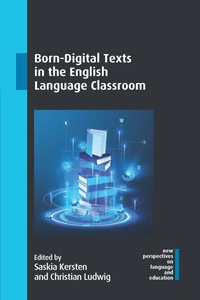
Born-Digital Texts in the English Language Classroom
Published on 11. June 2024
292 pages
978-1-80041-482-2 (ISBN)
Description

This book is the first to focus specifically on born-digital texts in EFL teaching, uniting international and innovative scholarship with practical classroom applications. The book develops a theoretically sound framework for curriculum, materials and methods design that takes into account the growing ubiquity of born-digital texts in the digital age. It covers a broad variety of born-digital text types (including those generated by AI) which so far have not been an explicit focus in the context of language teaching, while also providing a grounding in current discussions around digital tools in education. The chapters cover a wide range of issues from methodological approaches to born-digital texts to curriculum, syllabus and materials design. The book will be a valuable introduction to the subject for trainee and practising teachers, as well as teacher educators and students on EFL courses.
Chapter 7 is free to download as an open access publication under a CC BY licence and is available here: https://zenodo.org/records/11174197.
Chapter 7 is free to download as an open access publication under a CC BY licence and is available here: https://zenodo.org/records/11174197.
Reviews / Votes
Immerse yourself in the future of language learning with Born-Digital Texts in the English Language Classroom. This ground-breaking volume explores the myriad ways in which digitally born texts are revolutionising language learning, offering insights into established approaches and innovative curriculum design. From hashtags to AI, this collection empowers educators to navigate digital transformation and inspire change. * Maria Eisenmann, Julius-Maximilians-Universitaet Wuerzburg, Germany * This book provides an important, stimulating and accessible new set of critical reflections and empirical research reports. The chapters, from varying contexts, focus on both theoretical and practical issues arising from the need for fundamental rethinking of educational practices still largely based on print literacy in an age of digital literacies. Highly recommended. * Geoff Hall, University of Nottingham Ningbo China * This wide-ranging examination of born-digital texts from a variety of theoretical, linguistic and pedagogical perspectives is an important introduction both to the plethora of text types in the born-digital landscape - from tweets and hashtags to fanfiction - and to the many ways of using such texts in the classroom. The book's treatment of AI and its educational challenges is particularly timely in the post-truth society in which we find ourselves. * Amos Paran, IOE, UCL's Faculty of Education and Society, UK *More details
Series
Language
English
Place of publication
Bristol
United Kingdom
Target group
College/higher education
Product notice
Reflowable
ISBN-13
978-1-80041-482-2 (9781800414822)
Copyright in bibliographic data and cover images is held by Nielsen Book Services Limited or by the publishers or by their respective licensors: all rights reserved.
Schweitzer Classification
Other editions
Additional editions
Saskia Kersten | Christian Ludwig
Born-Digital Texts in the English Language Classroom
Book
06/2024
Multilingual Matters
€42.60
Shipment within 10-20 days
Persons
Saskia Kersten is Professor of Applied Linguistics and Media Didactics at the Ludwig-Maximilians-Universitaet Muenchen, Germany. Her research interests are formulaic language, digitally-mediated interaction, including its use in the EFL classroom, and corpus linguistic methods in interdisciplinary research.
Christian Ludwig is currently Visiting Professor at the Freie Universitaet Berlin, Germany. His research interests include literature and digital tools in language teaching as well as applying positive psychology in school settings.
Christian Ludwig is currently Visiting Professor at the Freie Universitaet Berlin, Germany. His research interests include literature and digital tools in language teaching as well as applying positive psychology in school settings.
Content
Acknowledgements
Chapter 1. Daniel Becker, Saskia Kersten, Christian Ludwig, Peter Schildhauer and Sandra Stadler-Heer: Born-Digital Text in English Language Teaching: The State of Play
Chapter 2. Saskia Kersten: The Linguistics of Born-Digital Texts
Chapter 3. Kathy A. Mills: What Counts as Language Learning in a Born-Digital Textual World?
Chapter 4. Celestine Caruso, Judith Hofmann and Kim Schick: Born-Digital Texts and Digitally Mediated Tasks: A Perfect Match for the Inclusive EFL Classroom?
Chapter 5. Ralf Giessler and Daniel Becker: #hashtagsareforlearning - Hashtags as Digital Texts and their Affordances in the EFL Classroom
Chapter 6. Peter Schildhauer and Katharina Kemper: Towards a Critical Digital Literacy Framework: Exploring the Impact of Algorithms in the Creation of Filter Bubbles on Instagram
Chapter 7. Valentin Werner: Exploring the Potential of Live Text for ELT
This chapter is open access under a CC BY licence and can be downloaded for free at: https://zenodo.org/records/11174197
Chapter 8. Janina Reinhardt: From Gaming to Linguistic Action: Let's Play Videos as (More Than) Mediation Tasks
Chapter 9. Sandra Stadler-Heer: Consuming and Producing Artificial Intelligence (AI)-Generated Text in English Language Classrooms
Chapter 10. Jasmina Najjar and Philip M. McCarthy: AI and the Digital Writing Process
Chapter 11. Christopher Rwodzi and Lizette J. De Jager: Learning English as a Second Language through Born-Digital Texts on Social Media in South Africa
Chapter 12. Maya Ashooh, Alecia Marie Magnifico and Bethany Silva: "I'm going to teach differently": Changing Perceptions of Writing Instruction through Digital Text Creation
Chapter 13. Tara McIlroy: Fanfiction Experiences of Japanese Students: Connecting Wild Reading and L2 Learning
Chapter 14. Carolin Zehne: The Potential of Location-Based Technologies and Mobile-Assisted Language Learning for ELT
Chapter 15. Jeanine Steinbock: Alice for the iPad: Digital Storybook Apps in the EFL Classroom
Chapter 16. Christian Ludwig, Michaela Sambanis and Georg Hartisch: #Literature Goes Digital: Digital Transformations in the ELT Literature Classroom
Index
Chapter 1. Daniel Becker, Saskia Kersten, Christian Ludwig, Peter Schildhauer and Sandra Stadler-Heer: Born-Digital Text in English Language Teaching: The State of Play
Chapter 2. Saskia Kersten: The Linguistics of Born-Digital Texts
Chapter 3. Kathy A. Mills: What Counts as Language Learning in a Born-Digital Textual World?
Chapter 4. Celestine Caruso, Judith Hofmann and Kim Schick: Born-Digital Texts and Digitally Mediated Tasks: A Perfect Match for the Inclusive EFL Classroom?
Chapter 5. Ralf Giessler and Daniel Becker: #hashtagsareforlearning - Hashtags as Digital Texts and their Affordances in the EFL Classroom
Chapter 6. Peter Schildhauer and Katharina Kemper: Towards a Critical Digital Literacy Framework: Exploring the Impact of Algorithms in the Creation of Filter Bubbles on Instagram
Chapter 7. Valentin Werner: Exploring the Potential of Live Text for ELT
This chapter is open access under a CC BY licence and can be downloaded for free at: https://zenodo.org/records/11174197
Chapter 8. Janina Reinhardt: From Gaming to Linguistic Action: Let's Play Videos as (More Than) Mediation Tasks
Chapter 9. Sandra Stadler-Heer: Consuming and Producing Artificial Intelligence (AI)-Generated Text in English Language Classrooms
Chapter 10. Jasmina Najjar and Philip M. McCarthy: AI and the Digital Writing Process
Chapter 11. Christopher Rwodzi and Lizette J. De Jager: Learning English as a Second Language through Born-Digital Texts on Social Media in South Africa
Chapter 12. Maya Ashooh, Alecia Marie Magnifico and Bethany Silva: "I'm going to teach differently": Changing Perceptions of Writing Instruction through Digital Text Creation
Chapter 13. Tara McIlroy: Fanfiction Experiences of Japanese Students: Connecting Wild Reading and L2 Learning
Chapter 14. Carolin Zehne: The Potential of Location-Based Technologies and Mobile-Assisted Language Learning for ELT
Chapter 15. Jeanine Steinbock: Alice for the iPad: Digital Storybook Apps in the EFL Classroom
Chapter 16. Christian Ludwig, Michaela Sambanis and Georg Hartisch: #Literature Goes Digital: Digital Transformations in the ELT Literature Classroom
Index
