

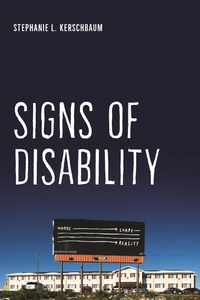
Signs of Disability
Published on 13. December 2022
277 pages
978-1-4798-1118-2 (ISBN)
Description

How can we learn to notice the signs of disability?
We see indications of disability everywhere: yellow diamond-shaped "deaf person in area" road signs, the telltale shapes of hearing aids, or white-tipped canes sweeping across footpaths. But even though the signs are ubiquitous, Stephanie L. Kerschbaum argues that disability may still not be perceived due to a process she terms "dis-attention."
To tell better stories of disability, this multidisciplinary work turns to rhetoric, communications, sociology, and phenomenology to understand the processes by which the material world becomes sensory input that then passes through perceptual apparatuses to materialize phenomena-including disability. By adding perception to the understanding of disability's materialization, Kerschbaum significantly expands our understanding of disability, accounting for its fluctuations and transformations in the semiotics of everyday life.
Drawing on a set of thirty-three research interviews focused on disabled faculty members' experiences with disability disclosure, as well as written narratives by disabled people, this book argues for the materiality of narrative, suggesting narratives as a means by which people enact boundaries around phenomena and determine their properties. Signs of Disability offers strategies and practices for challenging problematic and pervasive forms of "dis-attention" and proposes a new theoretical model for understanding disability in social, rhetorical, and material settings.
We see indications of disability everywhere: yellow diamond-shaped "deaf person in area" road signs, the telltale shapes of hearing aids, or white-tipped canes sweeping across footpaths. But even though the signs are ubiquitous, Stephanie L. Kerschbaum argues that disability may still not be perceived due to a process she terms "dis-attention."
To tell better stories of disability, this multidisciplinary work turns to rhetoric, communications, sociology, and phenomenology to understand the processes by which the material world becomes sensory input that then passes through perceptual apparatuses to materialize phenomena-including disability. By adding perception to the understanding of disability's materialization, Kerschbaum significantly expands our understanding of disability, accounting for its fluctuations and transformations in the semiotics of everyday life.
Drawing on a set of thirty-three research interviews focused on disabled faculty members' experiences with disability disclosure, as well as written narratives by disabled people, this book argues for the materiality of narrative, suggesting narratives as a means by which people enact boundaries around phenomena and determine their properties. Signs of Disability offers strategies and practices for challenging problematic and pervasive forms of "dis-attention" and proposes a new theoretical model for understanding disability in social, rhetorical, and material settings.
Reviews / Votes
"This engaging, accessible book builds on Stephanie Kerschbaum's already-award- winning scholarship on difference and discourse, constructing new research methods and approaches, but also building community on these pages. Signs of Disability offers an incredibly generative vocabulary for understanding the ways that disability matters: how we mark and signal it, how we ignore and hide it, how we powerfully inhabit and embody it through stories. Signs of Disability is a transformative book." (Jay Dolmage, University of Waterloo) "A lovely, powerful read, Signs of Disability makes consequential, engaging, and evocative contributions to scholarship in disability studies and in rhetorical studies. The book's theoretical and methodological interventions are significant and it offers cogent readings of texts, material culture, bodies, and more. Stephanie Kerschbaum tells powerful stories and draws readers deeply into the material life of disability and its signs." (Christa J. Olson, University of Wisconsin-Madison)More details
Series
Language
English
Place of publication
New York
United States
Target group
Professional and scholarly
Illustrations
14 b/w illustration
ISBN-13
978-1-4798-1118-2 (9781479811182)
Copyright in bibliographic data and cover images is held by Nielsen Book Services Limited or by the publishers or by their respective licensors: all rights reserved.
Schweitzer Classification
Other editions
Additional editions
Stephanie L. Kerschbaum
Signs of Disability
Book
12/2022
New York University Press
€34.50
Shipment within 10-20 days
Person
Stephanie L. Kerschbaum is Associate Professor in the Department of English at the University of Washington and author of Toward a New Rhetoric of Difference.
