

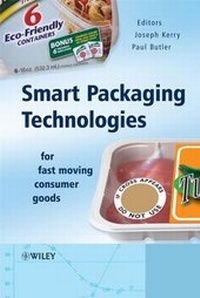
Smart Packaging Technologies for Fast Moving Consumer Goods
Description

More details
Other editions
Additional editions
Persons
Content
Preface.
1. Active Packaging of Food (Brian P.F. Day).
1.1 Introduction and Background Information.
1.2 Oxygen Scavengers.
1.3 Carbon Dioxide Scavengers/Emitters.
1.4 Ethylene Scavengers.
1.5 Ethanol Emitters.
1.6 Preservative Releasers.
1.7 Moisture Absorbers.
1.8 Flavour/Odour Absorbers and Releasers.
1.9 Temperature Control Packaging.
1.10 Temperature Compensating Films.
1.11 Conclusions.
References.
2. Active Polymer Packaging of Non-Meat Food Products (Amparo López-Rubio, Jose Maria Lagarón and Maria Jose Ocio).
2.1 Introduction.
2.2 Bread and Bakery Products.
2.3 Fruits and Vegetables.
2.4 Dairy Products.
2.5 Fish and Seafood.
2.6 Outlook and Future Developments.
Acknowledgements.
References.
3. Smart Packaging of Meat and Poultry Products (S.A. Hogan and J.P. Kerry).
3.1 Introduction.
3.2 Oxygen Scavengers.
3.3 Carbon Dioxide Scavengers and Emitters.
3.4 Moisture Control.
3.5 Antimicrobial Packaging.
3.6 Sensors.
3.7 Indicators.
3.8 Radio Frequency Identification.
3.9 Potential Future Applications for Smart Packaging with Meat Products.
References.
4. Application of Time-Temperature Integrators for Monitoring and Management of Perishable Product Quality in the Cold Chain (Petros S. Taoukis).
4.1 Introduction.
4.2 Time-Temperature Integrators.
4.3 Cold Chain Management.
Acknowledgement.
References.
5. Smart Packaging Technologies for Fish and Seafood Products (Alexis Pacquit, Karl Crowley and Dermot Diamond).
5.1 Introduction.
5.2 What Are the Parameters of Fish Quality?
5.3 Mechanisms of Fish Spoilage.
5.4 On-pack Quality Indicators.
5.5 Time-Temperature Integrators.
5.6 Food Quality Indicators.
5.7 Overview: TTI versus FQI.
5.8 Modified Atmosphere Packaging (MAP).
5.9 Conclusion.
Acknowledgements.
References.
6. Antimicrobial Packaging for Food (Young-Teck Kim, Kyungwon Kim, Jung H. Han and Robert M. Kimmel).
6.1 Background of Antimicrobial Packaging Systems for Food.
6.2 Governmental Encouragement.
6.3 Demand for Antimicrobial and Disinfectant Chemicals in the U.S Market.
6.4 History of Antimicrobial Packaging in Industry.
6.5 Antimicrobial Agents in Use for Commercialization.
6.6 Mechanism of Antimicrobial Packaging Systems.
6.7 Design of Antimicrobial Packaging Systems.
6.8 Prognosis for Commercialization.
6.9 The Future of Antimicrobial Packaging Systems.
References.
7. Freshness Indicators for Food Packaging (Maria Smolander).
7.1 Introduction.
7.2 Freshness Indicators for Quality Indicating Metabolites.
7.3 Volatile Nitrogen Compounds.
7.4 Biogenic Amines.
7.5 Carbon Dioxide.
7.6 Other Quality Indicators for Microbial Spoilage and Contamination.
References.
8. An Active Moisture-Management Packaging System for Food and Other Products: A Case Study (Robert Esse and Albert Saari).
8.1 Introduction.
8.2 Principles of Moisture-Management and Water Activity.
8.3 Moisture Sorption Isotherm.
8.4 An Active Moisture-Management System.
8.5 Mold Inhibition.
8.6 Printing Potassium Sorbate.
8.7 Packaging Executions.
8.8 Marketplace Executions and Testing.
8.9 Competitive Technology.
8.10 Future Trends.
References.
9. Smart Packaging Technologies for Fruits and Vegetables (M.F.F. Poças, T.F. Delgado and F.A.R. Oliveira).
9.1 Introduction.
9.2 Packaging Requirements for Fruits and Vegetables.
9.3 Time-Temperature Indicators.
9.4 Breathable Materials.
9.5 Gas and Volatiles Indicators.
9.6 RFID in the Fresh and Minimally Processed Fruits and Vegetables.
References.
10. The Influence of Product and Packaging Characteristics on Passive RFID Readability (Robb Clarke).
10.1 Introduction.
10.2 What Is Packaging?
10.3 Discussion of Specific Packaging Materials.
10.4 The Influence of Product and Packaging Materials on RFID.
10.5 The Influence of Packaging System Characteristics on RFID.
10.6 Chapter Summary.
References.
11. How Marks & Spencer is Using RFID to Improve Customer Service and Business Efficiency: A Case Study (James Stafford).
11.1 Marks and Spencer Foods.
11.2 Marks and Spencer Clothing.
12. Smart Packaging Technologies for Beverage Products (Maurice G. O'Sullivan and Joseph P. Kerry).
12.1 Introduction.
12.2 Gas Release Packaging.
12.3 Flavour Release Packaging.
12.4 Nutrient Release Packaging.
12.5 Pro-biotic Release Packaging.
12.6 Enzyme Release Packaging.
12.7 Odour Removal Packaging.
12.8 Thermochromic Labelling.
12.9 Smart Branding.
12.10 Anti-Counterfeit Beverage Packaging.
12.11 Tamper-proof Packaging.
References.
13. Consumer Benefits and Convenience Aspects of Smart Packaging (Paul Butler).
13.1 Introduction.
13.2 Evaluating the Consumer Value Proposition.
13.3 Improving Convenience in Product Use.
13.4 Improving Convenience for On-the-go Food and Drink Consumption.
13.5 Adding New Convenience Functionality - Self-Heating and Self-Cooling Packaging.
13.6 Improving Openability in Packaging.
13.7 Making Packaging Reusable for Other Functions.
13.8 Summary.
Reference.
14. Smart Packaging Technologies used with Aerosol and Household Cleaning Sprays (Lindsey Gaunt).
14.1 Introduction.
14.2 Electrostatic Spraying.
14.3 Natural Charge Separation Phenomenon.
14.4 Flow Electrification for Charge Separation.
14.5 Frictional Charging.
14.6 Domestic Aerosol Sprays.
14.7 Induction Charging for Charge Separation.
14.8 Realised Benefits.
14.9 Conclusions.
Acknowledgements.
References.
15. Smart Packaging in the Health, Beauty & Personal Care Sectors (Paul Butler).
15.1 Introduction - Drivers and Packaging Needs.
15.2 Current Smart Packaging Examples.
15.3 Latest Developments and Future Opportunities.
16. Laser Surface Authentication - Biometrics for Brand Protection of Goods and Packaging (Russell Cowburn).
16.1 Introduction.
16.2 Naturally Occurring Randomness.
16.3 Diffuse Laser Scattering.
16.4 The Statistics of LSA.
16.5 The Practicalities of Using LSA.
16.6 Applications and Advantages of LSA.
References.
17. Legislative Issues Relating to Smart Packaging (Rinus Rijk).
17.1 Introduction.
17.2 Smart Packaging.
17.3 Legislation Relevant to Smart Packaging.
17.4 Demonstration of Compliance of Active and Intelligent Packaging.
17.5 Conclusions.
References.
Index.
