

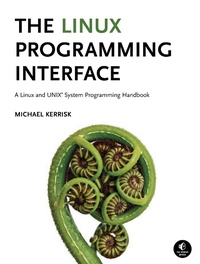
The Linux Programming Interface
A Linux and UNIX System Programming Handbook
Published on 1. October 2010
1552 pages
978-1-59327-291-3 (ISBN)
Description

The Linux Programming Interface (TLPI) is the definitive guide to the Linux and UNIX programming interface--the interface employed by nearly every application that runs on a Linux or UNIX system. In this authoritative work, Linux programming expert Michael Kerrisk provides detailed descriptions of the system calls and library functions that you need in order to master the craft of system programming, and accompanies his explanations with clear, complete example programs. You'll find descriptions of over 500 system calls and library functions, and more than 200 example programs, 88 tables, and 115 diagrams. You'll learn how to: -Read and write files efficiently -Use signals, clocks, and timers -Create processes and execute programs -Write secure programs -Write multithreaded programs using POSIX threads -Build and use shared libraries -Perform interprocess communication using pipes, message queues, shared memory, and semaphores -Write network applications with the sockets API While The Linux Programming Interface covers a wealth of Linux-specific features, including epoll, inotify, and the /proc file system, its emphasis on UNIX standards (POSIX.1-2001/SUSv3 and POSIX.1-2008/SUSv4) makes it equally valuable to programmers working on other UNIX platforms. The Linux Programming Interface is the most comprehensive single-volume work on the Linux and UNIX programming interface, and a book that's destined to become a new classic.
More details
Other editions
Additional editions
Book
10/2010
1st Edition
No Starch Press
€93.00
Available immediately

Book
No Starch Press
€93.55
Article exhausted; check different version
Person
Michael Kerrisk has been using and programming UNIX systems for more than 20 years, and has taught many week-long courses on UNIX system programming. Since 2004, he has maintained the man-pages project (http://www.kernel.org/doc/man-pages/), which produces the manual pages describing the Linux kernel and glibc programming APIs. He has written or co-written more than 250 of the manual pages and is actively involved in the testing and design review of new Linux kernel-userspace interfaces. Michael lives with his family in Munich, Germany.
Content
- Intro
- Title Page
- Copyright Page
- Brief Contents
- Contents in Detail
- Preface
- Chapter 1: History and Standards
- 1.1 A Brief History of UNIX and C
- 1.2 A Brief History of Linux
- 1.2.1 The GNU Project
- 1.2.2 The Linux Kernel
- 1.3 Standardization
- 1.3.1 The C Programming Language
- 1.3.2 The First POSIX Standards
- 1.3.3 X/Open Company and The Open Group
- 1.3.4 SUSv3 and POSIX.1-2001
- 1.3.5 SUSv4 and POSIX.1-2008
- 1.3.6 UNIX Standards Timeline
- 1.3.7 Implementation Standards
- 1.3.8 Linux, Standards, and the Linux Standard Base
- 1.4 Summary
- Chapter 2: Fundamental Concepts
- 2.1 The Core Operating System: The Kernel
- 2.2 The Shell
- 2.3 Users and Groups
- 2.4 Single Directory Hierarchy, Directories, Links, and Files
- 2.5 File I/O Model
- 2.6 Programs
- 2.7 Processes
- 2.8 Memory Mappings
- 2.9 Static and Shared Libraries
- 2.10 Interprocess Communication and Synchronization
- 2.11 Signals
- 2.12 Threads
- 2.13 Process Groups and Shell Job Control
- 2.14 Sessions, Controlling Terminals, and Controlling Processes
- 2.15 Pseudoterminals
- 2.16 Date and Time
- 2.17 Client-Server Architecture
- 2.18 Realtime
- 2.19 The /proc File System
- 2.20 Summary
- Chapter 3: System Programming Concepts
- 3.1 System Calls
- 3.2 Library Functions
- 3.3 The Standard C Library
- The GNU C Library (glibc)
- 3.4 Handling Errors from System Calls and Library Functions
- 3.5 Notes on the Example Programs in This Book
- 3.5.1 Command-Line Options and Arguments
- 3.5.2 Common Functions and Header Files
- 3.6 Portability Issues
- 3.6.1 Feature Test Macros
- 3.6.2 System Data Types
- 3.6.3 Miscellaneous Portability Issues
- 3.7 Summary
- 3.8 Exercise
- Chapter 4: File I/O: The Universal I/O Model
- 4.1 Overview
- 4.2 Universality of I/O
- 4.3 Opening a File: open()
- 4.3.1 The open() flags Argument
- 4.3.2 Errors from open()
- 4.3.3 The creat() System Call
- 4.4 Reading from a File: read()
- 4.5 Writing to a File: write()
- 4.6 Closing a File: close()
- 4.7 Changing the File Offset: lseek()
- 4.8 Operations Outside the Universal I/O Model: ioctl()
- 4.9 Summary
- 4.10 Exercises
- Chapter 5: File I/O: Further Details
- 5.1 Atomicity and Race Conditions
- 5.2 File Control Operations: fcntl()
- 5.3 Open File Status Flags
- 5.4 Relationship Between File Descriptors and Open Files
- 5.5 Duplicating File Descriptors
- 5.6 File I/O at a Specified Offset: pread() and pwrite()
- 5.7 Scatter-Gather I/O: readv() and writev()
- 5.8 Truncating a File: truncate() and ftruncate()
- 5.9 Nonblocking I/O
- 5.10 I/O on Large Files
- 5.11 The /dev/fd Directory
- 5.12 Creating Temporary Files
- 5.13 Summary
- 5.14 Exercises
- Chapter 6: Processes
- 6.1 Processes and Programs
- 6.2 Process ID and Parent Process ID
- 6.3 Memory Layout of a Process
- 6.4 Virtual Memory Management
- 6.5 The Stack and Stack Frames
- 6.6 Command-Line Arguments (argc, argv)
- 6.7 Environment List
- 6.8 Performing a Nonlocal Goto: setjmp() and longjmp()
- 6.9 Summary
- 6.10 Exercises
- Chapter 7: Memory Allocation
- 7.1 Allocating Memory on the Heap
- 7.1.1 Adjusting the Program Break: brk() and sbrk()
- 7.1.2 Allocating Memory on the Heap: malloc() and free()
- 7.1.3 Implementation of malloc() and free()
- 7.1.4 Other Methods of Allocating Memory on the Heap
- 7.2 Allocating Memory on the Stack: alloca()
- 7.3 Summary
- 7.4 Exercises
- Chapter 8: Users and Groups
- 8.1 The Password File: /etc/passwd
- 8.2 The Shadow Password File: /etc/shadow
- 8.3 The Group File: /etc/group
- 8.4 Retrieving User and Group Information
- 8.5 Password Encryption and User Authentication
- 8.6 Summary
- 8.7 Exercises
- Chapter 9: Process Credentials
- 9.1 Real User ID and Real Group ID
- 9.2 Effective User ID and Effective Group ID
- 9.3 Set-User-ID and Set-Group-ID Programs
- 9.4 Saved Set-User-ID and Saved Set-Group-ID
- 9.5 File-System User ID and File-System Group ID
- 9.6 Supplementary Group IDs
- 9.7 Retrieving and Modifying Process Credentials
- 9.7.1 Retrieving and Modifying Real, Effective, and Saved Set IDs
- 9.7.2 Retrieving and Modifying File-System IDs
- 9.7.3 Retrieving and Modifying Supplementary Group IDs
- 9.7.4 Summary of Calls for Modifying Process Credentials
- 9.7.5 Example: Displaying Process Credentials
- 9.8 Summary
- 9.9 Exercises
- Chapter 10: Time
- 10.1 Calendar Time
- 10.2 Time-Conversion Functions
- 10.2.1 Converting time_t to Printable Form
- 10.2.2 Converting Between time_t and Broken-Down Time
- 10.2.3 Converting Between Broken-Down Time and Printable Form
- 10.3 Timezones
- 10.4 Locales
- 10.5 Updating the System Clock
- 10.6 The Software Clock (Jiffies)
- 10.7 Process Time
- 10.8 Summary
- 10.9 Exercise
- Chapter 11: System Limits and Options
- 11.1 System Limits
- 11.2 Retrieving System Limits (and Options) at Run Time
- 11.3 Retrieving File-Related Limits (and Options) at Run Time
- 11.4 Indeterminate Limits
- 11.5 System Options
- 11.6 Summary
- 11.7 Exercises
- Chapter 12: System and Process Information
- 12.1 The /proc File System
- 12.1.1 Obtaining Information About a Process: /proc/PID
- 12.1.2 System Information Under /proc
- 12.1.3 Accessing /proc Files
- 12.2 System Identification: uname()
- 12.3 Summary
- 12.4 Exercises
- Chapter 13: File I/O Buffering
- 13.1 Kernel Buffering of File I/O: The Buffer Cache
- 13.2 Buffering in the stdio Library
- 13.3 Controlling Kernel Buffering of File I/O
- 13.4 Summary of I/O Buffering
- 13.5 Advising the Kernel About I/O Patterns
- 13.6 Bypassing the Buffer Cache: Direct I/O
- 13.7 Mixing Library Functions and System Calls for File I/O
- 13.8 Summary
- 13.9 Exercises
- Chapter 14: File Systems
- 14.1 Device Special Files (Devices)
- 14.2 Disks and Partitions
- 14.3 File Systems
- 14.4 I-nodes
- 14.5 The Virtual File System (VFS)
- 14.6 Journaling File Systems
- 14.7 Single Directory Hierarchy and Mount Points
- 14.8 Mounting and Unmounting File Systems
- 14.8.1 Mounting a File System: mount()
- 14.8.2 Unmounting a File System: umount() and umount2()
- 14.9 Advanced Mount Features
- 14.9.1 Mounting a File System at Multiple Mount Points
- 14.9.2 Stacking Multiple Mounts on the Same Mount Point
- 14.9.3 Mount Flags That Are Per-Mount Options
- 14.9.4 Bind Mounts
- 14.9.5 Recursive Bind Mounts
- 14.10 A Virtual Memory File System: tmpfs
- 14.11 Obtaining Information About a File System: statvfs()
- 14.12 Summary
- 14.13 Exercise
- Chapter 15: File Attributes
- 15.1 Retrieving File Information: stat()
- 15.2 File Timestamps
- 15.2.1 Changing File Timestamps with utime() and utimes()
- 15.2.2 Changing File Timestamps with utimensat() and futimens()
- 15.3 File Ownership
- 15.3.1 Ownership of New Files
- 15.3.2 Changing File Ownership: chown(), fchown(), and lchown()
- 15.4 File Permissions
- 15.4.1 Permissions on Regular Files
- 15.4.2 Permissions on Directories
- 15.4.3 Permission-Checking Algorithm
- 15.4.4 Checking File Accessibility: access()
- 15.4.5 Set-User-ID, Set-Group-ID, and Sticky Bits
- 15.4.6 The Process File Mode Creation Mask: umask()
- 15.4.7 Changing File Permissions: chmod() and fchmod()
- 15.5 I-node Flags (ext2 Extended File Attributes)
- 15.6 Summary
- 15.7 Exercises
- Chapter 16: Extended Attributes
- 16.1 Overview
- 16.2 Extended Attribute Implementation Details
- 16.3 System Calls for Manipulating Extended Attributes
- 16.4 Summary
- 16.5 Exercise
- Chapter 17: Access Control Lists
- 17.1 Overview
- 17.2 ACL Permission-Checking Algorithm
- 17.3 Long and Short Text Forms for ACLs
- 17.4 The ACL_MASK Entry and the ACL Group Class
- 17.5 The getfacl and setfacl Commands
- 17.6 Default ACLs and File Creation
- 17.7 ACL Implementation Limits
- 17.8 The ACL API
- 17.9 Summary
- 17.10 Exercise
- Chapter 18: Directories and Links
- 18.1 Directories and (Hard) Links
- 18.2 Symbolic (Soft) Links
- 18.3 Creating and Removing (Hard) Links: link() and unlink()
- 18.4 Changing the Name of a File: rename()
- 18.5 Working with Symbolic Links: symlink() and readlink()
- 18.6 Creating and Removing Directories: mkdir() and rmdir()
- 18.7 Removing a File or Directory: remove()
- 18.8 Reading Directories: opendir() and readdir()
- 18.9 File Tree Walking: nftw()
- 18.10 The Current Working Directory of a Process
- 18.11 Operating Relative to a Directory File Descriptor
- 18.12 Changing the Root Directory of a Process: chroot()
- 18.13 Resolving a Pathname: realpath()
- 18.14 Parsing Pathname Strings: dirname() and basename()
- 18.15 Summary
- 18.16 Exercises
- Chapter 19: Monitoring File Events
- 19.1 Overview
- 19.2 The inotify API
- 19.3 inotify Events
- 19.4 Reading inotify Events
- 19.5 Queue Limits and /proc Files
- 19.6 An Older System for Monitoring File Events: dnotify
- 19.7 Summary
- 19.8 Exercise
- Chapter 20: Signals: Fundamental Concepts
- 20.1 Concepts and Overview
- 20.2 Signal Types and Default Actions
- 20.3 Changing Signal Dispositions: signal()
- 20.4 Introduction to Signal Handlers
- 20.5 Sending Signals: kill()
- 20.6 Checking for the Existence of a Process
- 20.7 Other Ways of Sending Signals: raise() and killpg()
- 20.8 Displaying Signal Descriptions
- 20.9 Signal Sets
- 20.10 The Signal Mask (Blocking Signal Delivery)
- 20.11 Pending Signals
- 20.12 Signals Are Not Queued
- 20.13 Changing Signal Dispositions: sigaction()
- 20.14 Waiting for a Signal: pause()
- 20.15 Summary
- 20.16 Exercises
- Chapter 21: Signals: Signal Handlers
- 21.1 Designing Signal Handlers
- 21.1.1 Signals Are Not Queued (Revisited)
- 21.1.2 Reentrant and Async-Signal-Safe Functions
- 21.1.3 Global Variables and the sig_atomic_t Data Type
- 21.2 Other Methods of Terminating a Signal Handler
- 21.2.1 Performing a Nonlocal Goto from a Signal Handler
- 21.2.2 Terminating a Process Abnormally: abort()
- 21.3 Handling a Signal on an Alternate Stack: sigaltstack()
- 21.4 The SA_SIGINFO Flag
- 21.5 Interruption and Restarting of System Calls
- 21.6 Summary
- 21.7 Exercise
- Chapter 22: Signals: Advanced Features
- 22.1 Core Dump Files
- 22.2 Special Cases for Delivery, Disposition, and Handling
- 22.3 Interruptible and Uninterruptible Process Sleep States
- 22.4 Hardware-Generated Signals
- 22.5 Synchronous and Asynchronous Signal Generation
- 22.6 Timing and Order of Signal Delivery
- 22.7 Implementation and Portability of signal()
- 22.8 Realtime Signals
- 22.8.1 Sending Realtime Signals
- 22.8.2 Handling Realtime Signals
- 22.9 Waiting for a Signal Using a Mask: sigsuspend()
- 22.10 Synchronously Waiting for a Signal
- 22.11 Fetching Signals via a File Descriptor
- 22.12 Interprocess Communication with Signals
- 22.13 Earlier Signal APIs (System V and BSD)
- 22.14 Summary
- 22.15 Exercises
- Chapter 23: Timers and Sleeping
- 23.1 Interval Timers
- 23.2 Scheduling and Accuracy of Timers
- 23.3 Setting Timeouts on Blocking Operations
- 23.4 Suspending Execution for a Fixed Interval (Sleeping)
- 23.4.1 Low-Resolution Sleeping: sleep()
- 23.4.2 High-Resolution Sleeping: nanosleep()
- 23.5 POSIX Clocks
- 23.5.1 Retrieving the Value of a Clock: clock_gettime()
- 23.5.2 Setting the Value of a Clock: clock_settime()
- 23.5.3 Obtaining the Clock ID of a Specific Process or Thread
- 23.5.4 Improved High-Resolution Sleeping: clock_nanosleep()
- 23.6 POSIX Interval Timers
- 23.6.1 Creating a Timer: timer_create()
- 23.6.2 Arming and Disarming a Timer: timer_settime()
- 23.6.3 Retrieving the Current Value of a Timer: timer_gettime()
- 23.6.4 Deleting a Timer: timer_delete()
- 23.6.5 Notification via a Signal
- 23.6.6 Timer Overruns
- 23.6.7 Notification via a Thread
- 23.7 Timers That Notify via File Descriptors: The timerfd API
- 23.8 Summary
- 23.9 Exercises
- Chapter 24: Process Creation
- 24.1 Overview of fork(), exit(), wait(), and execve()
- 24.2 Creating a New Process: fork()
- 24.2.1 File Sharing Between Parent and Child
- 24.2.2 Memory Semantics of fork()
- 24.3 The vfork() System Call
- 24.4 Race Conditions After fork()
- 24.5 Avoiding Race Conditions by Synchronizing with Signals
- 24.6 Summary
- 24.7 Exercises
- Chapter 25: Process Termination
- 25.1 Terminating a Process: _exit() and exit()
- 25.2 Details of Process Termination
- 25.3 Exit Handlers
- 25.4 Interactions Between fork(), stdio Buffers, and _exit()
- 25.5 Summary
- 25.6 Exercise
- Chapter 26: Monitoring Child Processes
- 26.1 Waiting on a Child Process
- 26.1.1 The wait() System Call
- 26.1.2 The waitpid() System Call
- 26.1.3 The Wait Status Value
- 26.1.4 Process Termination from a Signal Handler
- 26.1.5 The waitid() System Call
- 26.1.6 The wait3() and wait4() System Calls
- 26.2 Orphans and Zombies
- 26.3 The SIGCHLD Signal
- 26.3.1 Establishing a Handler for SIGCHLD
- 26.3.2 Delivery of SIGCHLD for Stopped Children
- 26.3.3 Ignoring Dead Child Processes
- 26.4 Summary
- 26.5 Exercises
- Chapter 27: Program Execution
- 27.1 Executing a New Program: execve()
- 27.2 The exec() Library Functions
- 27.2.1 The PATH Environment Variable
- 27.2.2 Specifying Program Arguments as a List
- 27.2.3 Passing the Caller's Environment to the New Program
- 27.2.4 Executing a File Referred to by a Descriptor: fexecve()
- 27.3 Interpreter Scripts
- 27.4 File Descriptors and exec()
- 27.5 Signals and exec()
- 27.6 Executing a Shell Command: system()
- 27.7 Implementing system()
- 27.8 Summary
- 27.9 Exercises
- Chapter 28: Process Creation and Program Execution in More Detail
- 28.1 Process Accounting
- 28.2 The clone() System Call
- 28.2.1 The clone() flags Argument
- 28.2.2 Extensions to waitpid() for Cloned Children
- 28.3 Speed of Process Creation
- 28.4 Effect of exec() and fork() on Process Attributes
- 28.5 Summary
- 28.6 Exercise
- Chapter 29: Threads: Introduction
- 29.1 Overview
- 29.2 Background Details of the Pthreads API
- 29.3 Thread Creation
- 29.4 Thread Termination
- 29.5 Thread IDs
- 29.6 Joining with a Terminated Thread
- 29.7 Detaching a Thread
- 29.8 Thread Attributes
- 29.9 Threads Versus Processes
- 29.10 Summary
- 29.11 Exercises
- Chapter 30: Threads: Thread Synchronization
- 30.1 Protecting Accesses to Shared Variables: Mutexes
- 30.1.1 Statically Allocated Mutexes
- 30.1.2 Locking and Unlocking a Mutex
- 30.1.3 Performance of Mutexes
- 30.1.4 Mutex Deadlocks
- 30.1.5 Dynamically Initializing a Mutex
- 30.1.6 Mutex Attributes
- 30.1.7 Mutex Types
- 30.2 Signaling Changes of State: Condition Variables
- 30.2.1 Statically Allocated Condition Variables
- 30.2.2 Signaling and Waiting on Condition Variables
- 30.2.3 Testing a Condition Variable's Predicate
- 30.2.4 Example Program: Joining Any Terminated Thread
- 30.2.5 Dynamically Allocated Condition Variables
- 30.3 Summary
- 30.4 Exercises
- Chapter 31: Threads: Thread Safety and Per-Thread Storage
- 31.1 Thread Safety (and Reentrancy Revisited)
- 31.2 One-Time Initialization
- 31.3 Thread-Specific Data
- 31.3.1 Thread-Specific Data from the Library Function's Perspective
- 31.3.2 Overview of the Thread-Specific Data API
- 31.3.3 Details of the Thread-Specific Data API
- 31.3.4 Employing the Thread-Specific Data API
- 31.3.5 Thread-Specific Data Implementation Limits
- 31.4 Thread-Local Storage
- 31.5 Summary
- 31.6 Exercises
- Chapter 32: Threads: Thread Cancellation
- 32.1 Canceling a Thread
- 32.2 Cancellation State and Type
- 32.3 Cancellation Points
- 32.4 Testing for Thread Cancellation
- 32.5 Cleanup Handlers
- 32.6 Asynchronous Cancelability
- 32.7 Summary
- Chapter 33: Threads: Further Details
- 33.1 Thread Stacks
- 33.2 Threads and Signals
- 33.2.1 How the UNIX Signal Model Maps to Threads
- 33.2.2 Manipulating the Thread Signal Mask
- 33.2.3 Sending a Signal to a Thread
- 33.2.4 Dealing with Asynchronous Signals Sanely
- 33.3 Threads and Process Control
- 33.4 Thread Implementation Models
- 33.5 Linux Implementations of POSIX Threads
- 33.5.1 LinuxThreads
- 33.5.2 NPTL
- 33.5.3 Which Threading Implementation?
- 33.6 Advanced Features of the Pthreads API
- 33.7 Summary
- 33.8 Exercises
- Chapter 34: Process Groups, Sessions, and Job Control
- 34.1 Overview
- 34.2 Process Groups
- 34.3 Sessions
- 34.4 Controlling Terminals and Controlling Processes
- 34.5 Foreground and Background Process Groups
- 34.6 The SIGHUP Signal
- 34.6.1 Handling of SIGHUP by the Shell
- 34.6.2 SIGHUP and Termination of the Controlling Process
- 34.7 Job Control
- 34.7.1 Using Job Control Within the Shell
- 34.7.2 Implementing Job Control
- 34.7.3 Handling Job-Control Signals
- 34.7.4 Orphaned Process Groups (and SIGHUP Revisited)
- 34.8 Summary
- 34.9 Exercises
- Chapter 35: Process Priorities and Scheduling
- 35.1 Process Priorities (Nice Values)
- 35.2 Overview of Realtime Process Scheduling
- 35.2.1 The SCHED_RR Policy
- 35.2.2 The SCHED_FIFO Policy
- 35.2.3 The SCHED_BATCH and SCHED_IDLE Policies
- 35.3 Realtime Process Scheduling API
- 35.3.1 Realtime Priority Ranges
- 35.3.2 Modifying and Retrieving Policies and Priorities
- 35.3.3 Relinquishing the CPU
- 35.3.4 The SCHED_RR Time Slice
- 35.4 CPU Affinity
- 35.5 Summary
- 35.6 Exercises
- Chapter 36: Process Resources
- 36.1 Process Resource Usage
- 36.2 Process Resource Limits
- 36.3 Details of Specific Resource Limits
- 36.4 Summary
- 36.5 Exercises
- Chapter 37: Daemons
- 37.1 Overview
- 37.2 Creating a Daemon
- 37.3 Guidelines for Writing Daemons
- 37.4 Using SIGHUP to Reinitialize a Daemon
- 37.5 Logging Messages and Errors Using syslog
- 37.5.1 Overview
- 37.5.2 The syslog API
- 37.5.3 The /etc/syslog.conf File
- 37.6 Summary
- 37.7 Exercise
- Chapter 38: Writing Secure Privileged Programs
- 38.1 Is a Set-User-ID or Set-Group-ID Program Required?
- 38.2 Operate with Least Privilege
- 38.3 Be Careful When Executing a Program
- 38.4 Avoid Exposing Sensitive Information
- 38.5 Confine the Process
- 38.6 Beware of Signals and Race Conditions
- 38.7 Pitfalls When Performing File Operations and File I/O
- 38.8 Don't Trust Inputs or the Environment
- 38.9 Beware of Buffer Overruns
- 38.10 Beware of Denial-of-Service Attacks
- 38.11 Check Return Statuses and Fail Safely
- 38.12 Summary
- 38.13 Exercises
- Chapter 39: Capabilities
- 39.1 Rationale for Capabilities
- 39.2 The Linux Capabilities
- 39.3 Process and File Capabilities
- 39.3.1 Process Capabilities
- 39.3.2 File Capabilities
- 39.3.3 Purpose of the Process Permitted and Effective Capability Sets
- 39.3.4 Purpose of the File Permitted and Effective Capability Sets
- 39.3.5 Purpose of the Process and File Inheritable Sets
- 39.3.6 Assigning and Viewing File Capabilities from the Shell
- 39.4 The Modern Capabilities Implementation
- 39.5 Transformation of Process Capabilities During exec()
- 39.5.1 Capability Bounding Set
- 39.5.2 Preserving root Semantics
- 39.6 Effect on Process Capabilities of Changing User IDs
- 39.7 Changing Process Capabilities Programmatically
- 39.8 Creating Capabilities-Only Environments
- 39.9 Discovering the Capabilities Required by a Program
- 39.10 Older Kernels and Systems Without File Capabilities
- 39.11 Summary
- 39.12 Exercise
- Chapter 40: Login Accounting
- 40.1 Overview of the utmp and wtmp Files
- 40.2 The utmpx API
- 40.3 The utmpx Structure
- 40.4 Retrieving Information from the utmp and wtmp Files
- 40.5 Retrieving the Login Name: getlogin()
- 40.6 Updating the utmp and wtmp Files for a Login Session
- 40.7 The lastlog File
- 40.8 Summary
- 40.9 Exercises
- Chapter 41: Fundamentals of Shared Libraries
- 41.1 Object Libraries
- 41.2 Static Libraries
- 41.3 Overview of Shared Libraries
- 41.4 Creating and Using Shared Libraries-A First Pass
- 41.4.1 Creating a Shared Library
- 41.4.2 Position-Independent Code
- 41.4.3 Using a Shared Library
- 41.4.4 The Shared Library Soname
- 41.5 Useful Tools for Working with Shared Libraries
- 41.6 Shared Library Versions and Naming Conventions
- 41.7 Installing Shared Libraries
- 41.8 Compatible Versus Incompatible Libraries
- 41.9 Upgrading Shared Libraries
- 41.10 Specifying Library Search Directories in an Object File
- 41.11 Finding Shared Libraries at Run Time
- 41.12 Run-Time Symbol Resolution
- 41.13 Using a Static Library Instead of a Shared Library
- 41.14 Summary
- 41.15 Exercise
- Chapter 42: Advanced Features of Shared Libraries
- 42.1 Dynamically Loaded Libraries
- 42.1.1 Opening a Shared Library: dlopen()
- 42.1.2 Diagnosing Errors: dlerror()
- 42.1.3 Obtaining the Address of a Symbol: dlsym()
- 42.1.4 Closing a Shared Library: dlclose()
- 42.1.5 Obtaining Information About Loaded Symbols: dladdr()
- 42.1.6 Accessing Symbols in the Main Program
- 42.2 Controlling Symbol Visibility
- 42.3 Linker Version Scripts
- 42.3.1 Controlling Symbol Visibility with Version Scripts
- 42.3.2 Symbol Versioning
- 42.4 Initialization and Finalization Functions
- 42.5 Preloading Shared Libraries
- 42.6 Monitoring the Dynamic Linker: LD_DEBUG
- 42.7 Summary
- 42.8 Exercises
- Chapter 43: Interprocess Communication Overview
- 43.1 A Taxonomy of IPC Facilities
- 43.2 Communication Facilities
- 43.3 Synchronization Facilities
- 43.4 Comparing IPC Facilities
- 43.5 Summary
- 43.6 Exercises
- Chapter 44: Pipes and FIFOs
- 44.1 Overview
- 44.2 Creating and Using Pipes
- 44.3 Pipes as a Method of Process Synchronization
- 44.4 Using Pipes to Connect Filters
- 44.5 Talking to a Shell Command via a Pipe: popen()
- 44.6 Pipes and stdio Buffering
- 44.7 FIFOs
- 44.8 A Client-Server Application Using FIFOs
- 44.9 Nonblocking I/O
- 44.10 Semantics of read() and write() on Pipes and FIFOs
- 44.11 Summary
- 44.12 Exercises
- Chapter 45: Introduction to System V IPC
- 45.1 API Overview
- 45.2 IPC Keys
- 45.3 Associated Data Structure and Object Permissions
- 45.4 IPC Identifiers and Client-Server Applications
- 45.5 Algorithm Employed by System V IPC get Calls
- 45.6 The ipcs and ipcrm Commands
- 45.7 Obtaining a List of All IPC Objects
- 45.8 IPC Limits
- 45.9 Summary
- 45.10 Exercises
- Chapter 46: System V Message Queues
- 46.1 Creating or Opening a Message Queue
- 46.2 Exchanging Messages
- 46.2.1 Sending Messages
- 46.2.2 Receiving Messages
- 46.3 Message Queue Control Operations
- 46.4 Message Queue Associated Data Structure
- 46.5 Message Queue Limits
- 46.6 Displaying All Message Queues on the System
- 46.7 Client-Server Programming with Message Queues
- 46.8 A File-Server Application Using Message Queues
- 46.9 Disadvantages of System V Message Queues
- 46.10 Summary
- 46.11 Exercises
- Chapter 47: System V Semaphores
- 47.1 Overview
- 47.2 Creating or Opening a Semaphore Set
- 47.3 Semaphore Control Operations
- 47.4 Semaphore Associated Data Structure
- 47.5 Semaphore Initialization
- 47.6 Semaphore Operations
- 47.7 Handling of Multiple Blocked Semaphore Operations
- 47.8 Semaphore Undo Values
- 47.9 Implementing a Binary Semaphores Protocol
- 47.10 Semaphore Limits
- 47.11 Disadvantages of System V Semaphores
- 47.12 Summary
- 47.13 Exercises
- Chapter 48: System V Shared Memory
- 48.1 Overview
- 48.2 Creating or Opening a Shared Memory Segment
- 48.3 Using Shared Memory
- 48.4 Example: Transferring Data via Shared Memory
- 48.5 Location of Shared Memory in Virtual Memory
- 48.6 Storing Pointers in Shared Memory
- 48.7 Shared Memory Control Operations
- 48.8 Shared Memory Associated Data Structure
- 48.9 Shared Memory Limits
- 48.10 Summary
- 48.11 Exercises
- Chapter 49: Memory Mappings
- 49.1 Overview
- 49.2 Creating a Mapping: mmap()
- 49.3 Unmapping a Mapped Region: munmap()
- 49.4 File Mappings
- 49.4.1 Private File Mappings
- 49.4.2 Shared File Mappings
- 49.4.3 Boundary Cases
- 49.4.4 Memory Protection and File Access Mode Interactions
- 49.5 Synchronizing a Mapped Region: msync()
- 49.6 Additional mmap() Flags
- 49.7 Anonymous Mappings
- 49.8 Remapping a Mapped Region: mremap()
- 49.9 MAP_NORESERVE and Swap Space Overcommitting
- 49.10 The MAP_FIXED Flag
- 49.11 Nonlinear Mappings: remap_file_pages()
- 49.12 Summary
- 49.13 Exercises
- Chapter 50: Virtual Memory Operations
- 50.1 Changing Memory Protection: mprotect()
- 50.2 Memory Locking: mlock() and mlockall()
- 50.3 Determining Memory Residence: mincore()
- 50.4 Advising Future Memory Usage Patterns: madvise()
- 50.5 Summary
- 50.6 Exercises
- Chapter 51: Introduction to POSIX IPC
- 51.1 API Overview
- 51.2 Comparison of System V IPC and POSIX IPC
- 51.3 Summary
- Chapter 52: POSIX Message Queues
- 52.1 Overview
- 52.2 Opening, Closing, and Unlinking a Message Queue
- 52.3 Relationship Between Descriptors and Message Queues
- 52.4 Message Queue Attributes
- 52.5 Exchanging Messages
- 52.5.1 Sending Messages
- 52.5.2 Receiving Messages
- 52.5.3 Sending and Receiving Messages with a Timeout
- 52.6 Message Notification
- 52.6.1 Receiving Notification via a Signal
- 52.6.2 Receiving Notification via a Thread
- 52.7 Linux-Specific Features
- 52.8 Message Queue Limits
- 52.9 Comparison of POSIX and System V Message Queues
- 52.10 Summary
- 52.11 Exercises
- Chapter 53: POSIX Semaphores
- 53.1 Overview
- 53.2 Named Semaphores
- 53.2.1 Opening a Named Semaphore
- 53.2.2 Closing a Semaphore
- 53.2.3 Removing a Named Semaphore
- 53.3 Semaphore Operations
- 53.3.1 Waiting on a Semaphore
- 53.3.2 Posting a Semaphore
- 53.3.3 Retrieving the Current Value of a Semaphore
- 53.4 Unnamed Semaphores
- 53.4.1 Initializing an Unnamed Semaphore
- 53.4.2 Destroying an Unnamed Semaphore
- 53.5 Comparisons with Other Synchronization Techniques
- 53.6 Semaphore Limits
- 53.7 Summary
- 53.8 Exercises
- Chapter 54: POSIX Shared Memory
- 54.1 Overview
- 54.2 Creating Shared Memory Objects
- 54.3 Using Shared Memory Objects
- 54.4 Removing Shared Memory Objects
- 54.5 Comparisons Between Shared Memory APIs
- 54.6 Summary
- 54.7 Exercise
- Chapter 55: File Locking
- 55.1 Overview
- 55.2 File Locking with flock()
- 55.2.1 Semantics of Lock Inheritance and Release
- 55.2.2 Limitations of flock()
- 55.3 Record Locking with fcntl()
- 55.3.1 Deadlock
- 55.3.2 Example: An Interactive Locking Program
- 55.3.3 Example: A Library of Locking Functions
- 55.3.4 Lock Limits and Performance
- 55.3.5 Semantics of Lock Inheritance and Release
- 55.3.6 Lock Starvation and Priority of Queued Lock Requests
- 55.4 Mandatory Locking
- 55.5 The /proc/locks File
- 55.6 Running Just One Instance of a Program
- 55.7 Older Locking Techniques
- 55.8 Summary
- 55.9 Exercises
- Chapter 56: Sockets: Introduction
- 56.1 Overview
- 56.2 Creating a Socket: socket()
- 56.3 Binding a Socket to an Address: bind()
- 56.4 Generic Socket Address Structures: struct sockaddr
- 56.5 Stream Sockets
- 56.5.1 Listening for Incoming Connections: listen()
- 56.5.2 Accepting a Connection: accept()
- 56.5.3 Connecting to a Peer Socket: connect()
- 56.5.4 I/O on Stream Sockets
- 56.5.5 Connection Termination: close()
- 56.6 Datagram Sockets
- 56.6.1 Exchanging Datagrams: recvfrom() and sendto()
- 56.6.2 Using connect() with Datagram Sockets
- 56.7 Summary
- Chapter 57: Sockets: UNIX Domain
- 57.1 UNIX Domain Socket Addresses: struct sockaddr_un
- 57.2 Stream Sockets in the UNIX Domain
- 57.3 Datagram Sockets in the UNIX Domain
- 57.4 UNIX Domain Socket Permissions
- 57.5 Creating a Connected Socket Pair: socketpair()
- 57.6 The Linux Abstract Socket Namespace
- 57.7 Summary
- 57.8 Exercises
- Chapter 58: Sockets: Fundamentals of TCP/IP Networks
- 58.1 Internets
- 58.2 Networking Protocols and Layers
- 58.3 The Data-Link Layer
- 58.4 The Network Layer: IP
- 58.5 IP Addresses
- 58.6 The Transport Layer
- 58.6.1 Port Numbers
- 58.6.2 User Datagram Protocol (UDP)
- 58.6.3 Transmission Control Protocol (TCP)
- 58.7 Requests for Comments (RFCs)
- 58.8 Summary
- Chapter 59: Sockets: Internet Domains
- 59.1 Internet Domain Sockets
- 59.2 Network Byte Order
- 59.3 Data Representation
- 59.4 Internet Socket Addresses
- 59.5 Overview of Host and Service Conversion Functions
- 59.6 The inet_pton() and inet_ntop() Functions
- 59.7 Client-Server Example (Datagram Sockets)
- 59.8 Domain Name System (DNS)
- 59.9 The /etc/services File
- 59.10 Protocol-Independent Host and Service Conversion
- 59.10.1 The getaddrinfo() Function
- 59.10.2 Freeing addrinfo Lists: freeaddrinfo()
- 59.10.3 Diagnosing Errors: gai_strerror()
- 59.10.4 The getnameinfo() Function
- 59.11 Client-Server Example (Stream Sockets)
- 59.12 An Internet Domain Sockets Library
- 59.13 Obsolete APIs for Host and Service Conversions
- 59.13.1 The inet_aton() and inet_ntoa() Functions
- 59.13.2 The gethostbyname() and gethostbyaddr() Functions
- 59.13.3 The getservbyname() and getservbyport() Functions
- 59.14 UNIX Versus Internet Domain Sockets
- 59.15 Further Information
- 59.16 Summary
- 59.17 Exercises
- Chapter 60: Sockets: Server Design
- 60.1 Iterative and Concurrent Servers
- 60.2 An Iterative UDP echo Server
- 60.3 A Concurrent TCP echo Server
- 60.4 Other Concurrent Server Designs
- 60.5 The inetd (Internet Superserver) Daemon
- 60.6 Summary
- 60.7 Exercises
- Chapter 61: Sockets: Advanced Topics
- 61.1 Partial Reads and Writes on Stream Sockets
- 61.2 The shutdown() System Call
- 61.3 Socket-Specific I/O System Calls: recv() and send()
- 61.4 The sendfile() System Call
- 61.5 Retrieving Socket Addresses
- 61.6 A Closer Look at TCP
- 61.6.1 Format of a TCP Segment
- 61.6.2 TCP Sequence Numbers and Acknowledgements
- 61.6.3 TCP State Machine and State Transition Diagram
- 61.6.4 TCP Connection Establishment
- 61.6.5 TCP Connection Termination
- 61.6.6 Calling shutdown() on a TCP Socket
- 61.6.7 The TIME_WAIT State
- 61.7 Monitoring Sockets: netstat
- 61.8 Using tcpdump to Monitor TCP Traffic
- 61.9 Socket Options
- 61.10 The SO_REUSEADDR Socket Option
- 61.11 Inheritance of Flags and Options Across accept()
- 61.12 TCP Versus UDP
- 61.13 Advanced Features
- 61.13.1 Out-of-Band Data
- 61.13.2 The sendmsg() and recvmsg() System Calls
- 61.13.3 Passing File Descriptors
- 61.13.4 Receiving Sender Credentials
- 61.13.5 Sequenced-Packet Sockets
- 61.13.6 SCTP and DCCP Transport-Layer Protocols
- 61.14 Summary
- 61.15 Exercises
- Chapter 62: Terminals
- 62.1 Overview
- 62.2 Retrieving and Modifying Terminal Attributes
- 62.3 The stty Command
- 62.4 Terminal Special Characters
- 62.5 Terminal Flags
- 62.6 Terminal I/O Modes
- 62.6.1 Canonical Mode
- 62.6.2 Noncanonical Mode
- 62.6.3 Cooked, Cbreak, and Raw Modes
- 62.7 Terminal Line Speed (Bit Rate)
- 62.8 Terminal Line Control
- 62.9 Terminal Window Size
- 62.10 Terminal Identification
- 62.11 Summary
- 62.12 Exercises
- Chapter 63: Alternative I/O Models
- 63.1 Overview
- 63.1.1 Level-Triggered and Edge-Triggered Notification
- 63.1.2 Employing Nonblocking I/O with Alternative I/O Models
- 63.2 I/O Multiplexing
- 63.2.1 The select() System Call
- 63.2.2 The poll() System Call
- 63.2.3 When Is a File Descriptor Ready?
- 63.2.4 Comparison of select() and poll()
- 63.2.5 Problems with select() and poll()
- 63.3 Signal-Driven I/O
- 63.3.1 When Is "I/O Possible" Signaled?
- 63.3.2 Refining the Use of Signal-Driven I/O
- 63.4 The epoll API
- 63.4.1 Creating an epoll Instance: epoll_create()
- 63.4.2 Modifying the epoll Interest List: epoll_ctl()
- 63.4.3 Waiting for Events: epoll_wait()
- 63.4.4 A Closer Look at epoll Semantics
- 63.4.5 Performance of epoll Versus I/O Multiplexing
- 63.4.6 Edge-Triggered Notification
- 63.5 Waiting on Signals and File Descriptors
- 63.5.1 The pselect() System Call
- 63.5.2 The Self-Pipe Trick
- 63.6 Summary
- 63.7 Exercises
- Chapter 64: Pseudoterminals
- 64.1 Overview
- 64.2 UNIX 98 Pseudoterminals
- 64.2.1 Opening an Unused Master: posix_openpt()
- 64.2.2 Changing Slave Ownership and Permissions: grantpt()
- 64.2.3 Unlocking the Slave: unlockpt()
- 64.2.4 Obtaining the Name of the Slave: ptsname()
- 64.3 Opening a Master: ptyMasterOpen()
- 64.4 Connecting Processes with a Pseudoterminal: ptyFork()
- 64.5 Pseudoterminal I/O
- 64.6 Implementing script(1)
- 64.7 Terminal Attributes and Window Size
- 64.8 BSD Pseudoterminals
- 64.9 Summary
- 64.10 Exercises
- Appendix A: Tracing System Calls
- Appendix B: Parsing Command-Line Options
- Appendix C: Casting the NULL Pointer
- Appendix D: Kernel Configuration
- Appendix E: Further Sources of Information
- Appendix F: Solutions to Selected Exercises
- Bibliography
- Index
- Updates
- The Definitive Guide to Linux and Unix® System Programming
