

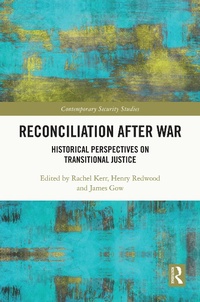
Reconciliation after War
Historical Perspectives on Transitional Justice
1st Edition
Published on 6. January 2021
362 pages
978-1-000-33118-9 (ISBN)
Description

This edited volume examines a range of historical and contemporary episodes of reconciliation and anti-reconciliation in the aftermath of war.
Reconciliation is a concept that resists easy definition. At the same time, it is almost invariably invoked as a goal of post-conflict reconstruction, peacebuilding and transitional justice. This book examines the considerable ambiguity and controversy surrounding the term and, crucially, asks what has reconciliation entailed historically? What can we learn from past episodes of reconciliation and anti-reconciliation? Taken together, the chapters in this volume adopt an interdisciplinary approach, focused on the question of how reconciliation has been enacted, performed and understood in particular historical episodes, and how that might contribute to our understanding of the concept and its practice. Rather than seek a universal definition, the book focuses on what makes each case of reconciliation unique, and highlights the specificity of reconciliation in individual contexts.
This book will be of much interest to students of transitional justice, conflict resolution, human rights, history and International Relations.
Reconciliation is a concept that resists easy definition. At the same time, it is almost invariably invoked as a goal of post-conflict reconstruction, peacebuilding and transitional justice. This book examines the considerable ambiguity and controversy surrounding the term and, crucially, asks what has reconciliation entailed historically? What can we learn from past episodes of reconciliation and anti-reconciliation? Taken together, the chapters in this volume adopt an interdisciplinary approach, focused on the question of how reconciliation has been enacted, performed and understood in particular historical episodes, and how that might contribute to our understanding of the concept and its practice. Rather than seek a universal definition, the book focuses on what makes each case of reconciliation unique, and highlights the specificity of reconciliation in individual contexts.
This book will be of much interest to students of transitional justice, conflict resolution, human rights, history and International Relations.
More details
Series
Edition
1. Auflage
Language
English
Place of publication
London
United Kingdom
Publishing group
Taylor & Francis Ltd
Target group
College/higher education
Professional and scholarly
Illustrations
1 Tables, black and white; 2 Halftones, black and white; 2 Illustrations, black and white
ISBN-13
978-1-000-33118-9 (9781000331189)
Copyright in bibliographic data and cover images is held by Nielsen Book Services Limited or by the publishers or by their respective licensors: all rights reserved.
Schweitzer Classification
Other editions
Additional editions
Rachel Kerr | Henry Redwood | James Gow
Reconciliation after War
Historical Perspectives on Transitional Justice
Book
08/2022
1st Edition
Routledge
€66.10
Shipment within 15-20 days
Rachel Kerr | Henry Redwood | James Gow
Reconciliation after War
Historical Perspectives on Transitional Justice
Book
01/2021
1st Edition
Routledge
€207.20
Shipment within 15-20 days
Reconciliation After War
Historical Perspectives on Transitional Justice
Book
01/2021
Routledge
Unfortunately, price unknown
Available (delivery time upon request)
Persons
Rachel Kerr is a Reader in International Relations and Contemporary War in the Department of War Studies and co-Director of the War Crimes Research Group at King's College London, UK.
Henry Redwood is a Lecturer in International Relations in the Department of War Studies, King's College London, UK.
James Gow is Professor of International Peace and Security and Co-Director of the War Crimes Research Group at King's College London, UK, and Non-Resident Scholar, Liechtenstein Institute, Princeton University, USA.
Henry Redwood is a Lecturer in International Relations in the Department of War Studies, King's College London, UK.
James Gow is Professor of International Peace and Security and Co-Director of the War Crimes Research Group at King's College London, UK, and Non-Resident Scholar, Liechtenstein Institute, Princeton University, USA.
Content
1. Introduction: A genealogy of reconciliation Henry Redwood and Rachel Kerr Part I: The Distant Past 2. Remembering What One Has Forgotten: Athenian Reconciliation After War (Crimes) Robin Osborne 3. Jesuit Peace-Making in the Kingdom of Naples: Reconciliation in Early-Modern Europe Stephen Cummins 4. Reconciliation and Oblivion in the English Republics Imogen Peck Part II: The Longue Duree 5. 1917 In 2017: A 'Useless' Past? Remembering and Forgetting the Bolshevik Revolution Natasha Kuhrt 6. One Hundred Years of Reconciliation: Fractured Memories o the Finnish Civil War Teemu Laulainen 7. The Paradox of Reconciliation: Early Post-War Chinese-Japanese Experience in Regional and Comparative Perspective Daqing Yang 8. There Once Was A Country: The Construction and Deconstruction of Yugoslavia Jelena Subotic 9. The Unreconciled US Civil War James Gow and Rana Ibrahem Part III: Alternative Perspectives 10. Religion and Reconciliation: Power, Practice and Rejections of the Truth and Reconciliation Project in South African and Bosnian Contexts George R. Wilkes 11. Burying the Hatchet: Exploring Indigenous Practice of Reconciliation Among Pastoralist Communities in East Africa Anne Kubai 12. If You Are Not Careful, Reconciliation Will Be Spreading All Over The Country': Reconciliation in Britain's Humanitarian Aid to Post-War Germany, 1919-1925 Ben Holmes 13. The Art of Healing and Reconciliation in Canada Jonathan Dewar Part IV: Challenging Conventional Wisdom 14. Reconciled to What? Community Relations and the Anti-Politics of Reconciliation in Northern Ireland Jonathan Evershed 15. Reconciliation Without Transitional Justice? The Challenges of Imposed Reconciliation in Spain Rosa Ana Alija-Fernandez and Olga Martin-Ortega 16. Unhealed Wounds: The Limits of German Reconciliation in the Case of Distomo, Greece Olga Burkhardt-Vetter 17. Reconciliation As An Ongoing Political Project: The Case of Japan Madoka Futamura 18. Epilogue Henry Redwood
