

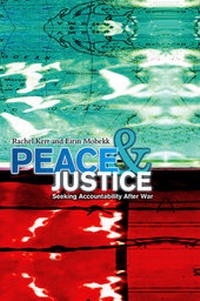
Peace and Justice
Description

A range of judicial and non-judicial approaches has been adoptedin recognition of the fact that there is no one-size-fits-all modelthrough which to seek accountability. This book considers themerits and drawbacks of these different responses and sets out anoriginal framework for analysing transitional societies andtransitional justice mechanisms.
Taking as its starting point the post-Second World War tribunalsat Nuremburg and Tokyo, the book goes on to discuss the creation ofad hoc international tribunals in the 1990s, hybrid/mixed courts,the International Criminal Court, domestic trials, truthcommissions and traditional justice mechanisms. With examples drawnfrom across the world, including the former Yugoslavia, Rwanda,Cambodia, Timor-Leste, Sierra Leone, Uganda and the DRC, itpresents a compelling and comprehensive study of the key responsesto war crimes.
Peace and Justice is a timely contribution in a world where anever-increasing number of post-conflict societies are grapplingwith the complex issues of transitional justice. It will be avaluable resource for students, scholars, practitioners andpolicy-makers seeking to understand past violations of human rightsand the most effective ways of addressing them.
More details
Other editions
Additional editions
Persons
Eirin Mobekk is is an independent consultant and researchassociate affiliated to the Centre for International Security andCooperation, Department of Peace Studies, University ofBradford.
Content
Contents.
List of abbreviations.
1 Peace and Justice.
1.1 Transitional/Post-Conflict Justice.
1.1.1 Accountability.
1.1.2 Deterrence.
1.1.3 Historical record.
1.1.4 Reconciliation, and healing.
1.1.5 Redress for victims.
1.1.6 Removal of perpetrators.
1.1.7 Capacity-building and the rule of law.
1.2 Risks and dangers.
1.2.1 Destabilisation.
1.2.2 Retraumatisation.
1.2.3 Politicisation.
1.3 Context, context and context.
1.3.1 Cultural norms and values.
1.3.2 Nature of the conflict and extent and types of abuses.
1.3.3 Needs of victims, survivors and perpetrators.
1.3.4 Peace agreement.
1.3.5 Finance and infrastructure.
1.3.6 Political will.
1.3.7 International involvement.
1.4 The book.
2 The Nuremberg Legacy.
2.1 Nuremberg and Tokyo.
2.2 International Humanitarian Law post-1945.
2.3 International Criminal Law.
2.4 Human Rights Law.
2.5 Conclusion.
3 Ad hoc International Criminal Tribunals: The ICTY and ICTR.
3.1 International judicial intervention.
3.2 Establishing a court and launching investigations.
3.3 Jurisdiction and Procedure.
3.4 State cooperation and judicial assistance.
3.5 Justice, Peace and Reconciliation.
3.5.1 Delivering justice.
3.5.2 Contribution to international criminal law.
3.5.3 Restoring and maintaining peace.
3.5.4 Deterrence.
3.5.5 Historical record.
3.5.6 Reconciliation.
3.5.7 Removing perpetrators.
3.5.8 Political leverage.
3.5.9 Engaging the local population.
3.6 Conclusion.
Box 3.1: The Yugoslav War.
Box 3.2: Rwanda.
4 The International Criminal Court.
4.1 Establishing the Court: the Rome Statute.
4.2 Jurisdiction and admissibility.
4.3 Applicable law.
4.4 The 'essential paradox' of complementarity.
4.5 The role of the Prosecutor.
4.6 The relationship with the Security Council.
4.7 The United States and the International Criminal Court.
4.8 International criminal justice and international peace and security: a 'perfect symbiosis'?.
4.9 Engaging the local population and meeting victims' needs.
4.10 Peace and justice?.
4.11 Conclusion.
Box 4.1: Situations and Cases.
Uganda.
Democratic Republic of Congo (DRC).
Sudan.
Box 4.2: Universal jurisdiction.
5 'Internationalized' Courts.
5.1 A New Breed of Tribunal?.
5.1.1 Jurisdiction and procedure.
5.1.2 Financial and logistical challenges.
5.1.3 State Cooperation and Judicial Assistance.
5.1.4 Relationship to domestic courts.
5.1.5 Communication and outreach.
5.2 Justice, peace and reconciliation.
5.2.1 Providing justice.
5.2.2 Peace and reconciliation.
5.2.3 Complementarity.
5.2.4 Capacity-building and the rule of law.
5.3 Conclusion.
Box 5.1: The Special Court for Sierra Leone.
Box 5.2: Regulation 64 Panels in Kosovo.
Box 5.3: Special Crime Panels in Timor-Leste Error! Bookmark not defined.
Box 5.4: 'Extraordinary Chambers' in Cambodia.
6 Domestic Trials.
6.1 Rights and Obligations in International Law.
6.2 Judicial Reform: A Primary Hurdle for Domestic Trials.
6.3 Political and Practical Obstacles to Domestic Trials.
6.3.1 Political Realities and Destabilisation.
6.3.2 Amnesties.
6.3.3 Financial Obstacles.
6.3.4 Victor's Justice or Vengeance.
6.3.5 Selectivity.
6.3.6 Re-victimisation.
6.3.7 Evidence and Witness Protection.
6.4 Benefits of Domestic Trials.
6.5 Conclusion.
Box 6.1: Domestic Trials - Rwanda.
Box 6.2: Domestic Trials - The Indonesian Ad Hoc Human Rights Court.
Box 6.3: The Supreme Iraqi Criminal Tribunal.
7 Truth Commissions.
7.1 Definitional Clarity.
7.2 Design and Resources.
7.3 'Truth' and 'reconciliation' in Truth Commissions.
7.4 Restorative Justice - Healing and Retraumatisation.
7.5 Additional Benefits and Limitations of Truth Commissions Error! Bookmark not defined.
7.5.1 Acknowledgement and Local Ownership Error! Bookmark not defined.
7.5.2 Amnesties.
7.5.3 Due Process and Naming Names.
7.5.4 Deterrence.
7.5.5 Political Obstacles.
7.6 Conclusion.
Box 7.1: The Truth and Reconciliation Commission in the DRC.
Box 7.2: The Truth and Reconciliation Commission in South Africa.
Box 7.3: The Commission on the Truth for El Salvador.
