

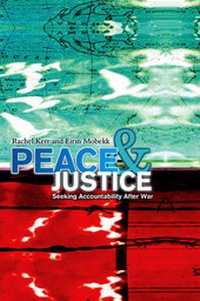
Peace and Justice
Description

Reviews / Votes
"Timely, well written and contributing to definitional clarity,this book is essential reading for students, scholars,practitioners and policy makers concerned with implementingtransitional justice in the twenty-first century." Political Studies Review "An excellent overview of the range of alternatives that havebeen used to deal with the perpetrators of mass atrocities. Kerrand Mobekk provide a timely and comprehensive analysis in an arenathat is characterized by rapid change. This book will be a greatresource for students and practitioners attempting to understandthe complexity of the institutions that have shaped the pursuit oftransitional justice in recent decades." Leslie Vinjamuri, School of Oriental and African Studies,University of London "This is an essential volume for scholars and students alike.Its sweeping scope offers a thorough survey of the proliferationand diversity of mechanisms for accountability following armedconflict." Chandra Lekha Sriram, University of East London "This is a must read for undergraduates and graduates who arelooking for a thorough introduction to the institutions that seekto bring peace through justice. Clear, concise and up to date, thebook is one of the best on the international relations bookshelf ontransitional justice." Julie Mertus, School of International Service, AmericanUniversityMore details
Other editions
Additional editions
Persons
Content
Preface and acknowledgements iv
Contents
List of abbreviations
1 Peace and Justice
1.1 Transitional/Post-Conflict Justice
1.1.1 Accountability
1.1.2 Deterrence
1.1.3 Historical record
1.1.4 Reconciliation, and healing
1.1.5 Redress for victims
1.1.6 Removal of perpetrators
1.1.7 Capacity-building and the rule of law
1.2 Risks and dangers
1.2.1 Destabilisation
1.2.2 Retraumatisation
1.2.3 Politicisation
1.3 Context, context and context
1.3.1 Cultural norms and values
1.3.2 Nature of the conflict and extent and types of abuses
1.3.3 Needs of victims, survivors and perpetrators
1.3.4 Peace agreement
1.3.5 Finance and infrastructure
1.3.6 Political will
1.3.7 International involvement
1.4 The book
2 The Nuremberg Legacy
2.1 Nuremberg and Tokyo
2.2 International Humanitarian Law post-1945
2.3 International Criminal Law
2.4 Human Rights Law
2.5 Conclusion
3 Ad hoc International Criminal Tribunals: The ICTY and ICTR
3.1 International judicial intervention
3.2 Establishing a court and launching investigations
3.3 Jurisdiction and Procedure
3.4 State cooperation and judicial assistance
3.5 Justice, Peace and Reconciliation
3.5.1 Delivering justice
3.5.2 Contribution to international criminal law
3.5.3 Restoring and maintaining peace
3.5.4 Deterrence
3.5.5 Historical record
3.5.6 Reconciliation
3.5.7 Removing perpetrators
3.5.8 Political leverage
3.5.9 Engaging the local population
3.6 Conclusion
Box 3.1: The Yugoslav War
Box 3.2: Rwanda
4 The International Criminal Court
4.1 Establishing the Court: the Rome Statute
4.2 Jurisdiction and admissibility
4.3 Applicable law
4.4 The 'essential paradox' of complementarity
4.5 The role of the Prosecutor
4.6 The relationship with the Security Council
4.7 The United States and the International Criminal Court
4.8 International criminal justice and international peace and security: a 'perfect symbiosis'?
4.9 Engaging the local population and meeting victims' needs
4.10 Peace and justice?
4.11 Conclusion
Box 4.1: Situations and Cases
Uganda
Democratic Republic of Congo (DRC)
Sudan
Box 4.2: Universal jurisdiction
5 'Internationalized' Courts
5.1 A New Breed of Tribunal?
5.1.1 Jurisdiction and procedure
5.1.2 Financial and logistical challenges
5.1.3 State Cooperation and Judicial Assistance
5.1.4 Relationship to domestic courts
5.1.5 Communication and outreach
5.2 Justice, peace and reconciliation
5.2.1 Providing justice
5.2.2 Peace and reconciliation
5.2.3 Complementarity
5.2.4 Capacity-building and the rule of law
5.3 Conclusion
Box 5.1: The Special Court for Sierra Leone
Box 5.2: Regulation 64 Panels in Kosovo
Box 5.3: Special Crime Panels in Timor-Leste Error! Bookmark not defined
Box 5.4: 'Extraordinary Chambers' in Cambodia
6 Domestic Trials
6.1 Rights and Obligations in International Law
6.2 Judicial Reform: A Primary Hurdle for Domestic Trials
6.3 Political and Practical Obstacles to Domestic Trials
6.3.1 Political Realities and Destabilisation
6.3.2 Amnesties
6.3.3 Financial Obstacles
6.3.4 Victor's Justice or Vengeance
6.3.5 Selectivity
6.3.6 Re-victimisation
6.3.7 Evidence and Witness Protection
6.4 Benefits of Domestic Trials
6.5 Conclusion
Box 6.1: Domestic Trials - Rwanda
Box 6.2: Domestic Trials - The Indonesian Ad Hoc Human Rights Court
Box 6.3: The Supreme Iraqi Criminal Tribunal
7 Truth Commissions
7.1 Definitional Clarity
7.2 Design and Resources
7.3 'Truth' and 'reconciliation' in Truth Commissions
7.4 Restorative Justice - Healing and Retraumatisation
7.5 Additional Benefits and Limitations of Truth Commissions Error! Bookmark not defined
7.5.1 Acknowledgement and Local Ownership Error! Bookmark not defined
7.5.2 Amnesties
7.5.3 Due Process and Naming Names
7.5.4 Deterrence
7.5.5 Political Obstacles
7.6 Conclusion
Box 7.1: The Truth and Reconciliation Commission in the DRC
Box 7.2: The Truth and Reconciliation Commission in South Africa
Box 7.3: The Commission on the Truth for El Salvador
