

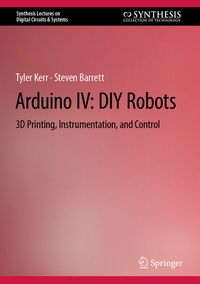
Arduino IV: DIY Robots
3D Printing, Instrumentation, and Control
Published on 13. September 2022
XIII, 232 pages
978-3-031-11209-6 (ISBN)
Description

This book gives a step-by-step introduction to designing and building your own robots. As with other books in the Arduino series, the book begins with a quick overview of the Arduino Integrated Development Environment (IDE) used to write sketches, and the hardware systems aboard the Arduino UNO R3 and the Mega 2560 Rev 3. The level of the text makes it accessible for students, hobbyist and professionals' first introduction to both Arduino and Robotics.
This book will be accessible by all levels of students, advanced hobbyists and engineering professionals, whether using as a self-reference or within a structure design laboratory. The text then examines the many concepts and characteristics common to all robots. In addition, throughout the book , reasonably priced, easily accessible and available off-the-shelf robots are examined. Examples include wheeled robots, tracked robots and also a robotic arm.
After a thorough and easy to follow Arduino IDE and hardware introduction, the book launches into "do it yourself" or DIY concepts. A unique feature of the book is to start with a hands-on introduction to low cost 3D printing. These concepts will allow you to design and print your own custom robot parts and chassis. We then explore concepts to sense a robot's environment, move the robot about and provide a portable power source. We conclude with a several DIY robot projects.
This book will be accessible by all levels of students, advanced hobbyists and engineering professionals, whether using as a self-reference or within a structure design laboratory. The text then examines the many concepts and characteristics common to all robots. In addition, throughout the book , reasonably priced, easily accessible and available off-the-shelf robots are examined. Examples include wheeled robots, tracked robots and also a robotic arm.
After a thorough and easy to follow Arduino IDE and hardware introduction, the book launches into "do it yourself" or DIY concepts. A unique feature of the book is to start with a hands-on introduction to low cost 3D printing. These concepts will allow you to design and print your own custom robot parts and chassis. We then explore concepts to sense a robot's environment, move the robot about and provide a portable power source. We conclude with a several DIY robot projects.
More details
Series
Language
English
Place of publication
Cham
Switzerland
Publishing group
Springer International Publishing
Product notice
Reflowable
Illustrations
XIII, 232 p. 127 illus., 81 illus. in color.
File size
8,68 MB
ISBN-13
978-3-031-11209-6 (9783031112096)
DOI
10.1007/978-3-031-11209-6
Schweitzer Classification
Other editions
Additional editions
Book
09/2022
1st Edition
Springer
€64.19
Shipment within 15-20 days
Persons
Tyler Kerr, M.S. received a B.A. in Geoscience from Franklin & Marshall College in Pennsylvania in 2011, and an M.S. in Geology (Paleontology) from the University of Wyoming in 2017. His background in paleontology and interest in emergent technology led him to a career in 3D printing, 3D scanning, digital rendering and digitizing museum collections. Today, he manages the Innovation Wyrkshop makerspace, one of the largest academic makerspaces in the Mountain West. In addition to the Innovation Wyrkshop, he designed and currently oversees nine successfully operating makerspaces across Wyoming, making him a state-recognized authority on makerspace development and programming. For his work, he was a recipient of the 2018 Laramie Young Professionals 20 under 40 award, the University of Wyoming's 2020 Employee of the Quarter award, and the 2021 Employee of the Year award. His academic interests include 3D printing, digitization, and developing creative, gamified, out-of-the-box nerdy ways to engage communities and teach complex topics in meaningful ways. With over 11 years of experience as an outreach coordinator and academic educator in Science, Technology, Engineering, Arts, and Math (STEAM), he aims to prove that everyone and anyone-even paleontological fossils like him-can be a maker.
Steven F. Barrett, Ph.D., P.E., received the B.S. Electronic Engineering Technology from the University of Nebraska at Omaha in 1979, the M.E.E.E. from the University of Idaho at Moscow in 1986 and the Ph.D. from The University of Texas at Austin in 1993. He was formally an active duty faculty member at the United States Air Force Academy, Colorado, and is now vice provost of Undergraduate Education at the University of Wyoming and Professor of Electrical and Computer Engineering. He is a member of IEEE (senior) and Tau Beta Pi (chief faculty advisor). His research interests include image processing, computer-assisted laser surgery andembedded controller systems. He is a registered Professional Engineer in Wyoming and Colorado. In 2004, he was named ``Wyoming Professor of the Year'' by the Carnegie Foundation for the Advancement of Teaching and in 2008 was the recipient of the National Society of Professional Engineers (NSPE) Professional Engineers in Higher Education, Engineering Education Excellence Award.
Steven F. Barrett, Ph.D., P.E., received the B.S. Electronic Engineering Technology from the University of Nebraska at Omaha in 1979, the M.E.E.E. from the University of Idaho at Moscow in 1986 and the Ph.D. from The University of Texas at Austin in 1993. He was formally an active duty faculty member at the United States Air Force Academy, Colorado, and is now vice provost of Undergraduate Education at the University of Wyoming and Professor of Electrical and Computer Engineering. He is a member of IEEE (senior) and Tau Beta Pi (chief faculty advisor). His research interests include image processing, computer-assisted laser surgery andembedded controller systems. He is a registered Professional Engineer in Wyoming and Colorado. In 2004, he was named ``Wyoming Professor of the Year'' by the Carnegie Foundation for the Advancement of Teaching and in 2008 was the recipient of the National Society of Professional Engineers (NSPE) Professional Engineers in Higher Education, Engineering Education Excellence Award.
Content
Introduction to Arduino.- Introduction to Low Cost 3D Printing.- Robotic Concepts and Sensors.- Motor Control and Actuators.- Power Source.- Applications.
