

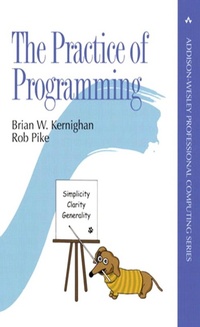
Practice of Programming, The
Description

With the same insight and authority that made their book The Unix Programming Environment a classic, Brian Kernighan and Rob Pike have written The Practice of Programming to help make individual programmers more effective and productive.
The practice of programming is more than just writing code. Programmers must also assess tradeoffs, choose among design alternatives, debug and test, improve performance, and maintain software written by themselves and others. At the same time, they must be concerned with issues like compatibility, robustness, and reliability, while meeting specifications.
The Practice of Programming covers all these topics, and more. This book is full of practical advice and real-world examples in C, C++, Java, and a variety of special-purpose languages. It includes chapters on:
- debugging: finding bugs quickly and methodically
- testing: guaranteeing that software works correctly and reliably
- performance: making programs faster and more compact
- portability: ensuring that programs run everywhere without change
- design: balancing goals and constraints to decide which algorithms and data structures are best
- interfaces: using abstraction and information hiding to control the interactions between components
- style: writing code that works well and is a pleasure to read
- notation: choosing languages and tools that let the machine do more of the work
Kernighan and Pike have distilled years of experience writing programs, teaching, and working with other programmers to create this book. Anyone who writes software will profit from the principles and guidance in The Practice of Programming.
More details
Other editions
Additional editions
Persons
Brian W. Kernighan works in the Computing Science Research Center at Bell Laboratories, Lucent Technologies. He is Consulting Editor for Addison-Wesley's Professional Computing Series and the author, with Dennis Ritchie, of The C Programming Language.
Rob Pike works in the Computing Science Research Center at Bell Laboratories, Lucent Technologies. He was a lead architect and implementer of the Plan 9 and Inferno operating systems. His research focuses on software that makes it easier for people to write software.020161586XAB04062001
Content
1. Style.
Names.
Expressions and Statements.
Consistency and Idioms.
Function Macros.
Magic Numbers.
Comments.
Why Bother?
2. Algorithms and Data Structures.
Searching.
Sorting.
Libraries.
A Java Quicksort.
O-Notation.
Growing Arrays.
Lists.
Trees.
Hash Tables.
Summary.
3. Design and Implementation.
The Markov Chain Algorithm.
Data Structure Alternatives.
Building the Data Structure in C.
Generating Output.
Java.
C++.
Awk and Perl.
Performance.
Lessons.
4. Interfaces.
Comma-Separated Values.
A Prototype Library.
A Library for Others.
A C++ Implementation.
Interface Principles.
Resource Management.
Abort, Retry, Fail?
User Interfaces.
5. Debugging.
Debuggers.
Good Clues, Easy Bugs.
No Clues, Hard Bugs.
Last Resorts.
Non-reproducible Bugs.
Debugging Tools.
Other People's Bugs.
Summary.
6. Testing.
Test as You Write the Code.
Systematic Testing.
Test Automation.
Test Scaffolds.
Stress Tests.
Tips for Testing.
Who Does the Testing?
Testing the Markov Program.
Summary.
7. Performance.
A Bottleneck.
Timing and Profiling.
Strategies for Speed.
Tuning the Code.
Space Efficiency.
Estimation.
Summary.
8. Portability.
Language.
Headers and Libraries.
Program Organization.
Isolation.
Data Exchange.
Byte Order.
Portability and Upgrade.
Internationalization.
Summary.
9. Notation.
Formatting Data.
Regular Expressions.
Programmable Tools.
Interpreters, Compilers, and Virtual Machines.
Programs that Write Programs.
Using Macros to Generate Code.
Compiling on the Fly.
Epilogue.
Appendix: Collected Rules.
Index. 020161586XT04062001
