

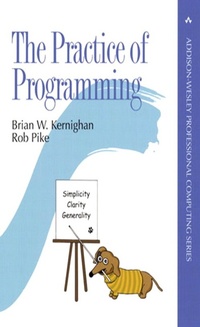
Practice of Programming, The
1st Edition
Published on 9. February 1999
288 pages
978-0-13-313341-7 (ISBN)
Description

With the same insight and authority that made their book The Unix Programming Environment a classic, Brian Kernighan and Rob Pike have written The Practice of Programming to help make individual programmers more effective and productive.
The practice of programming is more than just writing code. Programmers must also assess tradeoffs, choose among design alternatives, debug and test, improve performance, and maintain software written by themselves and others. At the same time, they must be concerned with issues like compatibility, robustness, and reliability, while meeting specifications.
The Practice of Programming covers all these topics, and more. This book is full of practical advice and real-world examples in C, C++, Java, and a variety of special-purpose languages. It includes chapters on:
debugging: finding bugs quickly and methodically
testing: guaranteeing that software works correctly and reliably
performance: making programs faster and more compact
portability: ensuring that programs run everywhere without change
design: balancing goals and constraints to decide which algorithms and data structures are best
interfaces: using abstraction and information hiding to control the interactions between components
style: writing code that works well and is a pleasure to read
notation: choosing languages and tools that let the machine do more of the work
Kernighan and Pike have distilled years of experience writing programs, teaching, and working with other programmers to create this book. Anyone who writes software will profit from the principles and guidance in The Practice of Programming.
The practice of programming is more than just writing code. Programmers must also assess tradeoffs, choose among design alternatives, debug and test, improve performance, and maintain software written by themselves and others. At the same time, they must be concerned with issues like compatibility, robustness, and reliability, while meeting specifications.
The Practice of Programming covers all these topics, and more. This book is full of practical advice and real-world examples in C, C++, Java, and a variety of special-purpose languages. It includes chapters on:
debugging: finding bugs quickly and methodically
testing: guaranteeing that software works correctly and reliably
performance: making programs faster and more compact
portability: ensuring that programs run everywhere without change
design: balancing goals and constraints to decide which algorithms and data structures are best
interfaces: using abstraction and information hiding to control the interactions between components
style: writing code that works well and is a pleasure to read
notation: choosing languages and tools that let the machine do more of the work
Kernighan and Pike have distilled years of experience writing programs, teaching, and working with other programmers to create this book. Anyone who writes software will profit from the principles and guidance in The Practice of Programming.
More details
Series
Edition
1. Auflage
Language
English
Place of publication
Boston
United States
Publishing group
Pearson Education (US)
Target group
College/higher education
File size
14,42 MB
ISBN-13
978-0-13-313341-7 (9780133133417)
Copyright in bibliographic data and cover images is held by Nielsen Book Services Limited or by the publishers or by their respective licensors: all rights reserved.
Schweitzer Classification
Other editions
Additional editions
Brian Kernighan | Rob Pike
Practice of Programming, The
Book
02/1999
Addison Wesley
€47.00
Article exhausted; check different version
Persons
Brian W. Kernighan works in the Computing Science Research Center at Bell Laboratories, Lucent Technologies. He is Consulting Editor for Addison-Wesley's Professional Computing Series and the author, with Dennis Ritchie, of The C Programming Language.
Rob Pike works in the Computing Science Research Center at Bell Laboratories, Lucent Technologies. He was a lead architect and implementer of the Plan 9 and Inferno operating systems. His research focuses on software that makes it easier for people to write software.
020161586XAB04062001
Rob Pike works in the Computing Science Research Center at Bell Laboratories, Lucent Technologies. He was a lead architect and implementer of the Plan 9 and Inferno operating systems. His research focuses on software that makes it easier for people to write software.
020161586XAB04062001
Content
1. Style.
2. Algorithms and Data Structures.
3. Design and Implementation.
4. Interfaces.
5. Debugging.
6. Testing.
7. Performance.
8. Portability.
9. Notation.
Epilogue.
Appendix: Collected Rules.
2. Algorithms and Data Structures.
3. Design and Implementation.
4. Interfaces.
5. Debugging.
6. Testing.
7. Performance.
8. Portability.
9. Notation.
Epilogue.
Appendix: Collected Rules.
