

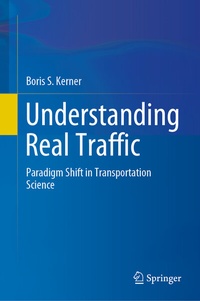
Understanding Real Traffic
Description

This book addresses the reader interested in vehicular traffic phenomena, who have not learned about them before. It presents traffic phenomena like traffic breakdown and the emergence of moving traffic jams by showcasing empirical traffic data measured in real-world traffic. The author explains how these empirical traffic studies have led to the three-phase traffic theory and why this new theory is in conflict with standard traffic theories developed before. Moreover, he presents the reason for the failure of applications of standard traffic theories in real-world traffic and discusses why understanding real traffic has caused a paradigm shift in traffic and transportation science. The book examines why understanding real traffic breakdown is the basis for an explanation for the autonomous driving effects on traffic flow. It shows that understanding real traffic is possible from real-world traffic data without the need of mathematical traffic models. This makes the book intuitive for non-specialists, who can qualitatively understand all the basic features of traffic dynamics. In turn, experienced traffic researchers can grasp concepts and ideas made here easily accessible by the author, one of the leading pioneers in the field of vehicular traffic.
More details
Other editions
Additional editions
Person
Boris S. Kerner was born in Moscow in 1947 and graduated from Moscow Technical University MIREA in 1972. He received the Ph.D. and Sc.D. (Doctor of Sciences) degrees from the Academy of Sciences of the Soviet Union in 1979 and 1986, respectively. Between 1972 and 1992, his major research interests included the physics of semiconductors, plasma and solid-state physics as well as the development of a theory of autosolitons - solitary intrinsic states, which form in a broad class of physical, chemical and biological dissipative systems.
Since 1992, he worked on understanding vehicular traffic at Daimler Company in Stuttgart, Germany. He is the pioneer of the three-phase traffic theory , which he introduced and developed in 1996-2002. Between 2000 and 2013, he was Head of Traffic , a field of research at Daimler. In 2011, he was appointed Professor at the University of Duisburg-Essen in Germany. Since his retirement from Daimler in 2013, Prof. Kernerhas been working at the University of Duisburg-Essen.
He authored more than 260 scientific works and patents as well as five books that are devoted to a variety of physical systems, complex dynamics of traffic flow in traffic and transportation networks, applications of diverse intelligent transportation systems for traffic prognosis, traffic control, dynamic traffic assignment as well as to the study of autonomous and connected vehicles in mixed traffic flow.
