

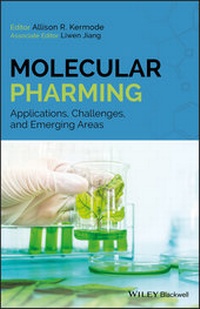
Molecular Pharming
Description

This comprehensive book communicates the recent advances and exciting potential for the expanding area of plant biotechnology and is divided into six sections. The first three sections look at the current status of the field, and advances in plant platforms and strategies for improving yields, downstream processing, and controlling post-translational modifications of plant-made recombinant proteins. Section four reviews high-value industrial and pharmacological proteins that are successfully being produced in established and emerging plant platforms. The fifth section looks at regulatory challenges facing the expansion of the field. The final section turns its focus toward small molecule therapeutics, drug screening, plant specialized metabolites, and plants as model organisms to study human disease processes.
Molecular Pharming: Applications, Challenges and Emerging Areas offers in-depth coverage of molecular biology of plant expression systems and manipulation of glycosylation processes in plants; plant platforms, subcellular targeting, recovery, and downstream processing; plant-derived protein pharmaceuticals and case studies; regulatory issues; and emerging areas. It is a valuable resource for researchers that are in the field of plant molecular pharming, as well as for those conducting basic research in gene expression, protein quality control, and other subjects relevant to molecular and cellular biology.
* Broad ranging coverage of a key area of plant biotechnology
* Describes efforts to produce pharmaceutical and industrial proteins in plants
* Provides reviews of recent advances and technology breakthroughs
* Assesses realities of regulatory and cost hurdles
* Forward looking with coverage of small molecule technologies and the use of plants as models of human disease processes
Providing wide-ranging and unique coverage, Molecular Pharming: Applications, Challenges and Emerging Areas will be of great interest to the plant science, plant biotechnology, protein science, and pharmacological communities.
More details
Other editions
Additional editions
Person
Allison R. Kermode is Professor and Michael Smith Senior Scholar at Simon Fraser University. Her work on plant-derived human proteins was recently featured in Nature magazine. Dr. Kermode is also the editor of Seed Dormancy: Methods and Protocols.
Liwen Jiang is Choh-Ming Li Professor of Life Sciences at the Chinese University of Hong Kong. He is a leader in research on protein targeting and trafficking in plant cells, plant organelle biogenesis and function, and the application of these processes to plant biotechnology.
Content
List of Contributors ix
Preface xiii
Part One The Molecular Farming/Pharming Landscape 1
1 Current Status and Perspectives of the Molecular Farming Landscape 3 Holger Spiegel, Eva Stöger, Richard M. Twyman, and Johannes F. Buyel
Part Two Molecular Biology of Plant Expression Systems and Manipulation of Glycosylation Processes in Plants 25
2 Synthetic Transcription Activator-Like Effector-Activated Promoters for Coordinated Orthogonal Gene Expression in Plants: Applications for Regulatory Circuit and Metabolic Engineering 27 Tom Schreiber and Alain Tissier
3 Contemporary and Emerging Technologies for Precise N-glycan Analyses 43 Iain B.H. Wilson, Katharina Paschinger, Jorick Vanbeselaere, and Chunsheng Jin
4 Production of Functionally Active Recombinant Proteins in Plants: Manipulating N- and O-glycosylation 67 Alexandra Castilho and Richard Strasser
Part Three Plant Platforms, Subcellular Targeting, Recovery, and Downstream Processing 91
5 Seeds as Bioreactors 93 Jinbo Shen, Xiangfeng Wang, and Liwen Jiang
6 Strategies to Increase Expression and Accumulation of Recombinant Proteins 119 Reza Saberianfar and Rima Menassa
7 The Impact of Six Critical Impurities on Recombinant Protein Recovery and Purification from Plant Hosts 137 Chelsea Dixon, Lisa R. Wilken, Susan L. Woodard, and Georgia O.F. Barros
8 Plant Recombinant Lysosomal Enzymes as Replacement Therapeutics for Lysosomal Storage Diseases: Unique Processing for Lysosomal Delivery and Efficacy 181 Allison R. Kermode, Grant McNair, and Owen Pierce
Part Four Plant-Derived Protein Pharmaceuticals and Case Studies 217
9 Plant-Produced Antibodies and Post-Translational Modification 219 Andreas Loos and Herta Steinkellner
10 Molecular Pharming: Plant-Made Vaccines 231 Qiang Chen, Matthew Dent, and Hugh Mason
11 Transgenic Rice for the Production of Recombinant Pharmaceutical Proteins: A Case Study of Human Serum Albumin 275 Daichang Yang, Jiquan Ou, Jingni Shi, Zhibin Guo, Bo Shi, and Naghmeh Abiri
12 Enzymes for Industrial and Pharmaceutical Applications - From Individual to Population Level Impact 309 Elizabeth E. Hood and Carole L. Cramer
Part Five Regulatory Issues 327
13 Biosafety, Risk Assessment, and Regulation of Molecular Farming 329 Penny A.C. Hundleby (nee Sparrow), Markus Sack, and Richard M. Twyman
Part Six Emerging Areas: Plant Specialized Metabolites and Small Molecule Drugs 353
14 Harnessing Plant Trichome Biochemistry for the Production of Useful Compounds 355 Alain Tissier
15 Reconstitution of Medicinally Important Plant Natural Products in Microorganisms 383 Ozkan Fidan and Jixun Zhan
16 Screening of Epidermal Growth Factor Receptor Inhibitors in Natural Products Derived From Extracts of Traditional Chinese Medicines 417 Li Feng and Jingwu Kang
17 Target-Directed Evolution of Mutant Transgenic Plant Cells as a Novel Source of Drugs 435 John Littleton, Dustin Brown, Deane Falcone, Gregory Gerhardt, Samir Gunjan, Dennis T. Rogers, and Jatinder Sambi
18 Plant Thermotolerance Proteins, Misfolded Proteins, and Neurodegenerative Diseases 457 Indranil Basak and Simon G. Møller
Index 475
