

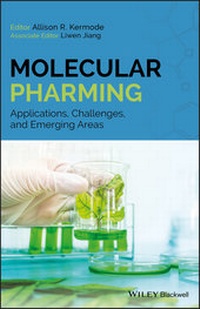
Molecular Pharming
Description

This comprehensive book communicates the recent advances and exciting potential for the expanding area of plant biotechnology and is divided into six sections. The first three sections look at the current status of the field, and advances in plant platforms and strategies for improving yields, downstream processing, and controlling post-translational modifications of plant-made recombinant proteins. Section four reviews high-value industrial and pharmacological proteins that are successfully being produced in established and emerging plant platforms. The fifth section looks at regulatory challenges facing the expansion of the field. The final section turns its focus toward small molecule therapeutics, drug screening, plant specialized metabolites, and plants as model organisms to study human disease processes.
Molecular Pharming: Applications, Challenges and Emerging Areas offers in-depth coverage of molecular biology of plant expression systems and manipulation of glycosylation processes in plants; plant platforms, subcellular targeting, recovery, and downstream processing; plant-derived protein pharmaceuticals and case studies; regulatory issues; and emerging areas. It is a valuable resource for researchers that are in the field of plant molecular pharming, as well as for those conducting basic research in gene expression, protein quality control, and other subjects relevant to molecular and cellular biology.
* Broad ranging coverage of a key area of plant biotechnology
* Describes efforts to produce pharmaceutical and industrial proteins in plants
* Provides reviews of recent advances and technology breakthroughs
* Assesses realities of regulatory and cost hurdles
* Forward looking with coverage of small molecule technologies and the use of plants as models of human disease processes
Providing wide-ranging and unique coverage, Molecular Pharming: Applications, Challenges and Emerging Areas will be of great interest to the plant science, plant biotechnology, protein science, and pharmacological communities.
More details
Other editions
Additional editions
Person
Allison R. Kermode is Professor and Michael Smith Senior Scholar at Simon Fraser University. Her work on plant-derived human proteins was recently featured in Nature magazine. Dr. Kermode is also the editor of Seed Dormancy: Methods and Protocols.
Liwen Jiang is Choh-Ming Li Professor of Life Sciences at the Chinese University of Hong Kong. He is a leader in research on protein targeting and trafficking in plant cells, plant organelle biogenesis and function, and the application of these processes to plant biotechnology.
Content
List of Contributors ix
Preface xiii
Part One The Molecular Farming/Pharming Landscape 1
1 Current Status and Perspectives of the Molecular Farming Landscape 3 Holger Spiegel, Eva Stöger, Richard M. Twyman, and Johannes F. Buyel
Part Two Molecular Biology of Plant Expression Systems and Manipulation of Glycosylation Processes in Plants 25
2 Synthetic Transcription Activator-Like Effector-Activated Promoters for Coordinated Orthogonal Gene Expression in Plants: Applications for Regulatory Circuit and Metabolic Engineering 27 Tom Schreiber and Alain Tissier
3 Contemporary and Emerging Technologies for Precise N-glycan Analyses 43 Iain B.H. Wilson, Katharina Paschinger, Jorick Vanbeselaere, and Chunsheng Jin
4 Production of Functionally Active Recombinant Proteins in Plants: Manipulating N- and O-glycosylation 67 Alexandra Castilho and Richard Strasser
Part Three Plant Platforms, Subcellular Targeting, Recovery, and Downstream Processing 91
5 Seeds as Bioreactors 93 Jinbo Shen, Xiangfeng Wang, and Liwen Jiang
6 Strategies to Increase Expression and Accumulation of Recombinant Proteins 119 Reza Saberianfar and Rima Menassa
7 The Impact of Six Critical Impurities on Recombinant Protein Recovery and Purification from Plant Hosts 137 Chelsea Dixon, Lisa R. Wilken, Susan L. Woodard, and Georgia O.F. Barros
8 Plant Recombinant Lysosomal Enzymes as Replacement Therapeutics for Lysosomal Storage Diseases: Unique Processing for Lysosomal Delivery and Efficacy 181 Allison R. Kermode, Grant McNair, and Owen Pierce
Part Four Plant-Derived Protein Pharmaceuticals and Case Studies 217
9 Plant-Produced Antibodies and Post-Translational Modification 219 Andreas Loos and Herta Steinkellner
10 Molecular Pharming: Plant-Made Vaccines 231 Qiang Chen, Matthew Dent, and Hugh Mason
11 Transgenic Rice for the Production of Recombinant Pharmaceutical Proteins: A Case Study of Human Serum Albumin 275 Daichang Yang, Jiquan Ou, Jingni Shi, Zhibin Guo, Bo Shi, and Naghmeh Abiri
12 Enzymes for Industrial and Pharmaceutical Applications - From Individual to Population Level Impact 309 Elizabeth E. Hood and Carole L. Cramer
Part Five Regulatory Issues 327
13 Biosafety, Risk Assessment, and Regulation of Molecular Farming 329 Penny A.C. Hundleby (nee Sparrow), Markus Sack, and Richard M. Twyman
Part Six Emerging Areas: Plant Specialized Metabolites and Small Molecule Drugs 353
14 Harnessing Plant Trichome Biochemistry for the Production of Useful Compounds 355 Alain Tissier
15 Reconstitution of Medicinally Important Plant Natural Products in Microorganisms 383 Ozkan Fidan and Jixun Zhan
16 Screening of Epidermal Growth Factor Receptor Inhibitors in Natural Products Derived From Extracts of Traditional Chinese Medicines 417 Li Feng and Jingwu Kang
17 Target-Directed Evolution of Mutant Transgenic Plant Cells as a Novel Source of Drugs 435 John Littleton, Dustin Brown, Deane Falcone, Gregory Gerhardt, Samir Gunjan, Dennis T. Rogers, and Jatinder Sambi
18 Plant Thermotolerance Proteins, Misfolded Proteins, and Neurodegenerative Diseases 457 Indranil Basak and Simon G. Møller
Index 475
1
Current Status and Perspectives of the Molecular Farming Landscape
Holger Spiegel1, Eva Stöger2, Richard M. Twyman3, and Johannes F. Buyel1,4
1 Fraunhofer Institute for Molecular Biology and Applied Ecology IME, Aachen, Germany
2 Department of Applied Genetics and Cell Biology, University of Natural Resources and Life Sciences, Vienna, Austria
3 TRM Ltd., York, UK
4 Institute for Molecular Biotechnology, RWTH Aachen University, Aachen, Germany
Abbreviations
CHO Chinese hamster ovary, CPMV Cowpea mosaic virus, CRISPR clustered regularly interspersed palindromic repeats, CTB cholera toxin B-subunit, EMA European Medicines Agency, FDA Food and Drug Administration, GMP good manufacturing practice, HBV Hepatitis B virus, HIV Human immunodeficiency virus, HSV Herpes simplex virus, ICM immune complex mimic, IgA immunoglobulin A, IgG immunoglobulin G, PMP plant-made pharmaceutical, RNAi RNA interference, scFv single-chain variable fragment, TALEN transcription activator-like effector nuclease, TMV Tobacco mosaic virus, USDA US Department of Agriculture, VLP virus-like particle.
1.1 Introduction
Molecular farming refers to the use of plants for the production of recombinant proteins. Plants are often presented as more scalable and less expensive than the current industry standards (microbial and animal cells in fermenters) (Stöger et al., 2014). In the case of pharmaceutical products, where the alternative term molecular pharming is often applied, plants are often considered to be safer too. However, plants are unlikely to displace industry stalwarts such as Escherichia coli and Chinese hamster ovary (CHO) cells, which are considered gold standards for protein manufacturing, at least when competing in areas where these established platforms are strongest. Plants cannot yet match the yields of these competitors, and adopting plants would require the bio-manufacturing industry to introduce new practices and technologies for both upstream production and downstream processing. Plants have a limited track record with the pharmaceutical regulators because manufacturing that complies with good manufacturing practice (GMP) is in its infancy (Fischer et al., 2012). In contrast, the industry favorites have a long and successful history, and the regulatory framework has been built up around them. Success has resulted in the selection of a small number of high-performance platform technologies that are widely used in commercial processes, whereas molecular farming is known for the diversity of expression strategies and production systems, making it difficult to establish standardized processes. This diversity is on one hand an advantage because it means that a suitable platform can be found for each product and application (e.g. edible crops for oral vaccines); but the absence of standard platforms makes the existing regulations more difficult to apply and this dissuades industry players from investing in long-term production capacity. This chapter provides an overview of the current molecular farming landscape in terms of the most prevalent platforms, products, and downstream processing strategies based on an analysis of the literature published between 2010 and 2016, and discusses the perspectives for this technology and likely future developments.
1.2 Brief history of Molecular Farming
Molecular farming differs from other applications of plant biotechnology in that the recombinant protein itself is the desired product rather than the effect it has on the performance or activity of the plant host (Ma et al., 2003; Stöger et al., 2014). The first deliberate use of plants as a production host involved the expression of a recombinant antibody in transgenic tobacco plants (Hiatt et al., 1989); this was swiftly followed by the production of human serum albumin in tobacco and potato plants and cell suspension cultures (Sijmons et al., 1990). The fact that these initial products were human proteins with medical relevance immediately established the possibility of using plants for the production of protein biopharmaceuticals, which became known as plant-made pharmaceuticals (PMPs). The resulting gold rush of researchers looking to express diverse pharmaceutical proteins in plants led to many proof-of-principle studies that were published in the 1990s and early 2000s (reviewed by Fischer and Emans, 2000; Ma et al., 2003; Twyman, 2005). These early studies shared three main characteristics. First, there was no universal agreement on the ideal host platform, leading to the development of an extremely diverse array of production systems (Twyman et al., 2003). The diversity embraced different species of whole plants (tobacco, cereals, legumes, oilseeds, leafy edible crops, potato, tomato, and various aquatic and unicellular species), various tissue and cell culture systems (hairy roots, teratomas, and cell suspension cultures), and a bewildering array of expression strategies (transgenic plants, transplastomic plants, various transient expression systems, inducible expression, and different protein targeting strategies). Second, and in contrast to the diversity of expression hosts, three main product classes emerged: antibodies, vaccine candidates, and replacement human proteins. Third, and perhaps most importantly in the context of future events, very few of these studies were concerned with anything further than establishing that the recombinant proteins could be expressed. The commercial potential of molecular farming was touted on the basis that plants were safe, scalable, and economical compared to existing platforms, but without the translational research to show whether or not these promises could be fulfilled. Many small start-up companies were established to promote specific host systems for molecular farming, but without the ability to translate such early-stage research they soon went out of business. The big industry players, which had initially expressed cautious interest in this emerging technology, eventually withdrew their support (Fischer et al., 2014).
While the molecular farming pharma bubble expanded and then collapsed, other researchers were considering the industrial potential of the technology. The major player was Prodigene Inc. (College Station, TX, USA), which was investigating the use of maize as a platform for the production of research-grade reagents and industrial enzymes in addition to pharmaceuticals. Importantly, the research carried out by Prodigene looked into the economic viability of molecular farming at an early stage. The key aspect was that they considered not only upstream production but also downstream processing, and they were the first to develop a commercial process which took into account the upstream yield, the downstream recovery and purity, and compared the overall costs to existing production methods (Hood et al., 1999; Kusnadi et al., 1998). Accordingly, they found that maize-derived recombinant avidin was commercially competitive with the existing commercial avidin product derived from hens' eggs (Hood et al., 1999) and that maize-derived ß-glucuronidase was commercially competitive with the existing commercial enzyme isolated from bacteria (Witcher et al., 1998). Many of the downstream processing concepts developed by Prodigene provided the foundations of more recent processes for the isolation of PMPs (Menkhaus et al., 2004; Nikolov and Woodard, 2004; Wilken and Nikolov, 2012). These methods have also been adopted by the next generation of companies using cereals for commercial molecular farming, including Ventria Bioscience (Fort Collins, CO, USA) which produces various pharmaceutical and cosmetic products in rice seeds (Wilken and Nikolov, 2006, 2010) and ORF Genetics (Kopavogur, Iceland) which produces diagnostic and research reagents as well as cosmetic products in barley.
The pioneers of pharmaceutical molecular farming learned their lessons from the early failures and looked at the Prodigene story with renewed interest. Success in their own field would require more focus on the downstream elements of the production process as well as translational research to make the leap from proof-of-principle studies to commercial reality. One more lesson was also taken from Prodigene, which eventually went out of business not because its products were unprofitable but due to cumulative fines levied against them for breaching environmental regulations (the adventitious growth of some of their transgenic maize plants in a neighboring soybean field). The molecular farming community now generally avoids using field grown plants unless they are well isolated and there is minimal risk of outcrossing or admixture. Ventria Bioscience grows rice in Colorado, well away from rice crops destined for the food chain. Other than this atypical exception, molecular farming is mostly carried out in contained facilities, attracting a lower regulatory burden and avoiding the associated negative public perception issues.
The next wave of pharmaceutical molecular farming therefore focused on several issues that were not addressed in the 1990s and early 2000s: the ability to develop entire manufacturing processes that were economical at the industrial scale, the ability to harmonize molecular farming with existing regulations covering pharmaceutical products, and the ability to compete with the existing industry platforms. This resulted in the consolidation of molecular farming technology around a...
